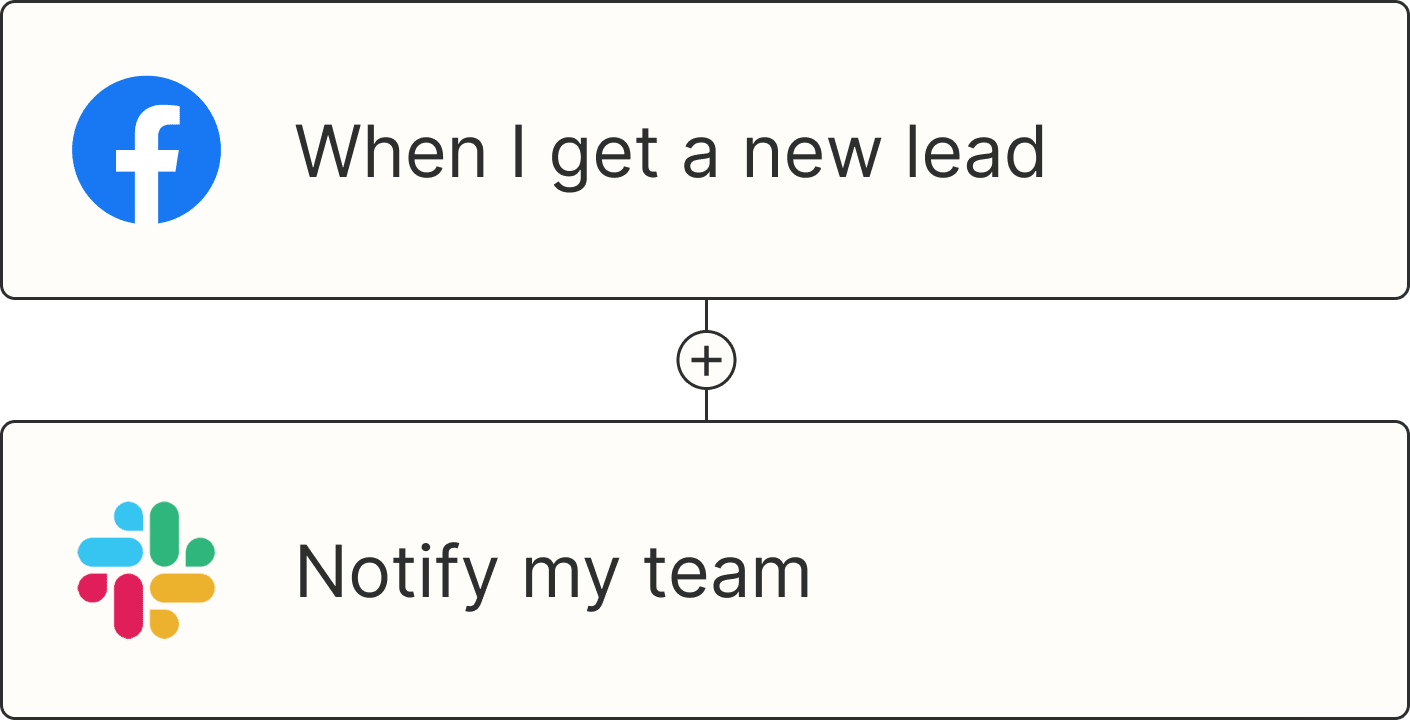
Congrats: You've captured some leads through Facebook Lead Ads! Now you need to act fast based on where your prospects are in the sales funnel. You might need your sales team to reach out while they're warm, for example, or add them to a nurture campaign—or create custom deals in your CRM for each new lead.
But manually downloading and uploading leads is a huge chore at scale. By automating this process every step of the way, you can avoid wasting time on repetitive tasks. You can even build a fully automated lead management system that lets your team respond to every new prospect with speed and agility.
Thankfully, Zapier's Facebook Lead Ads integration can do all that lead management work for you. Here are four ways you can automate Facebook Lead Ads and increase your digital ad funnel's ROI.
Zapier is the most connected AI orchestration platform—integrating with thousands of apps from partners like Google, Salesforce, and Microsoft. Use forms, data tables, and logic to build secure, automated, AI-powered systems for your business-critical workflows across your organization's technology stack. Learn more.
Skip ahead
To get started with a Zap template—what we call our pre-made workflows—just click on the button. It only takes a few minutes to set up. You can read more about setting up Zaps here.
Back up leads in a spreadsheet
Spreadsheets are the unsung heroes of any business. They're not always pretty or fun to look at, but they can store essential data while letting everyone across your organization access the information they need. That's great for teams like accounting or marketing that might not have access to your customer relationship management (CRM) tool.
But the more places you store lead information, the harder it is to keep all those records in sync—especially if your sales cycle moves quickly. That's where automation can help by letting you keep an accurate and up-to-date backup of all your leads in a spreadsheet. From there, you can use that spreadsheet as a central source of truth for other workflows (automated or not).
Add new Facebook Lead Ads leads to rows on Google Sheets


Create multiple rows in Google Sheets for each new lead from Facebook Lead Ads
Create Records in Zapier Tables for New Facebook Lead Ads

If you like to stay informed about updates to your records without keeping Google Sheets open in your browser 24/7, you can use this multi-step Zap to send yourself or another person an email whenever a new lead is added to your spreadsheet.
Send a Gmail email and add a spreadsheet row to Google Sheets for new leads in Facebook Lead Ads

Track leads in your CRM
When you choose a CRM for your business, you need to consider whether you can automatically send lead information into that app. Otherwise, you'll need to check every few days to download new lead data, import it into your CRM manually, and then take action.
With Zapier, you can copy lead data to any CRMs we integrate with. Set this up to occur automatically on a regular basis—or even in real time—so your team instantly has access to the latest prospect information. That way, your sales team can follow up fast and understand the status of every lead at any given moment. They can track the lead through the sales process in your CRM, seeing when to send initial messages, when to follow up, and when to push to close.
Create contacts on Zoho CRM from new leads from Facebook Lead Ads

Add leads to campaigns on LeadConnector from new Facebook Lead Ads leads

You can even have new leads added to your project management software so nothing is ever missed.
Add or update Brevo contacts whenever new leads appear in Facebook Lead Ads

Create items in monday.com from new leads in Facebook Lead Ads

Of course, when someone clicks on a Facebook ad, you'll often still need to do a little research to fill in the gaps in their profile. You might need their full name, occupation, or other demographic data. But don't worry: You can also use Zaps to automatically enrich your leads before adding them to your CRM. That way, you and your sales staff can hit the ground running.
Enrich Facebook leads with Clearbit and add to Pipedrive


Enrich Facebook leads with Clearbit and add to HubSpot

Pro tip: Are you collecting leads from various sources? With the customizable template below, you can build a Zapier agent that automatically captures, enriches, and nurtures leads from multiple tools. Learn more about Zapier Agents.

Get customized alerts for new leads
Once lead information shows up in your CRM, you have a new problem: you need to notify your sales team right away so they can take action.
This step is crucial for businesses that have sales teams on hand for high-value products or deals. If your business is in an industry like car sales or professional services, for instance, you want to be able to get in touch right when a prospect's interest peaks (and before they start looking for other solutions). Automatic notifications for your sales team help support that work—and keep your team from constantly refreshing your CRM to see what's new.
Send emails in Gmail for new leads in Facebook Lead Ads

Get Slack channel notifications for new Facebook Lead Ads

Dispatch emails in Microsoft Outlook with new leads in Facebook Lead Ads

If your sales team needs to respond to time-sensitive leads on the go, you can even use a Zap to send WhatsApp Business notifications or SMS messages for new Facebook lead activity.
Send WhatsApp Business messages for new Facebook Lead Ads leads

Send SMS messages for new leads from Facebook Lead Ads

Nurture leads with automatic emails
Striking while the iron is hot is important. While your sales team needs to know about new leads, having an automated email system do some of the initial outreach and nurture can be a game changer.
Zapier can help you have an email autoresponder ready to go so you can automatically send out a welcome series to new leads right away. If your ads offer a lead magnet (like an eBook, access to a webinar, or a coupon code for a free class), this type of automated workflow promptly sends your leads exactly what they expect.
Subscribe new Facebook Lead Ad leads to a Mailchimp list

Add or update ActiveCampaign contacts with new Facebook Lead Ads leads

Submit Kajabi forms for new Facebook Lead Ads leads

Create or update HubSpot contacts from new Facebook Lead Ads leads
Ideally, you'll do the following when it comes to automatic emails:
Send the first autoresponder welcome email right away, as soon as a new lead fills out the form on your ad. Your new prospect is probably excited about the lead magnet they converted on, so delivering it to them ASAP is important.
Keep the first email simple. Don't start bombarding new leads with a ton of aggressive offers right away. Welcome them, confirm their subscription, and let them know you're there if they have questions.
Send another email in a day or so with more information. It's called a welcome series for a reason. Your sales team can follow up a day or so later to assess where the lead is at and offer help, or you can offer additional content-focused newsletters. Test what works for your brand and business.
Generate custom deals and packages
A great way to boost conversion rates is to give your sales team the ability to create custom deals and packages for leads. But putting together a single custom offer can be time-consuming—not to mention doing that multiple times over every day.
Automation gives you the power to instantly create deals or packages that are trackable as soon as new leads come through your Facebook Lead Ads. These offers can be generated automatically upon lead form completion, giving your sales team plenty of leverage to start off strong and letting you track what's driving conversions.
Create Pipedrive deals from new Facebook Lead Ads leads
Create new leads and opportunities in Salesforce from Facebook Lead Ads

Add new Facebook Lead Ads leads to HubSpot as deals
Use webhooks to fill in the gaps
Sometimes, you may come across a situation where an app doesn't integrate with Zapier or you need to customize (or format) the data differently.
When that happens, you can use webhooks to fill in the gaps. This Zap will make sure every time you receive a new lead via Facebook, it'll be automatically sent to the webhook URL you define—and formatted exactly how you need.

Advanced Facebook lead automation tips
The best way to think about automation is as a well-oiled machine that manages systems, rather than just simple two-step workflows. Here's an example of an automated lead management system—visualized in Zapier Canvas—that a hypothetical sales team might use to respond to Facebook ad activity.

In this example, new Facebook leads are sent through Clearbit to be enriched before being added to a CRM tool like HubSpot. From there, the relevant salesperson is notified of high-scoring leads for immediate follow-up, while low-scoring leads are added to a Mailchimp segment for further nurturing. Go from Facebook interest to sales outreach (updating records along the way), all automatically.
What's the difference between our Facebook Lead Ads integration and our Facebook Conversions integration? While our Facebook Lead Ads integration allows you to automatically capture leads through pay-per-click ads and send them to other apps, our Facebook Conversions integration lets you automatically send conversion events from external platforms (like CRMs or eCommerce tools) back to Facebook for tracking.
Optimize your lead ads for your digital sales funnel
Facebook Lead Ads can be a powerful tool for your mid-funnel marketing strategy. If the first contact that a user has with your brand is a lead ad, they're more likely to fill out a form after they've watched a video ad showing a demo of your product or an ad sharing a customer testimonial, for example.
Retargeting can be incredibly valuable as well. You can create custom audiences who watched that first video to completion or from your customer list. You can also use the Facebook Conversions API to track how well your ads are performing based on real sales data.
Ultimately, automation not only helps you get leads faster, but it also lets you receive more lead information throughout the entire sales cycle.
Related reading:
This article was originally published in February 2017, with later contributions from Emily Irish, Ana Gotter, Elena Alston, and Nicole Replogle. It was most recently updated in February 2026 by Hannah Herman.