
I love my air fryer as much as the next millennial, but it's too easy to treat it like a magical appliance that can handle everything. While you can roast vegetables, reheat leftovers, make crispy chickpeas, and cook salmon in 12 minutes flat, you're not searing a steak in that thing. And if you're making fries for a crowd, you'll spend the next hour baking painfully small batches while everyone waits.
ServiceNow is the enterprise software equivalent. It covers enterprise ITSM, AI workflow automation, project portfolio management, customer service, and more. It's the industry standard for a reason. But it also comes with a six-figure price tag, a months-long implementation cycle, and a gargantuan feature set most organizations will never fully use. Sometimes you need to ditch the fancy air fryer for a purpose-built tool that'll do the job better, cheaper, and faster.
These are your best ServiceNow alternatives for each piece of that puzzle, so you can find exactly what you need without buying the whole package.
The best ServiceNow alternatives
Zapier for AI orchestration
Jira for software development teams
Freshservice for lightweight ITSM
Atera for IT automation
Salesforce for GTM teams
Zendesk for customer service and ITSM
Nextiva for VoIP
Planview for PPM
What makes the best ServiceNow alternative?
How we evaluate and test apps
Our best apps roundups are written by humans who've spent much of their careers using, testing, and writing about software. Unless explicitly stated, we spend dozens of hours researching and testing apps, using each app as it's intended to be used and evaluating it against the criteria we set for the category. We're never paid for placement in our articles from any app or for links to any site—we value the trust readers put in us to offer authentic evaluations of the categories and apps we review. For more details on our process, read the full rundown of how we select apps to feature on the Zapier blog.
A good ServiceNow alternative doesn't need to do everything ServiceNow does—it needs to do the specific thing you're actually picking it for, and do it well. That said, I evaluated every pick against a consistent set of criteria:
Fit for purpose. ServiceNow is an ITSM platform that's expanded into AI workflow automation, PPM, customer service, and more. The best alternatives are purpose-built for the slice of this massive pie they actually serve.
Implementation fit. ServiceNow's months-long implementation cycles are necessary in some cases, but some teams need quicker time-to-value, so I kept that in mind.
Integration and automation depth. Automation is at the heart of ServiceNow, so all these alternatives need to build on that, either natively or with Zapier.
Value. ServiceNow's pricing is opaque, to say the least. I mostly looked for alternatives that offer clearer pricing, since that massive line item is a common reason folks are looking for ServiceNow alternatives to begin with.
Scalability. The best alternatives grow with you. A 10-person team probably doesn't need ServiceNow, but as they grow, they'll need something that can grow with them.
Based on thousands of hours of testing by the Zapier team, as well as my own experiences evaluating and testing this kind of software, these are my picks for the best ServiceNow alternatives.
ServiceNow alternatives at a glance
Best for | Standout features | Pricing | |
|---|---|---|---|
AI orchestration | 9,000+ app integrations; trusted governance layer | Free plan available; paid plans from $19.99/month | |
Software development teams | Incident-to-code traceability; deep Agile workflow support | Free plan available; paid plans from $7.91/user/month | |
Lightweight ITSM | Strong self-service portal; lightweight | From $19/agent/month | |
IT automation | Per-technician pricing with unlimited devices; Shared Script Library | From $149/technician/month | |
GTM teams | Omnichannel service; 13,000+ AgentExchange integrations | From $25/user/month | |
Customer service | Advanced reporting; sentiment analysis; great integrations | From $19/agent/month | |
VoIP | Omnichannel communications; AI-powered routing | From $15/user/month | |
PPM | Strategic portfolio alignment; advanced capacity planning | Contact for pricing |
Best ServiceNow alternative for AI orchestration
Zapier

Zapier pros:
9,000+ app integrations
Model flexibility and interoperability
Built-in form builder, database, and process mapping
SOC 2 Type II, GDPR, SSO, SCIM, and audit logs at the Enterprise tier
Zapier cons:
No mobile apps
Free plan limited to two-step workflows
I'll be upfront: I work at Zapier, and I think it's a strong option here. But just because I have that (correct) opinion doesn't mean Zapier is the right fit for every ServiceNow use case, so read on and make the call yourself.
Zapier lets you build end-to-end IT automation workflows that eliminate manual handoffs entirely. It connects every tool in your organization and automates what happens between them, without a single line of code.
For example, when a new incident is created in your monitoring platform, Zapier can simultaneously open a ticket in your service desk, post to a Slack channel with priority routing logic, create a Jira issue for the engineering team, and assign it to the right agent based on predefined rules—all automatically. No one writes that workflow in ServiceNow in an afternoon. You can also add AI at any step in the process and orchestrate the entire workflow autonomously. And you can access Zapier's vast integration library directly from your favorite AI tools with Zapier MCP.
Zapier Copilot lets you describe what you want in plain language and get a working automation draft, which means your marketing, sales, and HR teams can automate their own workflows without filing a request with IT. But for enterprises, Zapier still gives IT the security, visibility, and control they need, with SOC 2 Type II, GDPR, and CCPA compliance, SSO and SCIM provisioning, audit logs, and role-based access controls.
Zapier isn't going to replace ServiceNow's CMDB or change management governance, but if what you need is a no-code automation and AI orchestration layer that connects your whole stack, Zapier is hard to beat.
Zapier pricing: Free plan available; paid plans from $19.99/month for the Professional plan, which includes multi-step workflows and premium app connections; enterprise plan available.
Read more: How Remote manages global operations with automation
Best ServiceNow alternative for software development teams
Jira Service Management

Jira pros:
Incident-to-code traceability across Atlassian products
Highly customizable workflows and automation rules
Free plan available for up to three agents
Jira cons:
Steep learning curve for non-technical users
Complexity compounds quickly if governance isn't maintained
ServiceNow and Jira overlap in the ITSM space: both handle incident management, change requests, and service desks. But they're optimized for completely different teams. ServiceNow is built for IT operations at enterprise scale, while Jira is built for software development teams who happen to also need an ITSM (and want their service desk wired directly to their engineering workflow).
The thing that separates Jira Service Management from every other help desk tool is incident-to-code traceability. When a customer reports a bug, a support agent can escalate it to the DevOps team, and the Jira issue pulls in the specific code commits, builds, and deployments associated with that request. Instead of treating development and service as separate worlds, it lumps them together.
Atlassian Intelligence handles smart ticket routing, automated categorization, and knowledge base search that understands technical terminology and code structures. Jira automations are flexible: you can orchestrate complex multi-step rules that automatically escalate incidents based on the DevOps team's workload, route tickets based on code ownership, and trigger deployments for approved changes.
Like ServiceNow, Jira's power comes with a lot of complexity. Things like permission schemes, workflow configurations, and automation rules need careful planning and multiple iterations to get right. But if you're considering ServiceNow, you're probably prepared for that.
Jira also integrates with Zapier, so you can connect it to the rest of your stack and build AI-powered workflows that run in the background. For example, when a new high-priority Jira issue is created, Zapier can automatically notify your on-call Slack channel, create a corresponding ticket in your service desk, and update your project management tool—all without anyone touching a keyboard.
Jira pricing: Free plan available; paid plans from $20/agent/month for the Standard plan, which includes AI-powered support, a custom-branded help center, and unlimited customers.
Read more: Jira vs. ServiceNow and The best Jira alternatives
Best ServiceNow alternative for lightweight ITSM
Freshservice

Freshservice pros:
Straightforward navigation and clean layout
Comprehensive asset and change management
Excellent self-service portal for end users
Freshservice cons:
Limited customization compared to enterprise platforms
Native monitoring capabilities are basic
ServiceNow is the gold standard for ITSM, but getting there involves months of implementation, dedicated admins, and a licensing bill that shall not be named. Freshservice gives you less depth, but you can be up and running in weeks instead of months, with an interface anyone on your team can actually navigate.
Freshservice does all the basics: it discovers hardware and software across your network, tracks licenses and warranties, and maps relationships between assets—which is more than enough for smaller or less complex organizations. It also lets you build no-code workflows across connected apps, so you can deploy software, create accounts, and provision cloud resources, even starting from templates in some cases. And the self-service portal is clean and functional—if that's a big part of what you're looking for, it can justify the switch from heavier platforms.
If you're already in the Freshworks ecosystem—using Freshdesk for support and Freshsales for CRM—it's an easy pick. But Freshservice also integrates with Zapier, so you can connect it to any tool in your stack, trigger automations when change requests are approved, or sync asset data with your procurement system.
Freshservice pricing: From $19/agent/month for the Starter plan, which includes incident management, asset management, and the self-service portal; enterprise plan available.
Best ServiceNow alternative for IT automation
Atera

Atera pros:
Per-technician pricing with unlimited devices (no per-device fees)
Shared Script Library for reusable automation scripts
AI ticketing with auto-routing and auto-tagging
Atera cons:
PSA functionality is basic compared to dedicated platforms
Can get costly for teams with multiple technicians
While most IT management platforms charge per device—which scales into painful territory fast—Atera charges per technician and lets you monitor an unlimited number of devices. For a managed service provider handling dozens of clients, that's a nice little pricing model.
The AI Copilot diagnoses problems, suggests fixes based on similar historical tickets, writes and modifies scripts, generates ticket summaries, and analyzes device logs. But I'd argue that the Shared Script Library is Atera's most distinctive operational feature. Pre-made scripts let your IT team schedule device reboots, delete temporary files, defragment systems, and automate patch management without needing to write a new script every time leadership decides to automate something.
Atera doesn't go as deep into server management or advanced workflows as ServiceNow's infrastructure module. But if your IT team's primary focus is ticket management, endpoint monitoring, and remote monitoring and management (RMM), Atera is one of the most complete options at its price point.
Atera also integrates with Zapier, enabling workflows like automatically routing new Atera tickets to Microsoft Teams channels or triggering alerts based on specific device events. Automate all your ITSM workflows and build AI-powered workflows that connect to the rest of the business, too.
Atera pricing: From $149/technician/month (billed annually) for the Professional plan, which includes RMM, patch management, and remote access; enterprise plan available.
Read more: The best IT management software
Best ServiceNow alternative for GTM teams
Salesforce

Salesforce pros:
Gold standard CRM software for lead, pipeline, and contact management
Einstein AI across sales and service workflows
Omnichannel Service Cloud for customer-facing ITSM use cases
Salesforce cons:
Complex to implement and navigate, especially outside the Salesforce ecosystem
Pricing escalates quickly with add-ons
Not built for back-end IT infrastructure management
If you're on a GTM team and IT wants to put you on ServiceNow, what do you propose instead? I'll tell you: Salesforce. It's the best option if your organization is CRM-first and also needs some service management capability. But if you're IT-first and also need some CRM, stick with ServiceNow. While they overlap in the middle, neither does the other's core job particularly well.
Salesforce handles workflow automation that ties directly to customer data, pipeline movement, and lead management. And its Service Cloud extends that into support and service management with solid case routing, knowledge management, and a single workspace that surfaces every interaction from every channel.
Salesforce's Einstein AI is everywhere across the software. Einstein Bots handle 24/7 conversational support, Einstein Case Classification automatically routes cases, and Einstein Service Replies generate personalized responses based on real-time conversation data and your knowledge base. The AI features are woven into the platform's core.
Salesforce rewards the team that invests in it properly, which typically means a dedicated admin and a willingness to go all in with the Salesforce universe. It also integrates with Zapier, connecting it to thousands of additional tools so your GTM workflows function outside of Salesforce's bubble. Learn more about how to automate Salesforce.
Salesforce pricing: From $25/user/month for the Starter Suite, which includes CRM, email outreach, and basic case management; enterprise plan available.
Read more: Salesforce vs. ServiceNow
Best ServiceNow alternative for customer service and ITSM in one
Zendesk
Zendesk pros:
User-friendly interface with comprehensive, granular reporting
Advanced AI, including sentiment analysis, predictive routing, and 24/7 chatbots
Highly customizable knowledge base and self-service portal
Zendesk cons:
Expensive compared to many help desk alternatives
Can take time to learn the full platform
ServiceNow has a help desk. Zendesk is a help desk. That's most of what you need to know.
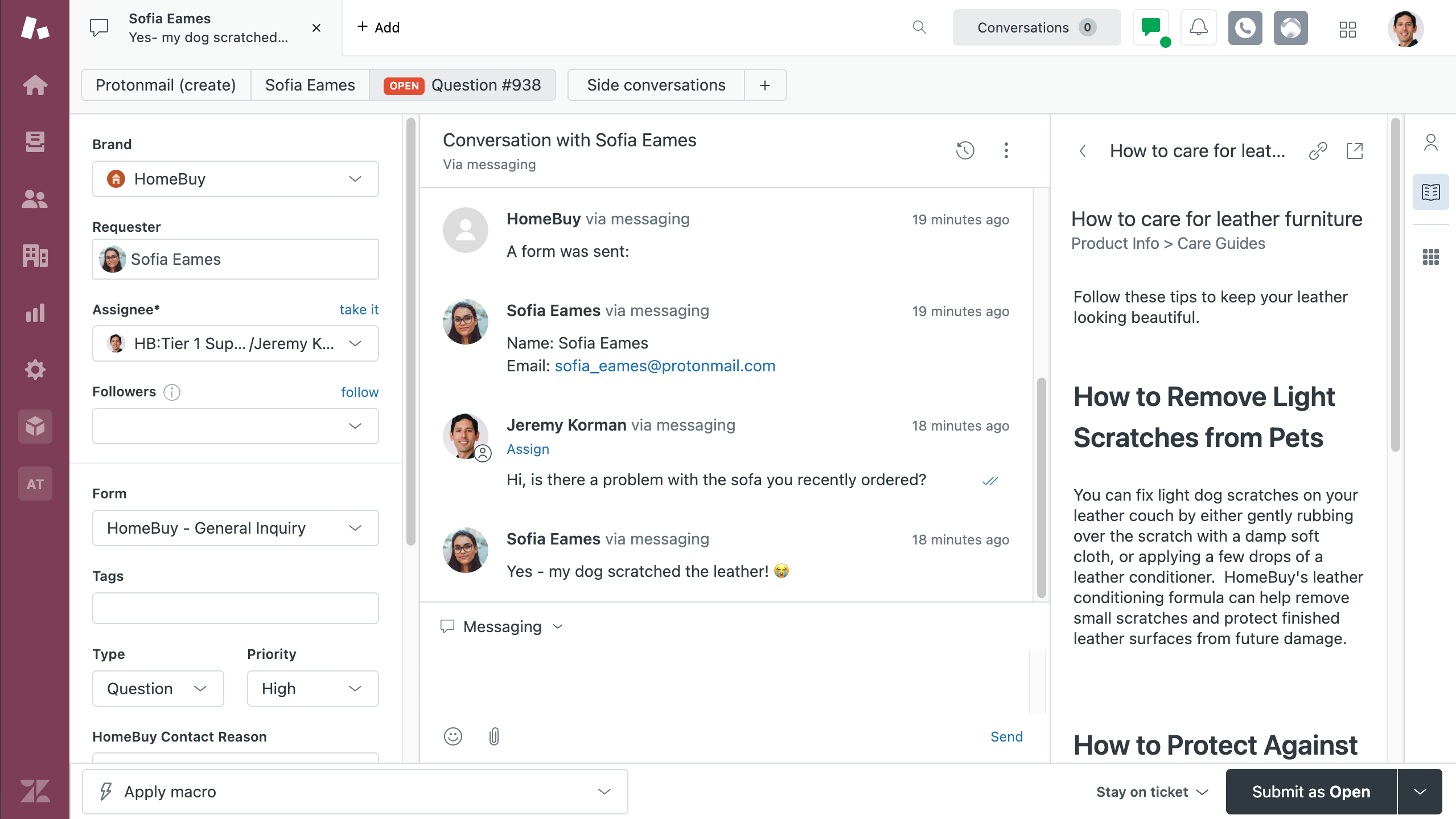
ServiceNow's customer-facing service capabilities are solid, but they exist in service of an ITSM. Zendesk, on the other hand, is built from the ground up for customer support, and it shows in the details. Multi-channel support (email, chat, social, phone, WhatsApp) flows into a unified dashboard, conversations are trackable across channels without leaving the browser, and the onboarding is designed for support agents, not IT admins.
Zendesk also has a dedicated employee service product, which is what makes it much more of a ServiceNow competitor. Its ITSM capabilities include a centralized service hub for managing tickets, incidents, knowledge, and assets, along with built-in automation to handle common workflows like onboarding, approvals, and request routing. Employees can submit requests from any channel, while self-service portals and AI-powered knowledge bases deflect repetitive tickets and speed up resolutions. It also layers in asset and lifecycle management, so IT teams can track devices, surface asset data inside tickets, and automate tasks like provisioning or patching.
Zendesk's features don't run as deep as ServiceNow's, but if you want a more customer-focused solution that also does ITSM, it's a great alternative.
Zendesk also integrates with Zapier, so you can build AI-powered workflows around your support queue: auto-create tickets from form submissions, route high-priority tickets to a dedicated Slack channel, or sync ticket data with your CRM. Learn more about how to automate Zendesk.
Zendesk pricing: From $19/agent/month for the Support Team plan, which includes email and social ticketing, pre-written responses, and basic reporting; paid plans with full AI and omnichannel support from $55/agent/month.
Read more: The best Zendesk alternatives
Best ServiceNow alternative for VoIP
Nextiva

Nextiva pros:
Omnichannel communication, including social media, web chat, and phone in one queue
AI-powered routing, speech-to-text, and sentiment analysis
Comprehensive reporting on customer interactions across all channels
Nextiva cons:
Expensive if you're not using the full omnichannel feature set
The abundance of channels and features can be overwhelming to set up
For plenty of organizations, customer communications are as critical to their service delivery as ticketing. When your agents are fielding calls from customers who are simultaneously submitting tickets and posting complaints on X, you need a unified system—not three separate tools with no shared view.
That's Nextiva's pitch. Calls, video, team chat, social media interactions (on TikTok, Instagram, X, LinkedIn, and YouTube), web chat, and online review responses all funnel into the same queue that handles voice calls. Your agents get a unified view of the customer regardless of channel, instead of four different dashboards they're alt-tabbing between.
Behind the scenes, AI speech-to-text transcribes every call in real time, sentiment analysis flags callers who are escalating toward a bad outcome (and how many times they've said "absolutely unacceptable"), and intelligent routing matches customers with agents based on skills and availability. And the analytics go beyond call metrics: you can track customer satisfaction scores, social engagement, and how customers interact with your brand across every channel in a single report.
Nextiva isn't the cheapest option on this list, and if your team just needs basic phone coverage without the omnichannel layer, you're paying for features you won't use. But for service-first teams managing customer relationships across multiple channels, it's the most complete communication platform on this list.
Nextiva integrates with Zapier, so you can automate things like logging every inbound call as a CRM record, creating support tickets when a call ends with a negative sentiment score, or firing a survey email the moment a conversation closes.
Nextiva pricing: From $15/user/month for the Core plan, which includes inbound and outbound voice, business SMS, video meetings, call routing, and team chat; enterprise plan available.
Read more: The best VoIP providers
Best ServiceNow alternative for PPM
Planview Portfolios

Planview Portfolios pros:
Connects organizational strategy directly to project execution
Advanced capacity planning and demand management
Planview Portfolios cons:
Steep learning curve with a notoriously unintuitive interface
Planview Portfolios is a project portfolio management (PPM) platform. That use case is on the edge of what ServiceNow does, so if that's not what you're looking for, go ahead and skip this one.
ServiceNow's PPM is solid for organizations already living in the ServiceNow ecosystem who want portfolio visibility without adding another platform. But if project portfolio management is a core function for your organization—if you're juggling hundreds of projects and managing capacity across large teams—you want a tool that was built for exactly that.
Planview Portfolios' demand management feature centralizes project requests from every source, evaluates them against strategic goals, and gives leadership an actual framework for saying no to the initiatives that don't pass the test. Portfolio analysis lets you score, prioritize, and run what-if scenarios across your project mix. It sounds like standard PPM, but the depth of Planview's scenario modeling is hard to match. You can even model the ripple effects of adding, delaying, or canceling any project before it happens in the real world.
Planview Copilot brings AI-powered insights to the portfolio, flagging resource bottlenecks and surfacing at-risk initiatives. And financial planning tools handle budgeting, forecasting, and cost tracking at scale, which means you can answer "where did all our money go?" instead of just claiming your Zoom connection is unstable.
If portfolio management is a core function for your organization rather than a ServiceNow feature you barely use, Planview Portfolios is worth the investment.
Planview Portfolios pricing: Contact for pricing
Read more: The best PPM software
Which ServiceNow alternative should you choose?
ServiceNow is a lot of things to a lot of teams, which means the right alternative depends almost entirely on what job you were actually hiring it for.
And really, most organizations aren't choosing between ServiceNow and one alternative. They're choosing between ServiceNow and a combination of these alternatives. And sometimes that's your best bet.
If you end up combining a few tools—an ITSM like Freshservice for ticketing, a CRM like Salesforce for sales teams, and a customer service platform like Zendesk for support—you can make them work together as a cohesive stack with Zapier.
Zapier is the secure, governed layer that connects 9,000+ apps and lets you orchestrate entire business processes across IT and beyond.
Related reading:


