
We independently review every app we recommend in our best apps lists. When you click some of the links on this page, we may earn a commission. Learn more.
Intercom is an impressive platform, designed to handle the entire customer lifecycle, across every touchpoint, from onboarding through retention. But not every business needs that level of commitment from its help desk.
If you're looking for something a little less complex or a little less eerily omniscient, there are plenty of Intercom alternatives for customer support, customer engagement, and customer experience.
The Zapier team and I have spent hundreds of hours in these apps, and based on all that testing, plus a whole lot of research, these are my picks for the best Intercom alternatives.
The best Intercom alternatives
Zendesk for omnichannel support
HubSpot for all-in-one sales, marketing, and service
Freshdesk for ticket management
Customer.io for lifecycle automation
LiveChat for live chat
What makes the best Intercom alternative?
How we evaluate and test apps
Our best apps roundups are written by humans who've spent much of their careers using, testing, and writing about software. Unless explicitly stated, we spend dozens of hours researching and testing apps, using each app as it's intended to be used and evaluating it against the criteria we set for the category. We're never paid for placement in our articles from any app or for links to any site—we value the trust readers put in us to offer authentic evaluations of the categories and apps we review. For more details on our process, read the full rundown of how we select apps to feature on the Zapier blog.
Intercom covers a lot of ground: traditional ticketing, live chat, AI-powered support, proactive messaging, onboarding flows, lifecycle marketing, and in-product engagement. An alternative doesn't have to do all of those things, but there were a few features I considered non-negotiables.
AI features. Every tool advertises AI features, but I wanted to see if those features actually reduced agent workload or improved customer experience. Intercom is an AI-forward app, so any alternative needs to offer something compelling.
Omnichannel support. Intercom handles email, chat, phone, and social in one inbox. The best alternatives either match that surface area or focus on fewer channels exceptionally well.
Proactive engagement capability. This is the thing most pure help desks miss. Intercom lets you reach out to customers before they reach out to you, with things like triggered messages, onboarding nudges, and upsell flows. Every app on this list offers that in some capacity, even if it's not as powerful as Intercom.
Value for price. Intercom charges per seat and per resolution. A "resolution" is any conversation that Fin AI Agent closes without escalating to a human—currently $0.99 each. That means a team handling 5,000 AI-resolved conversations a month is paying an extra $4,950 on top of their seat costs, every month, with no cap. The total bill fluctuates based on how well Fin performs, which makes budgeting unpredictable. So I kept my eye on pricing predictability as I was reviewing the alternatives.
Integration depth. Your help desk needs to talk to your CRM, your database, your marketing stack, and basically every other app that tracks customer touchpoints. I looked for apps that have a lot of integrations—either natively or through Zapier.
Those criteria helped me narrow down the field, and the final picks were determined by how well I thought they could serve as an Intercom replacement.
Intercom alternatives at a glance
Best for | Standout features | Pricing | |
|---|---|---|---|
Omnichannel support | Intelligent triage, AI voice agents, workforce management, 2,000+ integrations | From $19/agent/month, plus per-resolution prices | |
All-in-one sales, marketing, and service | Shared CRM across all Hubs; AI agents for support, prospecting, and content | Free plan available; paid plans from $7/seat/month | |
Ticket management | Pre-built AI agents; omnichannel unified inbox | Free plan available; paid plans from $15/agent/month | |
Lifecycle automation | Journeys workflow builder with multi-split branches; automates email, SMS, push, Slack, and more | From $100/month | |
Live chat | Asynchronous mode; message sneak peek; modular add-ons for chatbots and help center | From $19/month |
Best Intercom alternative for omnichannel support
Zendesk
Zendesk pros:
Unified omnichannel ticketing across email, chat, phone, social, and WhatsApp
AI voice agents and text agents for frontline resolution
Workforce management and AutoQA tools for scaling support operations
Zendesk cons:
AI features are gated behind higher-priced tiers
Can feel like overkill for smaller teams
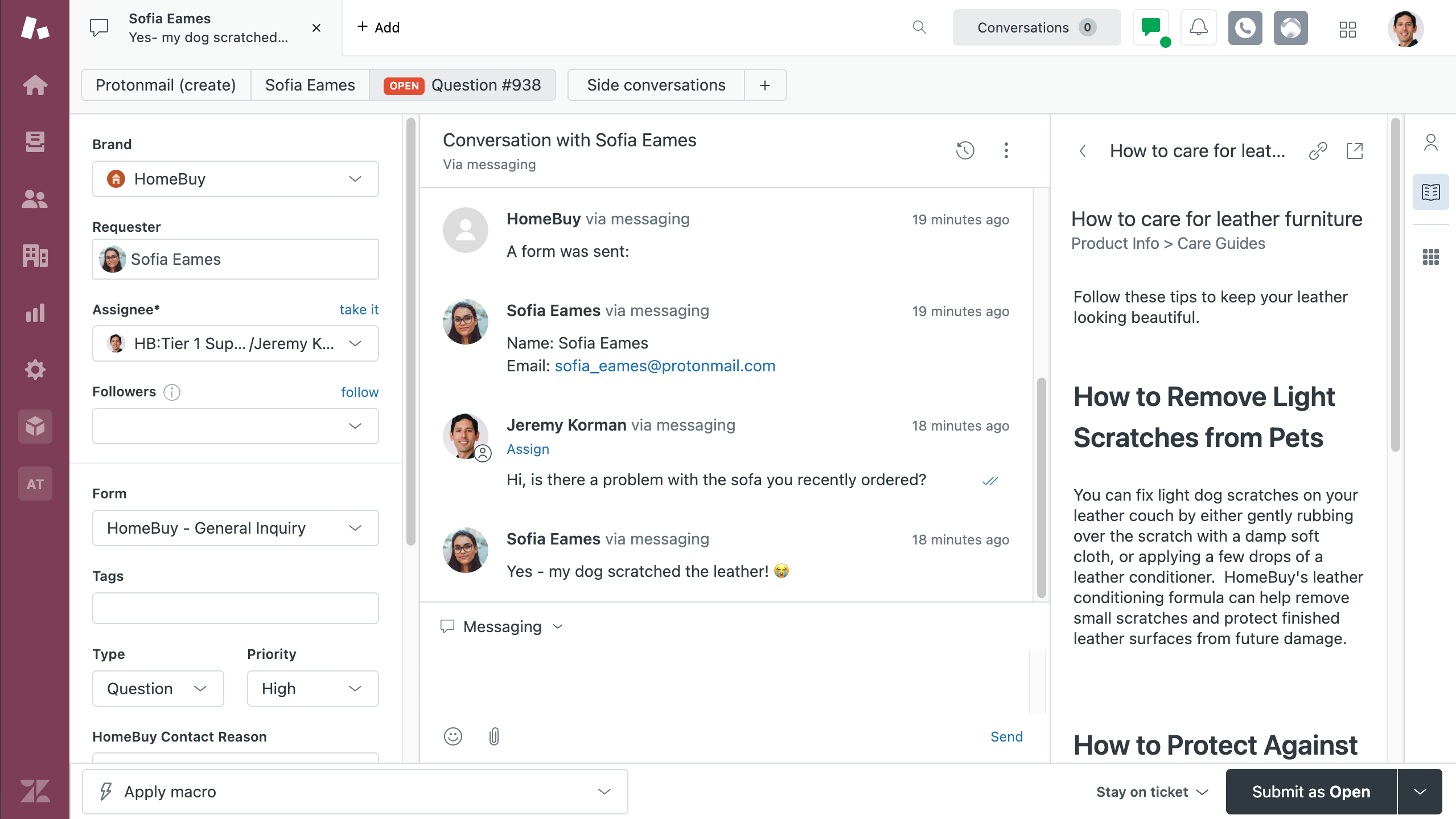
Zendesk is the closest thing the customer support world has to a default setting. It's been around for nearly two decades, powers support at companies ranging from scrappy startups to Fortune 500s, and gets picked first so often that I don't really feel like I need to explain why it tops a list of help desk software. Still, it isn't really an apple-for-apple comparison with Intercom, so I'll dig in a little.
Zendesk was built around resolution, and it handles inbound communication across basically every channel you could imagine. Every incoming contact—email, live chat, phone call, WhatsApp message, X DM—lands as a ticket in a unified queue. Agents don't lose the thread when customers bounce between channels, and the side conversations feature lets them loop in colleagues via Slack, email, or Microsoft Teams without leaving the platform.
Zendesk's AI competes well with Intercom's. The Intelligent Triage system automatically classifies incoming tickets by intent, sentiment, and entity (it'll pull an order number out of a customer message without being asked), then routes them accordingly. AI agents can handle text and voice channels, and an AI copilot assists human agents with suggested responses and knowledge base retrieval mid-conversation. I also really like the AutoQA feature, which scores 100% of interactions (not a random sample). All of this combined makes Zendesk work at scale. Just keep in mind that, like on Intercom, you'll have to pay per resolution when an AI agent handles things, and it's actually a bit more expensive than Intercom.
Zendesk does offer proactive messaging, including behavior-triggered in-product messages and onboarding prompts. But if sophisticated lifecycle engagement and product-led messaging are a major requirement, Intercom is more developed here since it started offering these kinds of features a lot sooner—Zendesk is newer to that game.
Zendesk integrates with Zapier, which means you can build AI-powered workflows that connect Zendesk to every other tool in your stack. For example, whenever a Zendesk ticket is tagged as high-priority, you can route it to a senior agent, and fire a notification in Slack—all automatically. You can also access and act on all your Zendesk data directly from your AI assistant. Learn more about automating Zendesk.
Zendesk pricing: From $19/agent/month (billed annually) for the Support Team plan; plans with AI features start at $55/agent/month (billed annually). You also need to pay per resolution for AI agent resolutions.
Read more: Zendesk vs. Intercom
Best Intercom alternative for all-in-one sales, marketing, and service
HubSpot

HubSpot pros:
Single CRM shared across sales, marketing, support, and ops
AI agents for customer service, prospecting, content, and social
HubSpot cons:
Pricing structure gets complicated fast once you start combining Hubs and tiers
Steeper learning curve than most tools on this list
The analogy I keep coming back to for HubSpot is IKEA. It's a furniture store, yes, but it also sells art, inexplicably large stuffed animals, and my favorite cinnamon buns. HubSpot is a CRM, yes, but it also offers marketing automation, customer support, and operations tools. The layout isn't always intuitive, but if you need all of it—which, once you're inside the maze, you realize you absolutely do—you're saving yourself a lot of separate shopping trips.
What makes HubSpot a strong Intercom alternative specifically is its CRM foundation. Every Hub—sales, marketing, service, content—sits on the same contact record. So when a customer reaches out to support, the agent can see which emails they opened, what they downloaded, how far they are in the sales pipeline, and whether they've already complained about this exact thing before (they have). That context is one of Intercom's draws too.
HubSpot's AI, Breeze, is everywhere in the platform. It can draft responses, summarize conversations, and build workflows without making you leave your current context. But Breeze Agents are specialized: the Customer Agent handles inbound support using your CRM context to power personalized, predictive routing; the Prospecting Agent researches leads and automates outreach sequences; the Content Agent helps generate blog posts and landing pages. These aren't chatbots with a fresh coat of paint—they're actually integrated into the platform's data.
HubSpot is broader in scope than Intercom, but if a help desk is your number one priority, it's not as purpose-built for that. Having said that, if you're already using other HubSpot Hubs, Service Hub is a natural extension and there's no reason to switch tools. But if you're starting from scratch and customer support is your primary use case, I'd go to Zendesk or Freshdesk first.
Connect HubSpot to Zapier to extend it across your full stack—automatically routing leads, syncing support data, and triggering AI-powered workflows across every tool your team uses. You can even access and take action on your HubSpot data directly from your AI chat window. Learn more about automating HubSpot.
HubSpot pricing: Free plan available; paid plans from $7/seat/month for the Service Hub
Best Intercom alternative for ticket management
Freshdesk

Freshdesk pros:
AI agents available at a lower price tier than most competitors
Fast setup with pre-built vertical AI agents and one-click workflow templates
Omnichannel unified inbox
Freshdesk cons:
Less advanced customization and AI capabilities than Intercom
Pricing can scale quickly with headcount
Freshdesk makes AI customer support accessible to teams that aren't operating at enterprise scale. Most Intercom competitors put all their best AI features into the highest pricing tiers. Freshdesk gets you AI agents at $29/user/month on Freshdesk Omni. That's the same entry price as Intercom's Essential plan, but it covers more of the operational basics right out of the box, and you get 500 AI agent sessions included, instead of paying per-resolution right out of the gate.
Freddy AI Agent handles autonomous customer conversations: it can gather order status, surface relevant knowledge base content, and resolve routine queries without a human in the loop. Freddy AI Copilot, on the other hand, assists human agents with real-time response suggestions, sentiment gauging, and autocomplete. And Freddy AI Insights surfaces patterns in support data so you can actually do something with the information you're collecting. These features aren't as polished or as flexible as Intercom's Fin AI ecosystem, but you can pick and choose which you need and add them accordingly.
I want to shout out Freshdesk Omni specifically: it's a unified inbox that consolidates tickets and conversations from email, chat, phone, WhatsApp, Instagram, and Facebook Messenger into one interface. That covers a lot of Intercom's breadth without requiring the same premium.
You can connect Freshdesk with Zapier to build AI-powered end-to-end workflows that automate your customer support—and securely access your customer data directly from your AI chat window. Learn more about how to automate Freshdesk.
Freshdesk pricing: Free plan available for up to 10 agents; Freshdesk Omni starts at $29/agent/month (billed annually), which includes 500 Freddy AI Agent sessions per month; additional sessions at $49/100.
Best Intercom alternative for lifecycle automation
Customer.io

Customer.io pros:
Workflow builder handles email, SMS, push notifications, Slack messages, and webhooks in one canvas
API-friendly and customizable
Customer.io cons:
Expensive entry point relative to simpler alternatives
No shared support inbox
There's a version of Intercom that a lot of product and growth teams have been using for years that has nothing to do with support tickets. It's the version where a user signs up, hits day three without completing setup, and gets a targeted message that says exactly the right thing at exactly the right moment—automatically. If that's the Intercom you're trying to replace, Customer.io is the tool built specifically for that job.
Customer.io's Journeys platform is a workflow builder where you connect triggers, conditions, and actions on a visual canvas. The trigger is almost anything: things like a user event, a page view, a date, a segment change, or an API call. The actions span email, SMS, push notifications to mobile apps, Slack messages, webhooks, and more—it's an impressive number of channels. And multi-split branches let you A/B test up to eight message variations in a single journey.
Every user in Customer.io is a profile with attributes and events attached. A journey can fire based on a specific event (user completed step 3 but not step 4), a calculated attribute (account age + feature usage = churn risk score), or a custom object you define. The Liquid templating system means messages can be personalized down to the sentence level based on what's true about that specific user. And the platform's AI can suggest segments, draft message copy from templates, and analyze campaign performance.
Keep in mind that Customer.io isn't a support tool. There's no shared inbox, no ticketing, and no live chat. So if you need both sides of customer communication, you'll pair Customer.io with a help desk. But if you're considering Intercom primarily for outbound lifecycle messaging, Customer.io handles that more specifically.
Customer.io also integrates with Zapier so you can build end-to-end customer data workflows that run automatically or straight from your AI chat window. Learn more about how to automate Customer.io.
Customer.io pricing: From $100/month for the Essentials plan
Best Intercom alternative for live chat
LiveChat

LiveChat pros:
Asynchronous mode bridges offline and online conversations seamlessly
Message sneak peek lets agents see what customers are typing before they send
Add chatbots, help centers, and knowledge bases as needed
LiveChat cons:
Limited support for structured ticketing workflows
Some teams come to Intercom for the live chat, use maybe 20% of the platform, and pay for the rest anyway. If that's you, LiveChat is your best bet. It focuses on one thing—real-time customer messaging—and it does it better than almost anything else on the market.
Installing the chat widget only takes a few minutes, and once you're in, it has every feature you could want from live chat. Asynchronous mode means that if a customer sends a message after business hours, LiveChat holds it in the queue and delivers your reply to both the chat widget and the customer's email when you respond. And message sneak peek—a vaguely creepy feature that lets you see what a customer is typing before they hit send—gives agents a few extra seconds to prepare, which adds up meaningfully in high-volume environments.
LiveChat also connects to WhatsApp, Messenger, and SMS, so it's not purely a website widget. And the modular approach to the broader platform is worth noting: if you eventually need a help center or a knowledge base, for example, you can add those without switching platforms.
The gap compared with Intercom is more noticeable when you move beyond conversational engagement into broader product adoption and lifecycle messaging. LiveChat supports proactive, behavior-targeted messages and can guide visitors around your product, but it's built around real-time customer conversations rather than sophisticated onboarding journeys and lifecycle engagement.
Zapier's LiveChat integration lets you connect your live chat to the rest of your tech stack—for example, whenever a LiveChat conversation ends, you can use AI to summarize the interaction, update the customer record in your CRM, and create a follow-up task in your project management tool.
LiveChat pricing: From $19/month for one user (billed annually) for the Starter plan
Which Intercom alternative should you choose?
If you need serious support infrastructure at scale, Zendesk is the strongest choice. It's really where most people should start if they're looking for Intercom levels of customer support features. Otherwise, take a look at what I said each app here is best for, and start with the one that fits your needs the most—it's that simple.
Whatever you pick, you'll want an automation layer connecting it to the rest of your stack. Zapier connects to 9,000+ apps—including all of these tools—so your support conversations, CRM data, and marketing workflows can actually talk to each other instead of living in separate silos. With Zapier, the difference between any of these Intercom alternatives gets a lot smaller.
Related reading:


