We independently review every app we recommend in our best apps lists. When you click some of the links on this page, we may earn a commission. Learn more.
MailerLite is a lot of teams' first pick for email marketing, and it's usually because of the price tag: it consistently wins on the elusive price-to-features ratio. On top of that, for a lot of small businesses—including solo operators and creators with a newsletter and a dream—it's exactly the right tool.
But as teams grow, MailerLite can start to lag. And for a few dollars more a month, there might be a tool that does a lot more. The Zapier team (myself included) has collectively spent thousands of hours testing email marketing tools, and based on all that human testing, we have strong opinions about the best tools for the job.
Here, I'll share my picks for the best MailerLite alternatives, including other budget-friendly options and some heavier hitters if you're looking to expand.
The best MailerLite alternatives
Sender for a free alternative
Mailchimp for an all-in-one marketing platform
Kit for creators
Brevo for big contact lists
ActiveCampaign for automation power users
Audienceful for newsletters
Loops for SaaS and product teams
Omnisend for eCommerce
What is MailerLite?
MailerLite is an email marketing platform built for small businesses and creators who want capable tools without paying for a bloated feature set they'll never use. It includes a drag-and-drop email editor with dynamic content blocks (like countdown timers, RSS feeds, and embedded product details), a solid automation builder, landing pages and website hosting, and audience segmentation. And even better, that's all included on a free plan that supports up to 500 subscribers and 12,000 emails per month.
Paid plans start at $9/month (billed annually) for the Growing Business tier, which unlocks unlimited email sends, templates, and a few other features. The Advanced plan ($18/month billed annually) adds smart sending, a custom HTML editor, and multi-trigger automations. For most small businesses, it's a lot of value at a modest price.
What makes the best MailerLite alternative?
How we evaluate and test apps
Our best apps roundups are written by humans who've spent much of their careers using, testing, and writing about software. Unless explicitly stated, we spend dozens of hours researching and testing apps, using each app as it's intended to be used and evaluating it against the criteria we set for the category. We're never paid for placement in our articles from any app or for links to any site—we value the trust readers put in us to offer authentic evaluations of the categories and apps we review. For more details on our process, read the full rundown of how we select apps to feature on the Zapier blog.
You're probably not looking for something more complicated or expensive just for the sake of it. Here's what actually matters when evaluating alternatives:
Value for price. MailerLite's free plan is solid, and its entry-level plans are affordable. That doesn't mean all the apps on my list are cheap, but if there's a bigger price tag, it's because there's added value, either in contact allowance, features, or both.
Ease of use. MailerLite is easy to use, which is one of the main reasons it's so popular for folks just getting started with email marketing. So an alternative that adds complexity without adding more capability isn't actually an upgrade.
A specific fit for your use case. A creator building an audience has different needs than a SaaS startup managing lifecycle emails or an eCommerce brand trying to recover abandoned carts. The best alternative is the one that's actually built for how you work. If an app didn't offer a specific alternative use case, it didn't make the list.
Integration depth. MailerLite connects with Zapier, which means you can automate workflows across thousands of other apps across your tech stack. For an app to make this list, it needs to match that level of integration depth.
When we test email marketing tools at Zapier, we go deep. We build emails, test complex automations, and try features like segmentation, A/B testing, and any other standout feature on offer. All of the apps here have been put through the wringer by me or another trusted app tester for Zapier.
MailerLite alternatives at a glance
Best for | Standout features | Pricing | |
|---|---|---|---|
A generous free plan | 2,500 subscribers and 15,000 emails free | Free plan available; paid plans from $39.90/month | |
All-in-one marketing platform | AI-powered segmentation; email, SMS, social, and website in one place | Free plan available; paid plans from $10/month | |
Creators | Unlimited sends for up to 10,000 subscribers free; built-in digital product tools | Free plan available; paid plans from $33/month | |
Big contact lists | 100,000 contacts on free plan; visual automation builder | Free plan available; paid plans from $8.08/month | |
Automation power users | 950+ automation recipes; behavior-based triggers | From $15/month | |
Simple email marketing | Notion-style editor; free for up to 1,000 contacts | Free plan available; paid plans from $29/month | |
SaaS and product teams | Unlimited automation workflows free; API-first for product-triggered emails | Free plan available; paid plans from $49/month | |
eCommerce | Lots of pre-built eCommerce flows; product recommendations; email and SMS | Free plan available; paid plans from $16/month |
Best free MailerLite alternative
Sender

Sender pros:
2,500 subscribers and 15,000 emails/month for free—5x MailerLite's subscriber limit
Full automation and segmentation access on the free plan
Affordable paid tiers
Sender cons:
Clunky drag-and-drop editor
Fewer template options than competitors
If you're bumping up against MailerLite's 500-subscriber ceiling and don't want to pay yet, Sender is the clearest direct comparison. The free plan includes 2,500 subscribers and 15,000 email sends per month—five times the subscriber limit and 25% more sends than MailerLite's free tier. And crucially, it doesn't gate the good stuff: full automation and audience segmentation are both included at no cost.
The automation feature includes nine pre-built workflows covering common use cases—like win-back campaigns, webinar follow-ups, and abandoned cart recovery—plus 11 standard triggers to build your own. It's not as polished as MailerLite's automation builder, and the drag-and-drop email editor is a step behind in my testing, but for a free tool, the functionality holds up.
When you do need to upgrade, Sender's paid plans are super affordable. For example, $39.90/month gets you 10,000 subscribers, 120,000 email sends, SMS features, whitelabeling, and up to three users. You'd have to pay $65.70 for 10,000 subscribers on MailerLite (though you'd get unlimited email sends, so it's a bit of a trade-off).
If you're choosing a free plan primarily as long-term runway, not just a trial, Sender's generous limits mean you can grow significantly before you ever have to open your wallet. Plus, Sender integrates with Zapier, so you can connect it to thousands of apps—sync subscribers from your eCommerce store, add leads from forms, or automate list management without manual data entry.
Sender pricing: Free for up to 2,500 subscribers and 15,000 emails per month; paid plans from $7/month for 1,000 subscribers and 12,000 email sends/month.
Best MailerLite alternative for an all-in-one marketing platform
Mailchimp

Mailchimp pros:
Email, SMS, social media, landing pages, and website management in one platform
AI-powered predictive segmentation based on purchase likelihood and lifetime value
Great template library and polished drag-and-drop editor
Mailchimp cons:
Free plan is far more limited than it used to be (250 subscribers, 500 sends/month)
Pricing scales steeply with list size
Mailchimp shows up on several of Zapier's best email marketing lists, and that's not a coincidence. It's a capable platform: intuitive for beginners, powerful enough for growing teams, and packed with features that MailerLite simply doesn't offer, especially on the marketing channel side.
If you're looking for a free option, stick with MailerLite (or check out Sender). But if you're already on a paid plan—or you're ready to be—Mailchimp becomes a lot more appealing. You can manage your website, landing pages, paid ads, social posts, and SMS campaigns from the same dashboard where you're writing email campaigns. And the AI segmentation features—like predictive purchase likelihood, estimated customer lifetime value, and lookalike audience finding—are also much more advanced than what MailerLite offers, especially once you connect your eCommerce store.
For MailerLite users who want to centralize their marketing stack, Mailchimp is a trusted name that holds up to testing. It might be more than some teams need, but it's a really natural next step from MailerLite.
Mailchimp also integrates with Zapier, so you can layer on even more logic. Automatically add contact details from new CRM entries, trigger the right campaign based on purchase intent, or sync audiences across your ad and email platforms, for example. Learn more about how to automate Mailchimp.
Mailchimp pricing: Free plan available for up to 250 contacts and 500 sends/month; paid plans from $10/month (billed annually) for 500 contacts on the Essentials plan.
Read more: MailerLite vs. Mailchimp
Best MailerLite alternative for creators
Kit

Kit pros:
Free plan supports up to 10,000 subscribers with unlimited email sends
Built-in digital product sales, tip jar, and creator monetization tools
Solid automation workflows
Kit cons:
Limited visual customization
A/B testing limited to subject lines
Kit (formerly ConvertKit) has a really generous free plan for anyone running a newsletter or creator business. Up to 10,000 subscribers with unlimited sends for free is a lot of runway, even compared to MailerLite. So if your list is growing fast and you're not ready to pay, Kit is a compelling option.
There are a few trade-offs, though. For starters, once you move past the free plan, the paid Creator plan starts at $33/month for 1,000 subscribers—notably more expensive than MailerLite's $9/month Growing Business plan at the same list size. Also, Kit's email editor isn't built for image-heavy, visually branded campaigns. If MailerLite's dynamic content blocks (like countdown timers, RSS feeds, and product embeds) are part of your regular workflow, you'll notice the difference.
But Kit has a lot going for it. It offers flexible tagging, sophisticated segmentation, and an automation builder that goes well beyond simple sequences. It lets you connect landing pages, trigger actions based on purchases, and move subscribers between flows based on behavior. Kit is also built for monetization in a way that MailerLite isn't, at least not out of the box. You can sell digital products and subscriptions, take tips, and run your own creator business without stitching together a separate tool.
Kit also integrates with Zapier, so you can automate subscriber management, sync new contacts from other apps, and connect Kit to your broader marketing stack. Learn more about how to automate Kit.
Kit pricing: Free plan available for up to 10,000 subscribers with unlimited sends and basic segmentation; paid plans from $33/month (billed annually) for the Creator plan, which unlocks full automation and unlimited sequences.
Read more: MailerLite vs. Kit
Best MailerLite alternative for big contact lists
Brevo

Brevo pros:
100,000 contacts on the free plan
Visual automation builder with multi-channel workflows
Full-featured CRM and live chat built in
Brevo cons:
Strict 300 email/day send limit on the free plan
Reporting features are limited at lower tiers
Where MailerLite caps your free plan at 500 subscribers, and other options go up to 2,500 or even 10,000, Brevo lets you have up to 100,000 contacts for free. The catch is the daily send limit: 300 emails per day on the free plan. But if you're managing a large list and sending infrequently—or just want to import your full audience without hitting a paywall—that 100k is a nice buffer to have.
Paid plans for Brevo start at $9/month for the Starter tier—roughly on par with MailerLite's Growing Business plan—but Brevo's pricing scales more by email volume rather than subscriber count, which can be cheaper if your list is large but your sends are targeted. For example, you can have 500,000 contacts and 20,000 emails a month on Brevo for $29/month. On MailerLite, if you need that many contacts, you're looking at prices in the thousands.
In my testing, Brevo excelled at automation. The visual drag-and-drop canvas handles complex multi-channel workflows—email, SMS, WhatsApp, and push notifications—and lets you combine multiple triggers in a single flow. Brevo also includes a full CRM, a live chat widget, and AI features, which is a lot of surface area for a tool in this price range.
Brevo also integrates with Zapier, so you can build AI-powered workflows across your entire tech stack. Automatically create new Brevo contacts from form submissions, sync subscribers from your CRM, or trigger campaigns based on behavior in other apps. Discover more ways to automate Brevo with Zapier.
Brevo pricing: Free plan available for up to 300 emails per day and 100,000 contacts; paid plans from $8.08/month for 5,000 emails/month with unlimited daily sends.
Best MailerLite alternative for automation power users
ActiveCampaign

ActiveCampaign pros:
950+ pre-built automation recipes covering email, SMS, CRM, and site tracking
Active Intelligence AI suite for campaign generation and predictive segmentation
ActiveCampaign cons:
No free plan
Steep learning curve
Noticeably more expensive than MailerLite
ActiveCampaign is what you graduate to when MailerLite's automation starts feeling too simple. That's not a knock on MailerLite—for straightforward welcome sequences and drip campaigns, it does the job well. But ActiveCampaign shines if you want more advanced automations that react to whether someone opened an email (or didn't), visited a specific page, had their lead score cross a threshold, or moved to a new deal stage in your CRM.
The automation builder includes tons of triggers and actions spanning email, SMS, site tracking, and its built-in CRM. You can build a re-engagement drip that only fires for contacts who viewed your demo but didn't book a call, or route hot leads to a sales rep the moment their behavior score ticks up—all within the same automation. The 950+ pre-built recipes mean you're rarely starting from scratch, even for complex use cases.
What you're giving up relative to MailerLite is price and simplicity. ActiveCampaign has no free plan, and the Starter plan begins at $15/month for 1,000 contacts—which is already more expensive than MailerLite's $9/month Growing Business plan at the same list size, and the gap widens fast. The Plus plan, which adds eCommerce automation and more advanced reporting, starts at $49/month for 1,000 contacts. And ActiveCampaign is a complex tool, so you should also expect to invest time upfront before it starts paying off.
If you're a SaaS company, an agency managing complex client journeys, or a business that cares about the nuance of which email someone got and what they did next, that investment is worth it. But if you're a small newsletter sender who just outgrew MailerLite's free plan, there are cheaper options here.
ActiveCampaign integrates with Zapier for even deeper automation. Do things like connecting your drip campaigns to the rest of your stack, triggering emails from CRM updates, and orchestrating workflows across your entire tech environment. Learn more about how to automate ActiveCampaign.
ActiveCampaign pricing: From $15/month (billed annually) for the Starter plan for 1,000 contacts; Plus plan from $49/month for 1,000 contacts adds unlimited automation, landing pages, and advanced reporting. Pricing scales with contact count.
Read more: MailerLite vs. ActiveCampaign
Best MailerLite alternative for newsletters
Audienceful

Audienceful pros:
Clean, Notion-style editor that's fast to learn
Free for up to 1,000 contacts with segmentation and one automated sequence
Full email marketing feature set without the bloat
Audienceful cons:
No pre-made templates
Analytics are less robust than most competitors
Automation is more limited than MailerLite's
Audienceful offers a nice balance between a full-featured email marketing platform and a dead simple email newsletter app.
The editor is text-forward, but you can add rich elements like media, buttons, and columns. And you have plenty of options for how to build your emails, with Notion-esque slash commands, web-builder style and buttons, or drag-and-drop elements from the right-hand menu.
You won't find a library of pre-built templates, but the Theme tab lets you set your typography, colors, and layout once and save them as a reusable custom template so your emails look consistent without being generic. The free plan covers up to 1,000 contacts (twice MailerLite's free subscriber limit) with two team members and full access to segmentation, though automation is limited to one sequence.
Paid plans start at $29/month for up to 3,000 contacts, which is slightly more expensive than MailerLite's comparable tier, but I found the simplicity of using Audienceful to be a breath of fresh air if you're feeling overwhelmed by email marketing.
Audienceful also integrates with Zapier to automate tasks like adding new subscribers, creating subscriber lists, and syncing contacts from other apps in your marketing stack.
Audienceful pricing: Free for up to 1,000 contacts and 2 team members; paid plans from $29/month (billed annually) for up to 3,000 contacts and additional automation.
Best MailerLite alternative for SaaS and product teams
Loops
Loops pros:
Unlimited automation workflows on the free plan
Purpose-built for SaaS
API-first for product-triggered and transactional emails
Loops cons:
Rich text editor only—no visual, image-heavy email design
Limited automation for complex multi-path logic
Less useful for traditional marketing emails or eCommerce
I'd say Loops is the most specialized tool on this list. It's built for SaaS companies that need to send product-triggered emails, onboarding flows, and transactional messages (like password resets, receipts, and 2FA confirmations) all from the same platform, rather than splitting that across multiple tools.
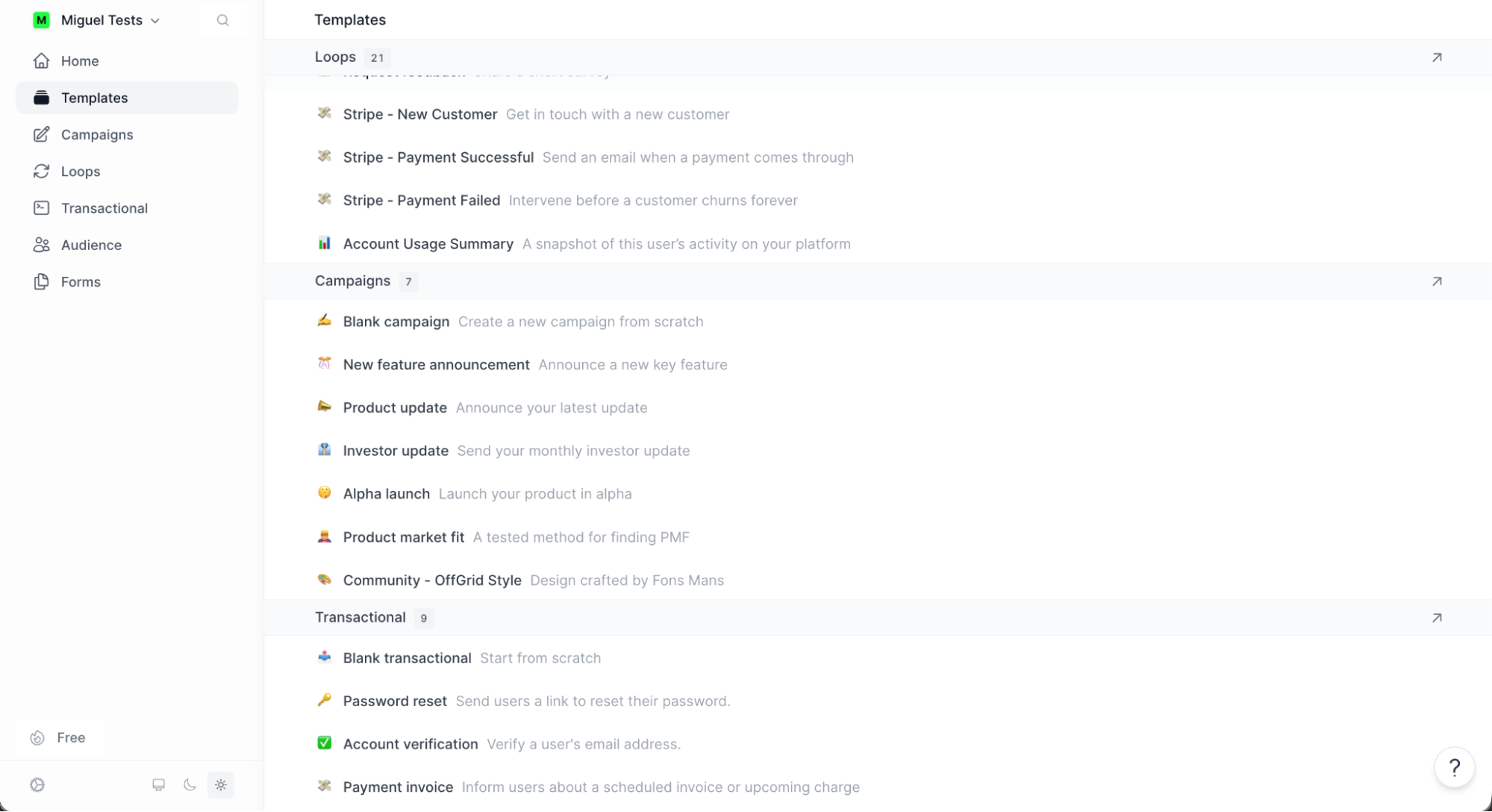
The free plan includes 1,000 contacts, 4,000 sends per month, and unlimited automated workflows, which is unusually generous for a tool in this tier. The 21 pre-built templates cover common SaaS lifecycle scenarios like welcoming new users, nudging trial signups to upgrade, and re-engaging churned accounts.
The editor is minimal by design. It's rich text only, with basic personalization via data variables. If your brand requires image-rich campaigns or you're sending promotional newsletters, Loops isn't the right fit. And because Loops triggers emails from API calls based on product activity, your developers will need to be involved in setup. This isn't a tool you configure through a visual form builder and walk away from.
If that all still sounds like what you need, Loops integrates with Zapier, making it easy to sync contacts from your CRM, billing system, or support platform and keep your Loops audiences current as your product data evolves.
Loops pricing: Free for up to 1,000 contacts and 4,000 emails/month; paid plan at $49/month for up to 5,000 contacts with unlimited email sends.
Best MailerLite alternative for eCommerce
Omnisend

Omnisend pros:
Lots of pre-built eCommerce automation flows
Email, SMS, and push notifications from one platform
Pre-built eCommerce segments and dynamic product recommendation blocks
Omnisend cons:
Free plan is very limited
Gets expensive fast as your list grows
Omnisend earns its place on this list with an asterisk. MailerLite has light eCommerce capabilities, but it's not what it's optimized for. Omnisend is the opposite: it's purpose-built for online retailers, and if abandoned cart recovery, browse abandonment, product recommendations, and post-purchase flows are central to your marketing strategy, it does all of those things better than MailerLite.
So here's the asterisk: Omnisend is more expensive, and its free plan is far less generous. Where MailerLite gives you 500 subscribers and 12,000 sends for free, Omnisend's free tier covers just 250 contacts and 500 email sends per month—basically enough to test the platform, not to run a real operation. Paid plans start at $16/month for 500 contacts, and pricing scales steeply with list size. If you're a small eCommerce store still deciding whether email marketing is worth investing in, Omnisend may not be the right starting point.
But if you're running an eCommerce business with an active store on Shopify, WooCommerce, BigCommerce, or Wix and you're ready to invest in a tool that earns its cost through recovered carts and automated product campaigns, Omnisend is hard to beat. The pre-built automation library gets you from zero to a complete eCommerce email strategy in an afternoon. Welcome flows, abandoned cart sequences, browse abandonment, post-purchase follow-ups, and win-back campaigns are all ready to customize with a few clicks. The product recommendation blocks dynamically pull in best-selling items, recently browsed products, or curated picks for each shopper. SMS and push notification campaigns live in the same workflow as email, so your cross-channel strategy stays tight.
Omnisend also integrates with Zapier, so you can extend its capabilities further. Add subscribers from other apps, sync engagement data back to your CRM, and build AI-powered workflows that keep your eCommerce marketing proactive. Learn more about how to automate Omnisend.
Omnisend pricing: Free plan available for up to 250 contacts and 500 email sends/month; Standard plan from $16/month for 500 contacts with 6,000 monthly emails. Pricing scales steeply with contact count.
Which MailerLite alternative should you use?
If the main reason you're leaving MailerLite is the 500-subscriber free plan ceiling, your clearest options are Sender (2,500 free subscribers, full automation access) or Kit (10,000 free subscribers and unlimited sends, though with a simpler editor and fewer features). Both let you grow considerably before you spend anything.
If you have a lot of contacts, Brevo is the way to go; if you're looking for simplicity, choose Audienceful. And if you need a more robust option from MailerLite, ActiveCampaign is the natural step up. Then there are the more niche tools, like Loops for SaaS and Omnisend for eCommerce.
With one exception, all the apps on this list offer a free subscription tier, so take a few for a spin and see which one fills the gaps MailerLite leaves you with.
Related reading: