Elon Musk has a big problem with OpenAI. Musk was involved in founding OpenAI in 2015, left with a lot of bad blood in 2018, and to cut a long story very short, is not happy with the direction things have taken since ChatGPT blew up. In response, he sued OpenAI (the case is ongoing as of this writing) and launched his own AI company, xAI. All this would be inside baseball, except that Grok keeps generating headlines:
In July 2025 Grok posted antisemitic content praising Hitler and started calling itself MechaHitler.
Between December 2025 and January 2026, Grok was used to generate millions of sexual images that were posted to X. Many of these images were nonconsensually created of real people, some of them children. Governments around the world have banned (or threatened to ban) Grok as a result. Regulatory investigations are ongoing.
In March 2025, xAI merged with X, the site formerly known as Twitter. The combined company is currently merging with SpaceX to create "the world's most valuable private company."
Grok was used by DOGE and has deals with US government departments.
They say any press is good press. I'm not so sure in this case, but it's probably still worth considering how Grok stacks up to the category leader, ChatGPT. I don't think it could ever be good enough to overcome the negative aura, but you might feel differently. So, let's dig in.
Table of contents:
Grok vs. ChatGPT at a glance
First, a clarification: Grok is the name of xAI's standalone chatbot, its LLM, and the chatbot built into X that uses the same model but has a slightly different feature set. ChatGPT is the chatbot built on OpenAI's various models.
The main thrust of this comparison is looking at ChatGPT (the chatbot) and Grok (the chatbot with its own website), but that obviously involves some discussion of the underlying models, the companies, how else they're available, and everything else.
With all that, ChatGPT and Grok are both solid AI chatbots, though there are some differences. You can see an overview below, or read on to get the full picture.
Grok | ChatGPT | |
|---|---|---|
Power | ⭐️⭐️⭐️⭐️⭐️ Grok is one of the best models around | ⭐️⭐️⭐️⭐️⭐️ OpenAI consistently has some of the most powerful models, and you can access them through ChatGPT |
Features | ⭐️⭐️⭐️ While Grok nails the basics, it lacks polish and is less flexible than ChatGPT | ⭐️⭐️⭐️⭐️⭐️ ChatGPT sets the standard for AI chatbots |
Availability | ⭐️⭐️⭐️⭐️ Web, mobile, and availability through X | ⭐️⭐️⭐️⭐️⭐️ Web, desktop, and mobile apps |
Value | ⭐️⭐️⭐️ Solid free plan; $10/month for SuperGrok Lite; $30/month for SuperGrok, which isn't as feature-rich as ChatGPT Plus | ⭐️⭐️⭐️⭐️⭐️ Solid free plan; $8/month for ChatGPT Go; $20/month for ChatGPT Plus |
Both ChatGPT and Grok offer powerful models
Comparing the best chatbots and AI models is getting increasingly silly. Grok 4.5 (which powers Grok) and GPT-5.6 are both incredibly powerful hybrid reasoning models. Unless you're really pushing the boundaries of what's possible with AI models, you're unlikely to find massive real-world differences between what Grok and ChatGPT are capable of for everyday tasks (coding is a different story). Both will help you write emails, analyze documents, summarize content from around the web—and whatever else you do with an AI chatbot—with equal aplomb.

In the chart below from ArtificialAnalysis, you can see how the Grok and OpenAI models stack up. OpenAI is clearly a little ahead right now, but Grok 5 is due in the next few months and will likely level the playing field. I also can't stress enough how little the day-to-day differences between the models is.

Having said that, over the past year, it's become clear that the most viable current use for AI tools is writing computer code. Anthropic led the charge with Claude Code, but OpenAI followed hard with Codex—Grok is a distant third. These agentic development platforms allow coders to work with models productively. It's not just the models that are excellent at writing functioning computer code, but the "harness" around them makes them effectively able to work on both local code and remote servers. It's suddenly made $200/month AI subscription plans something that people are prepared to pay for.
In part because of Grok's failure to keep pace in coding, Musk has declared that the company is being rebuilt from the ground up. Nine of the 12 cofounders have left.
Both ChatGPT and Grok have the basic features you'd expect from an AI chatbot
The feature overlap between ChatGPT and Grok is also huge.
Both are able to search the web and use the information they find to respond to your prompts. Grok can also pull in posts from X, which might help with newsworthy events—but I did see plenty of offensive messages when I asked it about more controversial topics like Ireland's housing crisis. (Musk is currently meddling in Irish politics.)
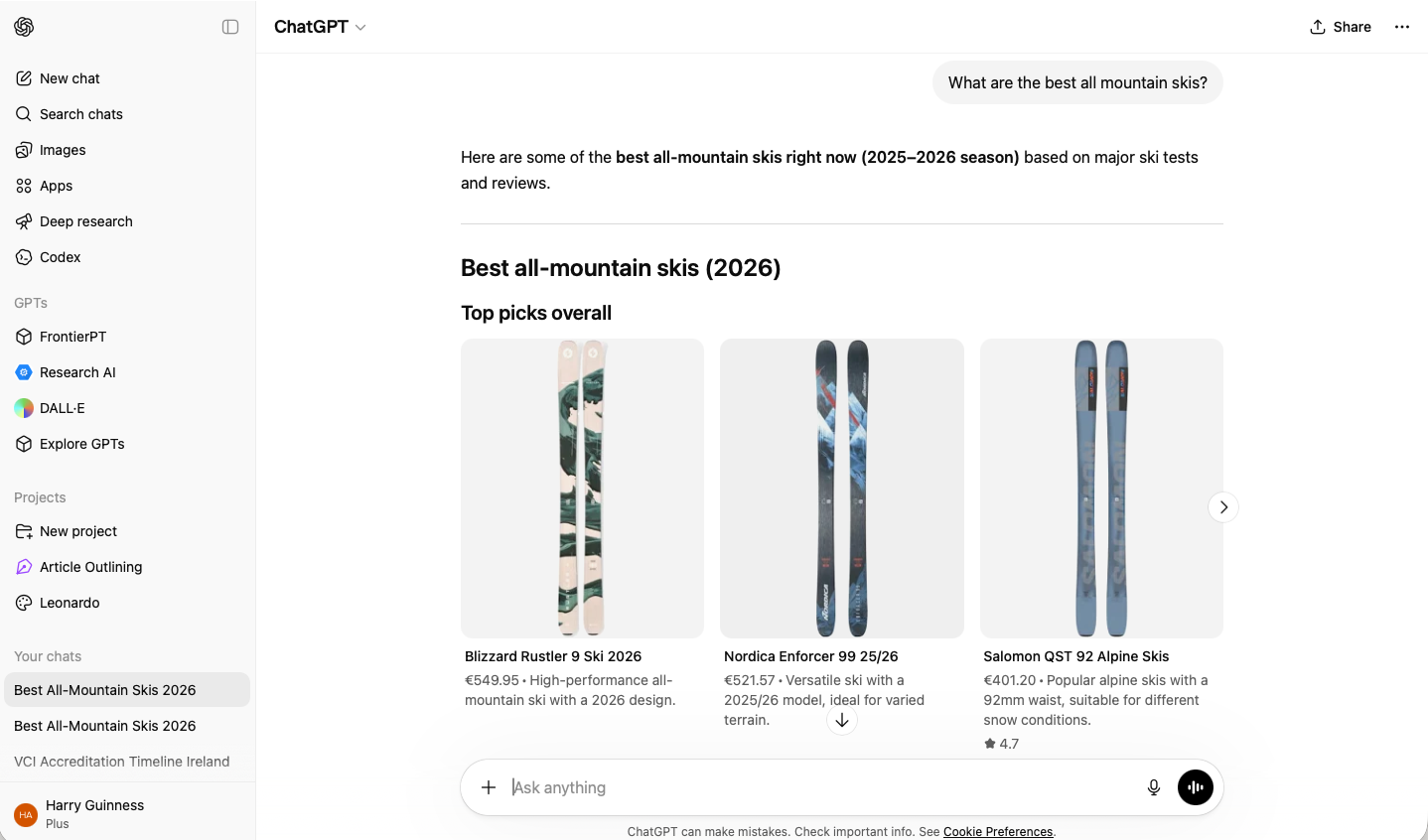
Both are multimodal, so they can read prompts that include images and documents.
Both are also capable of generating images. ChatGPT excels at it and prioritizes safety. Grok is a capable image generator, but given what it has frequently been used for, I can't recommend you check it out.
Both have voice modes that allow you to talk to the chatbot and even interrupt it, though Grok's only works through its mobile app.
Both can write code and run it in a sandbox. This allows them to analyze data from CSVs, PDFs, and other documents and perform detailed data analysis.
Both have memory and personalization. They can remember context across conversations and keep details about who you are and how you work in mind.

Plus, both are pretty nice to use. Really, when it comes to the fundamental features of a chatbot, both ChatGPT and Grok are equally solid.
ChatGPT has more useful features

ChatGPT is the more mature product, both in terms of its features and its general approach to pretty much everything. Here are the areas where I think ChatGPT stands out from Grok the most.
Codex, OpenAI's coding agent, is a powerful computer dev tool. It's one of the big points of difference between ChatGPT and Grok. It's also available through the command line.
A Google Docs-like workspace called Canvas that supports human-AI collaboration on writing and simpler coding tasks.
Agent mode. ChatGPT has a built-in virtual browser and computer. It can use these to browse the web and take actions (like book a haircut) or work on real files in an isolated environment.
Native integrations with tools like Google Drive, GitHub, Slack, Photoshop, Canva, and more.
The ability to create and use custom versions of ChatGPT.
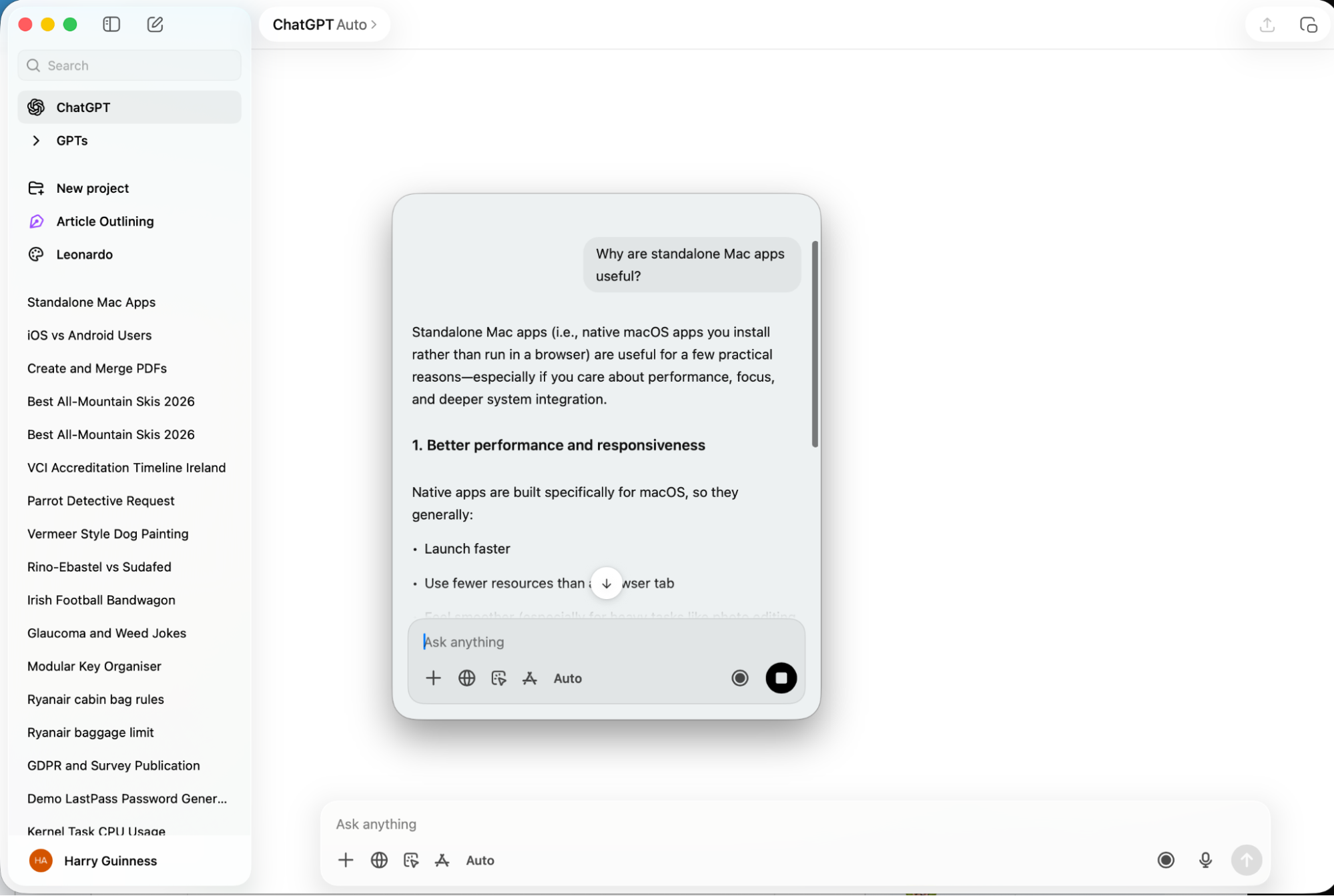
Dedicated Windows and Mac apps—not just web and mobile apps.
The ability to schedule ChatGPT to perform tasks at certain times.

Over the past year, Grok has caught up in a few areas. It now has team and enterprise plans, project and automation features, and a bit more polish. On its most expensive plan, Grok can use multiple agents at once and synthesize the results, which is interesting—though it doesn't seem to produce significantly better real-world results.
Last year, one area where ChatGPT stood out was its integration with Zapier, which lets you connect ChatGPT to thousands of other apps. Now Grok has one too. You can learn more about how to use Zapier to automate ChatGPT and how to use Zapier to automate Grok, and here are some examples to show you how it works.
Automatically reply to Google Business Profile reviews with ChatGPT


Send prompts to ChatGPT for Google Forms responses and add the ChatGPT response to a Google Sheet


Create email copy with ChatGPT from new Gmail emails and save as drafts in Gmail

Use Grok to run hourly checks for trending content online and send via email


Enrich lead data from HubSpot with Grok and add to Zapier Tables


Enrich Salesforce leads with Grok by xAI and update Salesforce

Grok doesn't match its marketing
Despite the controversies, there's still a big gap between what Musk claims Grok is and what it actually is.
In various statements, Musk has called Grok "maximally truth-seeking … even if that truth is sometimes at odds with what is politically correct." It's meant to be edgy, irreverent, funny, and opinionated. And, in my experience, it's kind of none of these things. When it goes off the rails (see, MechaHitler, deepfake scandal), it's offensive and headline generating. But in day-to-day use? Eh, it will occasionally use slang or answer more casually, but unless you prompt it to be different, its answers are very similar to ChatGPT.


Grok isn't some supergenius AI that occasionally says offensive-but-true-things because it's uniquely capable of seeing through society's delusions. It just has lower safety guardrails and allows (or encourages) NSFW content. From time to time, that combo backfires.
All this is to say that Grok is mostly just another solid chatbot, but the press around it is unavoidable. If I ran a public-facing business, I wouldn't want my name associated with Grok—even if it does the same job as ChatGPT most of the time.
ChatGPT is the one to pay for
There's one more big thing that needs to be talked about: the pricing plans.
ChatGPT has a good free plan; it has tight limits, but they're enough for occasional use. You get limited access to features like file uploads and image generation. Ads are also rolling out, but it's still a pretty compelling way to test out ChatGPT.
Grok's free plan is pretty similar. You can use Grok and try some advanced features. The limits are tight, but if you only use Grok occasionally or just want to try it out, you probably won't hit them. It used to include image generation, but that's been turned off for free users after the deepfake scandal.

Both apps also have a "cheap" tier. ChatGPT has ChatGPT Go at $8/month. It's still ad-supported, but you get higher usage limits. Grok is rolling out SuperGrok Lite at $10/month; the big thing it includes is image generation.
After that, ChatGPT Plus is $20/month while SuperGrok is $30/month. This is where ChatGPT really starts to offer more value: you get Codex access as well as its more polished product. I can't think of a compelling reason to spend the extra $10/month for Grok.

At the premium end, ChatGPT Pro costs $200/month; if you use Codex all the time, it's a good deal. SuperGrok Heavy costs $300/month. Again, I can think of no compelling reason to use it.
Similarly, both apps have Business and Enterprise plans with team features, support, and compliance. ChatGPT starts at $25/user/month, Grok at $30/user/month. This is another situation where ChatGPT is the easy winner, though not just because of its features. I think the potential reputational damage of being associated with Grok is a huge risk for any company; it's telling that ChatGPT's website lists some major corporate partners like Zendesk, Target, and Moderna, while, at the time of writing, Grok doesn't list a single client.
It's worth noting that Grok is also bundled with some paid X plans. Premium for $8/month includes "enhanced Grok access" while the $30/month Premium+ plan includes a SuperGrok subscription.
ChatGPT vs. Grok: Which should you choose?
ChatGPT is the best chatbot around for non-coding tasks, and even for coding, it's second best behind Claude. While Grok is just as powerful and useful for everyday tasks, it lacks a bit of polish, has no coding agent, comes with huge amounts of baggage, and costs more. If you use Grok, you probably won't be disappointed (until we see what the next controversy is), but ChatGPT is still the better option for almost everyone.
Related reading:
This article was originally published in March 2025. The most recent update was in April 2026.