OpenAI's ChatGPT is the biggest name in AI chatbots, but it's not the only one. In early 2025, the Chinese chatbot DeepSeek shocked the AI scene with a couple of big technological achievements—it rocketed up the app store charts and generated countless headlines. But now that the new cycle has died down, how does it stack up to ChatGPT in 2026?
Before we dig in, a note on naming conventions. I've been writing about AI models for a decade, and things continue to be confusing:
DeepSeek is the name of a family of AI models, a chatbot that uses them, and the company that developed them all.
ChatGPT is a chatbot developed by OpenAI; it uses the latest OpenAI models.
I'll try to keep things as clear as possible, but the main two things I'm comparing here are ChatGPT the chatbot and DeepSeek the chatbot.
Table of contents:
ChatGPT vs. DeepSeek at a glance
ChatGPT and DeepSeek are both easy-to-use AI chatbots, so they're broadly similar. Here's a quick look at how they stack up, but I'll dive deeper into some of the bigger differences below.
DeepSeek | ChatGPT | |
|---|---|---|
AI models | ⭐️⭐️⭐️⭐️ State-of-the-art AI models, though no multimodality | ⭐️⭐️⭐️⭐️⭐️ State-of-the-art AI models |
Features | ⭐️ A tech demo for DeepSeek's models | ⭐️⭐️⭐️⭐️⭐️ The most advanced AI chatbot around |
Free plan | ⭐️⭐️⭐️ Offers everything on its free plan, though there isn't a lot | ⭐️⭐️⭐️⭐️ Excellent, though you may feel pushed to upgrade |
Price | N/A—It's all free | ⭐️⭐️⭐️⭐️⭐️ At $20/month, ChatGPT Plus is well worth the cost; $8/month for ChatGPT Go also increases usage limits |
Security | ⭐️ Sends data to China | ⭐️⭐️⭐️⭐️⭐️ Now a secure enterprise app |
Both ChatGPT and DeepSeek offer powerful models
AI models are fast reaching the point where one-to-one comparisons are silly. Unless you're really pushing the limits of what AI language models are capable of (which comes with a whole host of risks), they're largely interchangeable for everyday tasks. Every good large language model (LLM) can now draft emails, edit blog posts, help you brainstorm, make code suggestions, and basically anything else you can think of—it's the features they have on top of this basic functionality that set them apart.

Both ChatGPT and DeepSeek use powerful, modern AI models—and they're both updated regularly and releasing new models all the time. The hybrid reasoning models they use can either respond quickly or use a "thinking" mode that takes more time and uses more resources. This mode is better at challenging reasoning, scientific, and coding problems but less useful for drafting an email.
In theory, ChatGPT should decide automatically when to use reasoning, but you can select "Thinking" if you want to force it to. With DeepSeek, you have to select "Deep Thinking."

In the charts above from Artificial Analysis, you can see how the models stack up on different benchmarks. OpenAI's models have a small edge, but the biggest performance gap is between the non-reasoning and reasoning versions. All this really says is that, unless you're pushing the limits of these chatbots, chances are you'll get great results with whatever model you use—so long as it's appropriate to the task.
ChatGPT is far more polished and feature-filled

ChatGPT has been one of the most important apps of the past few years, and it shows. Compared to DeepSeek, it's packed with additional features. Here are some of the big ones:
Image support. ChatGPT can understand uploaded images, charts, and other graphics. It can also generate images.
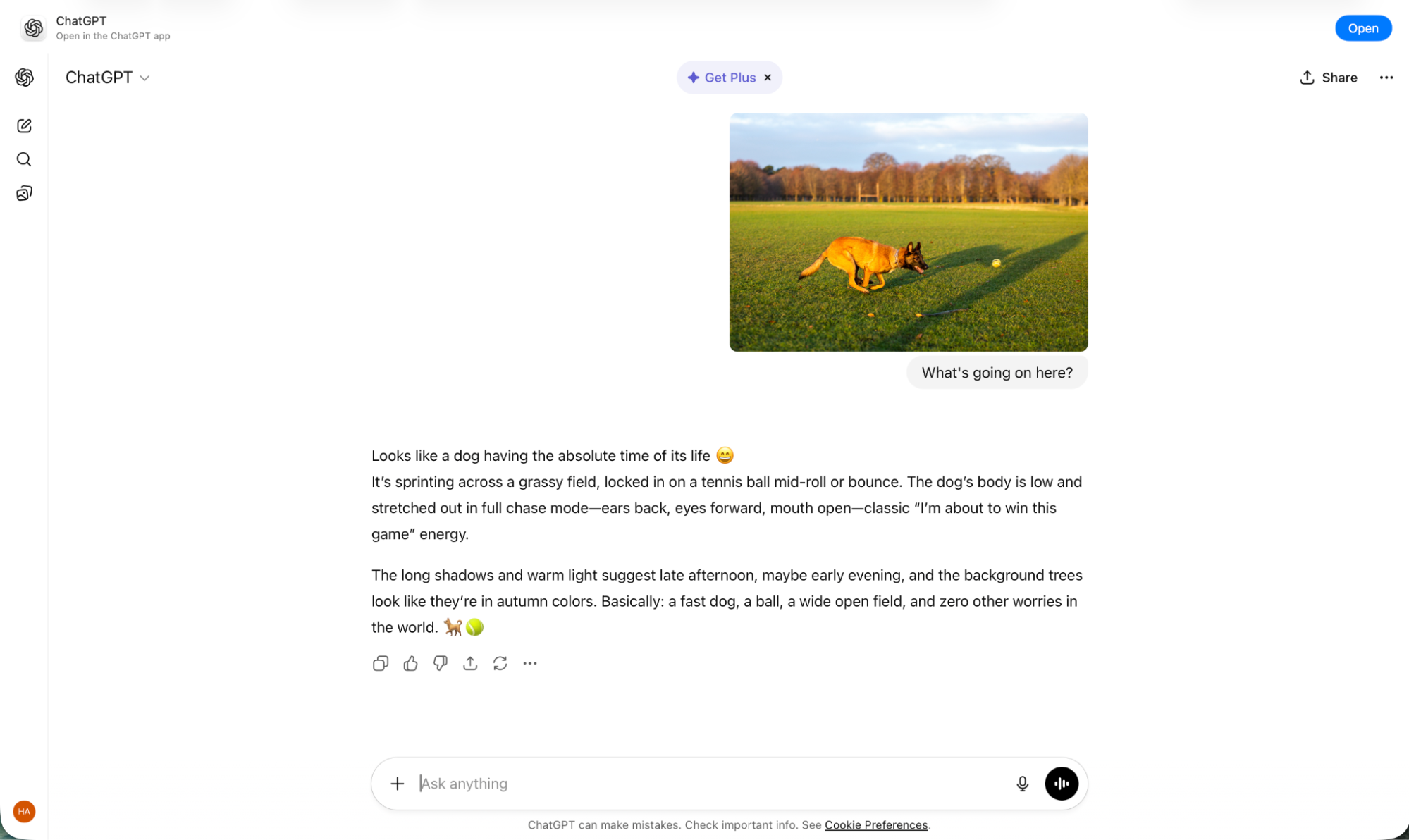
Voice mode. You can talk to ChatGPT. Advanced voice mode even allows you to interrupt the AI or use your camera for live vision support.
Custom instructions and memory. You can give ChatGPT specific instructions or ask it to remember details about you. It will then use these to tailor its responses.
Integrations. ChatGPT is built in to a lot of apps you use every day, and it even integrates with Zapier, so you can access it from any app you use.
Canvas. ChatGPT Canvas is a Google Docs-like workspace for AI-human collaboration on writing and coding tasks. It can even run code.
Codex. ChatGPT Codex is a dedicated AI coding app.
Atlas. ChatGPT is integrated with an AI-first browser.
Agent. ChatGPT has access to its own virtual environment and browser so it can take action on real websites.
Custom GPTs. You can create your own custom ChatGPT.
Windows and Mac apps. ChatGPT has desktop apps, while DeepSeek is only available on the web and through smartphone apps.
Scheduled tasks. ChatGPT can do things at certain times when you set up scheduled tasks.
Projects and other organizational features. It's not super robust, but ChatGPT helps you keep your AI chatbot conversations in order.
Team support. If you use ChatGPT for your company, you can get extra collaboration features.

And that's just scratching the surface. Perhaps more importantly, ChatGPT is just more polished. DeepSeek feels exactly like what it is: a chatbot that serves as a demonstration of the underlying models, not a product in its own right.
One thing ChatGPT and DeepSeek both have going for them is that they integrate with Zapier. By connecting ChatGPT or DeepSeek with Zapier, you can use their models to power workflows across your entire tech stack. For example, you can have DeepSeek or ChatGPT respond to messages or act on data in a database. Here are some templates to show you how it works.
Automatically reply to Google Business Profile reviews with ChatGPT


Send prompts to ChatGPT for Google Forms responses and add the ChatGPT response to a Google Sheet


Create email copy with ChatGPT from new Gmail emails and save as drafts in Gmail

Create chat completions in DeepSeek from new data source items in Notion


Issue new api requests in DeepSeek for each new message in Telegram

Create chat completions in DeepSeek every day with Schedule by Zapier

Zapier is the most connected AI orchestration platform—integrating with thousands of apps from partners like Google, Salesforce, and Microsoft. Use forms, data tables, and logic to build secure, automated, AI-powered systems for your business-critical workflows across your organization's technology stack. Learn more.
DeepSeek is a tech demo
DeepSeek generated headlines when it launched for three main reasons:
Its models are essentially as good as OpenAI's.
Its models are open, so anyone can download them, run them, and even customize them.
Its models are significantly cheaper to run.
All three of these things are still largely true, but they don't translate into a great AI chatbot. Instead, these are useful things to bear in mind if you're building an AI-powered app. Recent reports suggest that around 30 percent of global AI usage is now open Chinese AI models like DeepSeek V3.2.
For all that, DeepSeek is still a completely free chatbot with web and smartphone apps. I haven't hit any limits in my testing, and you don't have to deal with any upgrade notifications, blocked features, or all the other annoyances of using ChatGPT's free plan.
Of course, ChatGPT's free plan still has far more features, and it's the app I'd choose to use. But to make the most of it, you need to pay $8/month for ChatGPT Go or $20/month for ChatGPT Plus.
Is DeepSeek better than ChatGPT?
DeepSeek is important not because of what it can do, but because of the shift in AI models that it started. Since DeepSeek launched in 2025, there have been dozens of powerful open models released by Chinese AI labs. It no longer stands out as a unique OpenAI competitor, and its chatbot has lagged even further behind ChatGPT over the past year.
DeepSeek is also noteworthy because of the controversy inherent in any successful Chinese tech product. There's censorship, government bans over data privacy concerns, and allegations of chip smuggling. All these are valid concerns and certainly raise red flags if you want to use DeepSeek as your daily chatbot—but they're also less relevant if you plan to deploy DeepSeek's models yourself or use it through an API.
But really DeepSeek is going after an entirely different market than ChatGPT. While there is a DeepSeek chatbot, it's best to think of it as an occasionally useful tech demo rather than a ChatGPT competitor.
Sure, ChatGPT's free plan has some limitations, but it can also do far more; the reason that DeepSeek doesn't have the same usage limits or a paid plan is that it doesn't have the features to warrant them.
Related reading:
This article was originally published in February 2025. The most recent update was in February 2026.