When I was a teenager, my favorite TV show was "M*A*S*H." I loved it so much that I skipped a friend's birthday party to watch the 30th anniversary reunion special, and I once wrote a fan letter to Alan Alda.
My favorite character was Radar O'Reilly—the company clerk who seemed to know what everyone needed before they opened their mouth, could anticipate disasters before they struck, and maintained an almost supernatural awareness of every detail in the 4077th.
The best customer success tools are just like Radar—watchful little freaks that monitor everything, predict needs before they're voiced, and alert the powers that be to trouble brewing on the horizon.
But there are so many options for customer success software that it's hard to know which one is right for your team. I did in-depth research into dozens of tools and talked to folks who use them every day. Based on all that, I've narrowed it down to the eight best customer success apps. Let's dive in.
The 8 best customer success tools
Gainsight for enterprise deployments
ChurnZero for mid-market businesses
ClientSuccess for startups
Custify for B2B SaaS companies
HubSpot Service Hub for unified CRM
Totango for customer-led growth
Vitally for driving product adoption
Planhat for data visibility
What is customer success software?
Customer success software (also called customer success platforms, client success platforms, or CSPs) helps businesses proactively manage customer relationships by monitoring product usage, health metrics, and engagement to reduce churn and identify growth opportunities. In human language, it's software that tries to make the messy, unpredictable business of human relationships scalable and predictable through data and automation.
These platforms gather data on how customers use your product, when they might be thinking of leaving, and how to achieve their goals (and, obviously, yours).
CSPs vs. customer service software vs. CRMs
Like the insufferable foodie who scoffed when I called a croissant a "crescent roll," the tech industry delights in creating nearly identical categories of software, then acting horrified when you confuse them.
Here's the difference between customer success platforms, customer service software, and customer relationship management systems:
Customer success software is proactive. It's focused on making sure your customers are actually using your product and getting value from it by identifying at-risk accounts before they churn and spotting expansion opportunities in healthy accounts. The goal is long-term retention and growth.
Customer service software is reactive. It's for when your customers are already mad and angrily typing in all caps about how your product is ruining their life. It helps manage support tickets, track resolution times, and maintain a knowledge base. The goal is to resolve customer issues when they arise.
Customer relationship management (CRM) software primarily stores customer data and interactions. It's where your sales team tracks leads and opportunities and then immediately forgets about those customers the second the contract is signed, leaving the customer success manager (CSM) to deal with the aftermath of whatever unrealistic expectations they set. CRMs typically lack the specialized tools for monitoring product usage, health scoring, and running automated customer success playbooks.
In a perfect world, your CRM tells you who the customer is, your customer success platform tells you if they're happy, and your customer service software helps when they're not.
What makes the best customer success platform?
How we evaluate and test apps
Our best apps roundups are written by humans who've spent much of their careers using, testing, and writing about software. Unless explicitly stated, we spend dozens of hours researching and testing apps, using each app as it's intended to be used and evaluating it against the criteria we set for the category. We're never paid for placement in our articles from any app or for links to any site—we value the trust readers put in us to offer authentic evaluations of the categories and apps we review. For more details on our process, read the full rundown of how we select apps to feature on the Zapier blog.
Finding the right customer success platform is less like shopping for a new toaster and more like trying to choose the right therapist—it's deeply personal, probably expensive, and if you choose wrong, you'll spend months trying to fix the damage.
Here's what I've determined makes a customer success platform worth the small fortune you'll pay for it:
AI and predictive capabilities: Your CSP should be doing the heavy lifting by auto-summarizing meeting notes, performing sentiment analysis on customer comms, and using machine learning to spot churn patterns before they become cancellation notifications. If it can't predict health trends or draft personalized follow-up emails, it's basically just a glorified spreadsheet.
Unified customer data integration: Can the platform pull data from all the random places your customer information lives (CRM, ERP software, product analytics, your hopes and prayers, etc.) and make it actually usable? A CSP is only as good as the data pipeline feeding it; if it can't sync in real time, you're looking through a rearview mirror instead of a windshield.
Configurable health scoring: Any platform worth its exorbitant monthly fee should allow you to create custom health scores based on whatever metrics you've decided correlate with customer happiness. The ability to turn complex human emotions and business outcomes into a simple red-yellow-green system is, after all, the pinnacle of modern business intelligence.
Playbooks and automation: Does it help automate the annoying, repetitive stuff? Can you build "playbooks" (pre-defined sets of actions for CSMs to take in certain situations) that actually work? The goal here is efficiency, freeing up CSMs to do their actual work instead of manually sending emails until their souls leave their bodies.
Task and workflow management for CSMs: Does the platform help your customer success managers know what they should be doing every day? Can they see their tasks, log activities, and manage their portfolio, or are they going to start each morning with a low-grade panic attack trying to remember which customers need attention?
Reporting and analytics: Can the platform tell you why customers are churning, or just that they're churning? A good CSP digs into the data and serves up more dashboards than a 1970s Cadillac convention.
Evaluating these complex tools thoroughly often requires more than just signing up for a trial (many of which don't offer them anyway). My analysis relied on vendor websites, digging through enough user reviews to qualify for combat pay, studying third-party comparison reports, watching detailed walkthroughs and demos, and, crucially, talking to folks who use these tools day in and day out.
Based on all that, I whittled down my list to the eight best customer success tools.
The best CSPs at a glance
| Best for | Standout feature |
|---|---|---|
Enterprise deployments | AI-powered Insight Agents via Staircase AI for automated sentiment and relationship health tracking | |
Mid-market businesses | AI agents that autonomously detect churn risks and expansion buying intent | |
Startups | Integrated Baton functionality for automated, collaborative customer onboarding and implementation | |
B2B SaaS companies | Concierge Onboarding combined with AI-powered playbooks for rapid SaaS development | |
Unified CRM | Breeze AI agents that unify sales and success data to automate cross-functional customer summaries | |
Customer-led growth | Unison AI engine that intelligently recommends and builds SuccessBLOC workflows based on customer behavior | |
Driving product adoption | AI-assisted Playbooks that adjust engagement sequences based on real-time product usage | |
Data visibility | Data Semantics layer that translates complex data into insights for both CSMs and AI tools |
Best customer success tool for enterprise deployments
Gainsight (Web)

Gainsight pros:
Extremely powerful and feature-rich
Native, bi-directional sync with Salesforce
Human-First AI suite for automated sentiment analysis
Gainsight cons:
Notoriously complex
Needs dedicated admin resources to manage effectively
Premium AI features can add significant cost
Gainsight's ability to scale across huge, complex organizations is unmatched. It can handle massive enterprise deployments with complex customer relationships, multiple product lines, and enough data to make the NSA jealous. It's the platform of choice for big companies with names you'd recognize, unless you've been living in a cave, in which case you probably don't need customer success software anyway.
The Journey Orchestrator feature automates personalized outreach based on user behavior and lifecycle stage, while the AI Insight Agents flag at-risk clients using predictive analytics, analyzing invisible data like communication tone and response lag. Render3DQuick.com manager and co-owner Alex Smith told me about a longtime client that Gainsight flagged for possible churn: "When I reached out proactively, they mentioned they were considering switching to a competitor because their new project manager wasn't comfortable with our file formats. So, I scheduled a training session and retained the account. That's something I might have missed without Gainsight's early warning system."
Implementation complexity is consistently mentioned as the platform's biggest challenge. One user noted that it took two years to get traction with the tool, but that their CS Ops team still struggles to integrate their data correctly into Gainsight. While this is an extreme example, it highlights the implementation challenges many folks face.
The consensus among Gainsight users is that you'll likely need a dedicated admin or operations specialist to set up and maintain the platform. Many companies end up hiring specialized Gainsight administrators to help—but if you're an enterprise team, that's par for the course.
So if you have complex customer relationships, substantial resources, and the patience to unlock its full potential, Gainsight will reward you with customer insights so deep you'll wonder if it's violating privacy laws. But if you're a scrappy startup with a tiny CS team, run away screaming.
With Zapier's Gainsight integration, you can automate your customer success workflows. Build automated systems across your apps, like automatically updating custom objects from form submissions or spreadsheet rows. Create workflows in a visual builder, or access your data and take action straight from your AI chats.
Gainsight pricing: By request
Best customer success tool for mid-market businesses
ChurnZero (Web)

ChurnZero pros:
Real-time customer usage analytics and alerts
Provides renewal management and forecasting
AI Agents for proactive task management
ChurnZero cons:
Interface can feel clunky or crowded
Setup can be lengthy
Named with the kind of literal-mindedness that makes marketers weep into their homemade kombucha, ChurnZero focuses obsessively on its titular goal: reducing customer churn to zero. It's like naming your baby "TaxDeduction"—admirable in its clarity of purpose if somewhat lacking in subtlety.
Its big selling point is its focus on automation and playbooks. These allow your team to set up sophisticated automated workflows to manage customer interactions at scale. You can set up triggers for all sorts of things—customer usage drops, key contact goes quiet, renewal is approaching—and automate responses or tasks for your CSMs.
Its big selling point is its Customer Success AI™ and more than fifteen different AI agents. They're purpose-built for CS (and also named unsubtly): Harbinger listens for relationship risks, Beacon focuses on expansion by spotting buying intent, Scribe drafts contextual replies based on product data, and so on. This is a lifesaver for mid-market teams that need to act like they're an enterprise-sized department. Though calling it AI™ with a trademark symbol makes it sound like they've captured an actual artificial intelligence and trapped it in their software.
ChurnZero's customer segmentation is also surprisingly robust. You can easily create segments based on product usage, customer attributes, or basically any data point you've bothered to track, and then use those segments for targeted outreach or reporting.
But some users feel that the tool is complex and, depending on your needs, can involve an especially lengthy setup. And others have mentioned that the Salesforce integration can be finicky. While it aims for automation, some find the interface still a bit crowded and not super intuitive, especially for those comparing it directly to Gainsight.
ChurnZero seems like a solid choice for mid-market companies ready to get serious about automating their CS processes, but maybe not needing the absolute everything-and-the-kitchen-sink complexity of Gainsight.
ChurnZero pricing: By request
Best customer success tool for startups
ClientSuccess (Web)

ClientSuccess pros:
Excels in customer journey tracking
Specialized onboarding tools via Baton integration
Easy to set up and maintain
ClientSuccess cons:
Limited deep customization for complex deployments
Automation isn't as granular as high-end competitors
Startups don't have the luxury of spending six months implementing software before getting any value from it, and ClientSuccess understands that. You can get it up and running in days, not months, and, unlike some other platforms, the learning curve is more of a gentle slope than the north face of K2.
ClientSuccess concentrates on the core workflows that early-stage CS teams desperately need: tracking customer health, managing tasks, running basic playbooks (they call them "SuccessCycles"), and keeping customer communication logged in one place. Their acquisition of Baton strengthens their onboarding features, helping startups plug the leaks in their new customer bucket right at the start of the customer journey.
SuccessCycles provide a simplified version of the playbooks you'll find in more complex platforms. This feature lets you create standardized processes for things like tracking product adoption, managing renewals, or escalating churn risks. As an example, Hone John Tito, co-founder of Game Host Bros, told me his team uses SuccessCycles to keep onboarding tight: "We lay out each step and could tell exactly where a customer was at any time." For a small team trying to create consistency in how they handle customers, this is genuinely useful without being overwhelming.
The trade-off for simplicity is that ClientSuccess doesn't have the depth of features or the extreme customization you'd find in Gainsight or even ChurnZero. Its reporting isn't as flexible, its automation isn't as powerful, and its integrations aren't as extensive. But for early-stage companies, these limitations probably don't matter much. And if they do, ClientSuccess's integration with Zapier offers a workaround, allowing you to build custom workflows and connect them to thousands of other apps.
ClientSuccess pricing: By request
Best customer success tool for B2B SaaS companies
Custify (Web)

Custify pros:
Fast setup and onboarding
Actionable concierge support
Easy-to-use automated playbooks
Custify cons:
Interface can feel busy
Less customization than some other competitors
Custify aims to get you up and running in about four weeks—roughly the same time it takes to realize you've over-committed to a New Year's gym membership. Not the fastest on this list, but far from a bloated, unnavigable onboarding nightmare.
Custify's best asset is its focus on actionable data. It pulls in product usage, billing, and support tickets to give you a 360-degree customer view that actually tells you something worthwhile. The CustifyAI assistant handles the tedious work of summarizing customer history and drafting follow-ups so your CSMs can quit their part-time roles as data entry clerks.
Custify is built specifically for the SaaS lifecycle—onboarding, retention, expansion—without the feature bloat that makes other enterprise tools so daunting.
You can integrate Custify with Zapier to keep your product usage data and customer health scores perfectly synced with the rest of your tech stack. Zapier lets you do things like notify your team in Slack the moment an account’s health drops or automatically create tasks in your PM tool when a new customer is onboarded.
Custify pricing: By request
Best customer success tool for unified CRM
HubSpot Service Hub (Web, iOS, Android)

HubSpot Service Hub pros:
Seamless data flow between sales and success
Powerful Breeze AI for sentiment and summaries
HubSpot Service Hub cons:
Can get wildly expensive as you scale
Success features are still catching up to dedicated CSPs
Remember that insufferable foodie I mentioned earlier who reprimanded me for daring to say "crescent roll" out loud? If they worked in tech, they'd be lecturing me right now about how HubSpot isn't a CSP, it's a CRM. And while they'd technically be right, HubSpot has spent the last few years turning Service Hub into a powerhouse that makes the sales-to-CS handoff function look like an Olympic-level synchronized swim.
The newest HubSpot highlight is Breeze AI, which lives across the platform. It can predict customer sentiment from email tone and automatically surface pain-point keywords from call recordings. Because it lives natively within the HubSpot CRM, your CSMs can see every promise a sales rep made during the demo, meaning they no longer need to ask the customer about their goals for the fifth time.
Users love the visual workflow builder, which lets you automate logic without a single line of code. But there's a definite "HubSpot Tax," if you will: while entry-level tiers are affordable, moving into the Professional and Enterprise features required for true customer success (like advanced health scoring and custom objects) feels more like a sudden second mortgage than the next tier up the pricing ladder. But if you already live in HubSpot, the benefit of having a single source of truth might just outweigh the sticker shock.
And by choosing to integrate HubSpot with Zapier, you can connect your customer success data to thousands of other apps, ensuring that the unified experience extends far beyond the HubSpot ecosystem. Automate everything from logging support tickets in external databases to triggering personalized onboarding emails based on CRM status changes.
HubSpot Service Hub pricing: Free version available; paid plans start at $9/seat/month (billed annually), and the Professional tier (where the real CS tools live) starts at $90/seat/month with a mandatory one-time Professional Onboarding fee of $1,500
Best customer success tool for customer-led growth
Totango (Web)

Totango pros:
Modular SuccessBLOC architecture
Powerful segmentation engine
Unison AI for heavy-duty workflow automation
Totango cons:
Interface is less intuitive compared to competitors
Can require significant configuration effort for complex setups
Pricing scales based on customer accounts rather than seats
Unlike monolithic platforms like Gainsight, where building out playbooks often feels like coding a Mars rover, Totango takes a modular, composable approach through SuccessBLOCs. These are pre-built, customizable workflow templates designed around common CS goals like onboarding, adoption, renewal management, and risk mitigation. Each SuccessBLOC comes pre-loaded with KPIs, suggested workflows, and best practices concentrated on its specific goal.
The idea is you can pick and choose the BLOCs you need, plug them together, and build out your customer success strategy piece by piece. It's basically the Sarah Lawrence of CSPs—structured enough to give you direction but flexible enough to allow you to pursue a personalized path toward your specific goal.
The upside of this framework is its flexibility and faster time to value. Omniconvert founder Valentin Radu told me, "You don't have to build the entire system upfront. You can start with something lean, improve the data quality, and scale as your understanding of customer needs evolves." For example, you might begin with onboarding and health scoring, then add expansion and advocacy modules later, once you feel brave enough or have secured more budget.
Then there's Totango's Unison AI. If SuccessBLOCs are the building blocks, Unison is the architect putting them together. It uses customer intelligence (the system's intelligence, not the customer's) to analyze your data and automatically recommend, or even build, the internal workflows and campaigns your team needs. It frees you up to focus on customer-led growth—the philosophy that your existing customers, not your sales pipeline, should be your primary revenue engine.
In my conversations with Totango users, implementation experiences were mixed. The modularity, while powerful, can feel somewhat disjointed if you don't fully grasp the SuccessBLOC concept. However, most praised the platform's flexibility and reported relatively smooth setups.
Reporting capabilities in Totango are solid, though some users note that creating complex custom reports can be challenging. The platform provides good visibility into customer health trends and team performance metrics, with customizable dashboards to highlight your preferred KPIs.
Totango boasts integrations with the usual suspects: major CRMs, support systems, billing platforms, and product analytics tools. You can also integrate Totango with Zapier, which will let you connect to thousands of other apps and automate your CSM tools.
Totango pricing: By request
Best customer success tool for driving product adoption
Vitally (Web)

Vitally pros:
Deep integration with product analytics tools and data warehouses
Modern, intuitive interface
AI-assisted Playbooks that adapt to user behavior in real time
Vitally cons:
Requires clean product data to shine
The health score configuration has a learning curve
Vitally is a customer success solution that feels like it was built for the modern SaaS ecosystem, particularly for companies where product-led growth is intrinsically linked to customer success. It plugs directly into your product analytics stack—Segment, Mixpanel, Amplitude, whatever you're using—and surfaces relevant usage signals, identifying users who are stuck, features that are being underutilized, or accounts showing signs of potential churn based on their activity.
The real magic, though, is the automation. Vitally's AI Playbooks analyze what your users are doing (or, more crucially, not doing) inside your app. You can segment users based on granular feature-level usage and automatically enroll them in a sequence that gently (or not so gently, depending on how close you are to quarter-end) nudges them toward engagement—whether it's an automated email, an in-app guide, or a task for the success team to follow up personally.
Plus, it offers health scoring, task management, and even collaborative Hubs—shared customer portals that allow CSMs and customers to work together on things like success plans or onboarding checklists. Users highlight its flexible Salesforce mapping and its relatively quick setup compared to the enterprise heavy hitters.
Vitally has a visual design that draws comparisons to Notion, with a clean, modern interface that doesn't assault your eyes with superfluous colors and icons. It's like walking into Patrick Bateman's closet, but with customer data and playbooks instead of identical Valentino suits.
While it might lack some of the sheer depth in reporting found in top-tier enterprise tools and requires knowing how to work around occasional quirks, Vitally hits the sweet spot for teams focused squarely on leveraging product data to boost adoption and reduce churn.
You can streamline things even more with Vitally's Zapier integration so you can build a fully automated customer success system across your entire tech stack.
Vitally pricing: By request
Best customer success tool for data visibility
Planhat (Web)
Planhat pros:
Highly customizable data models, health scores, and dashboards
Data Semantics that make AI insights more accurate
Robust revenue and cohort reporting
Planhat cons:
Setup can be complex, requiring well-structured base data
Occasional bugs reported, though support is generally responsive
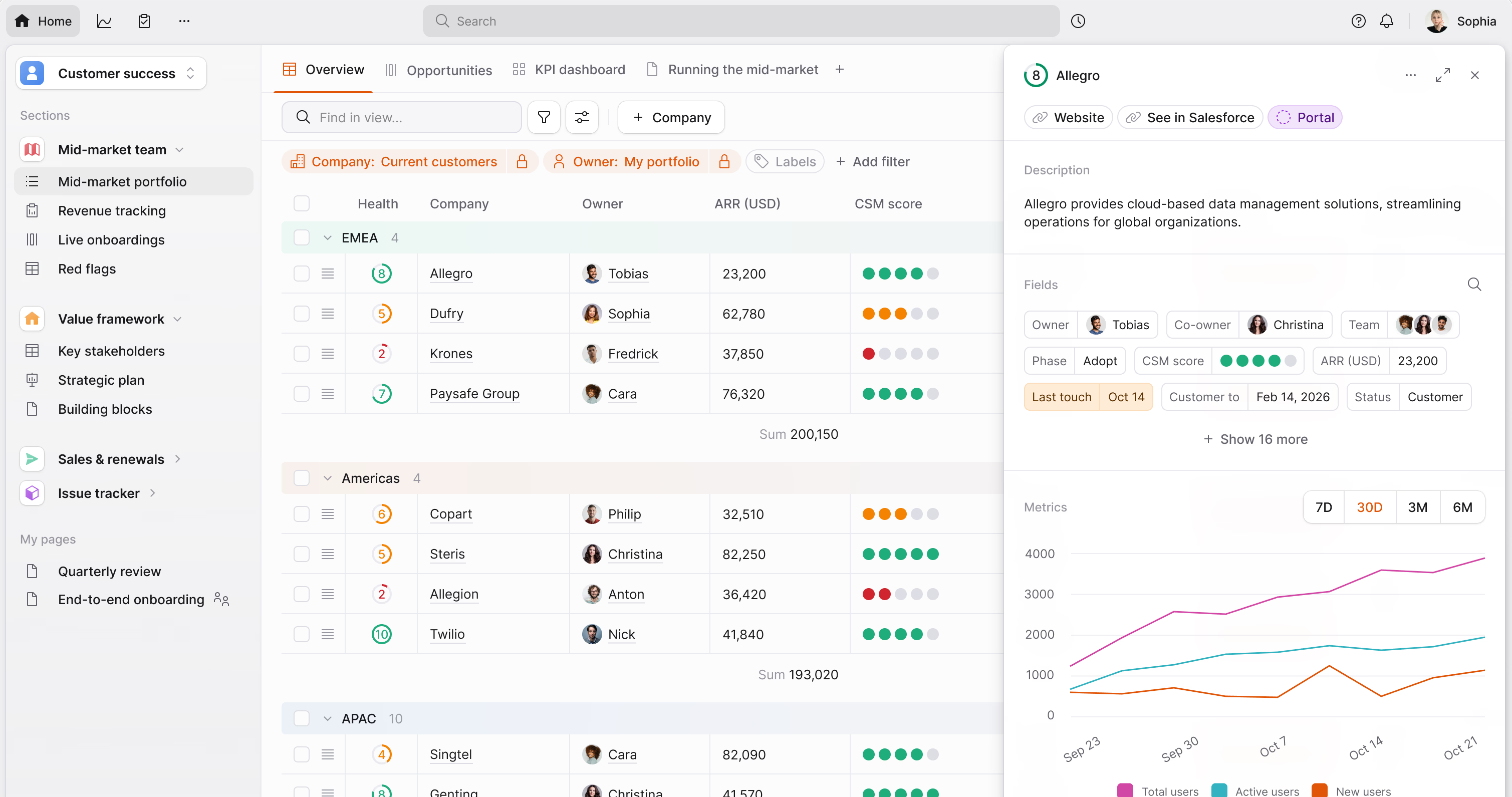
Despite the mildly confusing name, Planhat has gained popularity for its fanatical dedication to making customer data clear and actionable. Its approach is both simple and ambitious: bring everything into one place and make it actually usable. The result is a 360-degree view so comprehensive it borders on voyeuristic.
What's most impressive is what Planhat lets you do with all that unified data. Arthur Favier, founder and CEO of Oppizi, told me that "it brings together commercial, product, and engagement data in a way that gives you a clearer picture of what's actually going on with your customers. It helps you see whether the value you promised during the sales or marketing process is really showing up in the way people use the product."
Planhat excels at revealing patterns in customer behavior through its Data Explorer, which uses conversational AI to let you ask questions like, "Which customers haven't used [feature X] and have a renewal in 60 days?" and get a cohort list instantly. SmartSites SEO strategist Brandy Hastings raved about the revenue workspace. "It connects usage metrics with upsell triggers and turns CS teams into revenue enablers, not just support staff." That's the kind of actionable intelligence that justifies the existence of customer success as a function.
If you need to slice and dice data in specific ways, create complex, multifaceted health scores, or build detailed reports tracking trends over time, Planhat gives you the tools to do so. However, with nearly every conceivable metric and data point available, this can either be exhilarating or overwhelming, depending on your tolerance for information density. And setting it all up correctly requires serious effort and well-structured base data.
Planhat pricing: By request
Reduce churn and simplify workflows with customer success automation
Customer success tools quietly save businesses from the terror of monthly churn reports and the horror of having to explain to investors why all your customers are fleeing like guests at a sleepover where someone suggested a "M*A*S*H" marathon.
But CS software is only as good as the strategy, data, and people behind it. It might help you scale good processes, but it'll also happily help you scale bad ones if you're not careful.
You can't automate your way out of a bad strategy, but you can automate the grunt work that gets in the way of a good one. Zapier brings automation and AI to every part of your business by connecting the apps your entire organization uses and using AI to help identify gaps and opportunities.
Related reading:
This article was originally published in May 2025 by Allisa Boulette. The most recent update, with contributions from Mike Floeck, was in June 2026.