
We independently review every app we recommend in our best apps lists. When you click some of the links on this page, we may earn a commission. Learn more.
If you ask ten SEO professionals which tool they use, at least seven of them will say Ahrefs. The other three are lying. Ahrefs has become so synonymous with SEO research that recommending an alternative can feel a little like suggesting someone replace their morning coffee with lukewarm tap water. And yet, here we are.
Maybe Ahrefs' recent price increases have you looking around, or maybe you just need a tool that's more focused on the job you actually want done—say, content optimization or market intelligence.
Whatever the reason, there are solid Ahrefs alternatives out there that cover everything from enterprise-scale SEO to free keyword research, and a few that go places Ahrefs doesn't even try to go. Here's a breakdown of the best ones, what they're actually good at, and how to figure out which one fits your workflow.
The best Ahrefs alternatives
Semrush for all-in-one SEO and competitor analysis
Similarweb for market and traffic intelligence
Clearscope for SEO content optimization
Surfer for AI-powered content editing
Mangools for beginners
seoClarity for enterprise SEO at scale
Google Keyword Planner for free keyword research
Moz Pro for rank tracking with integrations
What makes the best Ahrefs alternative?
How we evaluate and test apps
Our best apps roundups are written by humans who've spent much of their careers using, testing, and writing about software. Unless explicitly stated, we spend dozens of hours researching and testing apps, using each app as it's intended to be used and evaluating it against the criteria we set for the category. We're never paid for placement in our articles from any app or for links to any site—we value the trust readers put in us to offer authentic evaluations of the categories and apps we review. For more details on our process, read the full rundown of how we select apps to feature on the Zapier blog.
Ahrefs earns its reputation on the strength of its backlink database, keyword analytics, and competitive research tools. If you're looking for an alternative, you're probably after one of a few things: broader functionality, better content optimization features, a lower price point, or a more approachable interface. The best alternatives hold up against at least one of those needs without sacrificing the data quality that makes SEO tools worth using in the first place.
When evaluating Ahrefs alternatives, these are the things that actually matter:
Data quality and freshness. An SEO tool is only as good as its data. The best alternatives offer keyword databases and backlink profiles that are regularly updated and large enough to surface real opportunities, not just the obvious ones everyone's already targeting.
Keyword and competitor research depth. Ahrefs built its reputation here, so any serious alternative needs to offer keyword difficulty scoring, traffic estimates, SERP analysis, and competitive gap tools that are specific enough to act on.
Content optimization features. Ahrefs tells you what to target; it's less prescriptive about how to write it. Tools with built-in content editors, keyword scoring, and on-page recommendations fill that gap.
Value for the feature set. Ahrefs' recent price increases have made it harder to justify at lower usage levels. The best alternatives offer comparable power at a price that makes sense for your team's actual workflow—not a list of features you'll never touch.
Integrations and workflow fit. SEO doesn't happen in a silo. A tool that connects to your CMS, reporting stack, or analytics platform is more useful than one you have to visit separately for every insight.
I've spent a lot of time in SEO tools—both as a content writer who depends on them and as someone who's had to evaluate them for roundups like this one. Here are my picks for the best Ahrefs alternatives, based on that testing and input from other real users.
Ahrefs alternatives at a glance
Best for | Standout feature | Pricing | |
|---|---|---|---|
All-in-one SEO and competitor analysis | Multiple competitor gap tools (Keyword Gap, Backlink Gap, Market Explorer) plus integrated content tools like ContentShake AI | From $117.33/month | |
Market and traffic intelligence | Detailed breakdown of competitor traffic sources (paid, organic, social, etc.) with macro-level market insights | From $125/month | |
SEO content optimization | Real-time content grading with keyword relevance scoring and AI Draft for content creation | From $129/month | |
AI-powered content editing | Content Editor with real-time optimization scoring and SERP Analyzer with detailed benchmarking charts | From $49/month | |
Beginners | Simple, intuitive suite of five SEO tools with clean visualizations and easy learning curve | From $37.70/month | |
Enterprise SEO at scale | Sia AI assistant for bulk SEO tasks like generating metadata and optimizing content at scale | Custom pricing | |
Free keyword research | Free keyword discovery and forecasting tools directly from Google data | Free | |
Rank tracking with integrations | Page Optimization Score offering detailed, per-page SEO recommendations | From $49/month |
Best Ahrefs alternative for all-in-one SEO and competitor analysis
Semrush

Semrush pros:
Massive suite of keyword, rank tracking, and competitor analysis tools
Modular dashboard with customizable widgets
Integrates with Zapier for workflow automation
Semrush cons:
Premium pricing; some key features locked to higher tiers
Can feel overwhelming if you only need a narrow set of tools
If Ahrefs is the gold standard for SEO competitor analysis, Semrush is the one tool that comes closest to matching it—and in some areas, it pushes ahead. These two tools are often positioned as direct competitors, and for good reason: they're targeting the same user, the same workflows, and largely the same data.
What Semrush does better than Ahrefs is breadth. It's less of a rank tracker with extras and more of a full digital marketing platform. You get five dedicated competitor analysis tools, including Keyword Gap for spotting missed ranking opportunities, Backlink Gap for comparing link profiles, and Market Explorer for macro-level market share analysis. Position Tracking gives you customizable daily updates on how specific pages rank for specific keywords, including your competitors' pages alongside yours.
There's also PageImprove, which lets you edit on-page SEO elements like H1s and metadata directly in your browser without touching the CMS, and ContentShake AI, an analytics-driven writing tool that bakes Semrush data into the content creation process. Ridiculous naming conventions aside, it's a meaningful addition for teams that want SEO research and content execution to live closer together.
Where Ahrefs still pulls ahead is keyword database depth and backlink accuracy for pure link analysis. If competitive link research is your primary use case, Semrush is close, but Ahrefs is still the reference point. If you need everything else—rank tracking, content, market intelligence, social analytics, and reporting—Semrush covers more ground in one subscription.
Semrush also integrates with Zapier—so if you want to do something like auto-create project tasks when a site audit finishes and ping the right person in Slack, that's the work of a few Zap workflows, not a custom build. It's a great setup if SEO insights tend to die in a dashboard tab instead of turning into actual work.
Semrush pricing: From $117.33 (billed annually) for the Pro plan, which includes 5 projects, 500 tracked keywords, and keyword/backlink research tools; higher tiers unlock more projects, historical data, and content marketing features.
Best Ahrefs alternative for market and traffic intelligence
Similarweb

Similarweb pros:
Actionable market data across five segmented intelligence products
Reliable, dynamic data sources updated continuously
User-friendly interface that doesn't require an analyst to interpret
Similarweb cons:
Limited granularity on niche or low-traffic sites
AI visibility features require a sales conversation to price
Ahrefs tells you how a competitor ranks for a keyword. Similarweb tells you where all their traffic actually comes from—paid, organic, direct, referral, social—and what it means for your market position. That's a different kind of intelligence, and for teams doing more than just SEO, it's often the more actionable one.
Similarweb collects data across five product segments: Digital Research Intelligence (market audiences, customer journeys), Digital Marketing Intelligence (SEO, keyword research, PPC analysis), Sales Intelligence (lead generation and enrichment), Stock Intelligence, and Shopper Intelligence (consumer demand and on-site SEO). Most users won't need all five, but the marketing and research modules alone are robust enough to replace several separate tools.
What makes Similarweb particularly useful as an Ahrefs alternative is the competitive context it adds. Instead of just seeing that a competitor ranks for a keyword, you're seeing their overall traffic mix, their top traffic sources by category, and how their audience behavior compares to yours. That macro-level view isn't really something Ahrefs offers.
The tradeoff is depth on the SEO side. Similarweb's keyword data and backlink analysis aren't as granular as Ahrefs or Semrush. If pure SEO performance is the goal, you'll feel that gap. But if you're doing competitive market research, benchmarking against industry traffic patterns, or building a sales or marketing strategy with real audience data behind it, Similarweb is the better tool for the job.
Similarweb pricing: From $125/month for the Competitive Intelligence plan for entrepreneurs; AI visibility features priced by request
Best Ahrefs alternative for SEO content optimization
Clearscope

Clearscope pros:
Highly detailed content grading with keyword relevance scoring
AI Draft feature for creating GEO-ready content
Content decay and page performance tracking built in
Clearscope cons:
Limited tool suite outside of content optimization
Monthly credit allotment; premium pricing
If your primary pain point with Ahrefs is that it tells you what keywords to target but doesn't help much with the actual content, Clearscope is the obvious next tool to look at.
The core product is a content optimization interface built around reports. You drop a keyword in, and Clearscope generates a report that gives you a content grade, a readability score, and an extensive list of related keywords ranked by relevance—with color-coded indicators showing how often they appear in competing posts. Write or paste content into the editor, and the grade updates in real time. The term map view shows a visual representation of which related keywords your competitors are clustering around, which is useful for understanding the topical depth a piece needs to rank.
Clearscope's natural evolution into GEO is worth noting. The AI Draft feature has become one of the better AI content creation tools in this space—flexible enough to handle different brand voices and content formats without requiring you to wire up models manually. And the Content Inventory connects your created-with-Clearscope pages to their AI Cited Pages view, closing the gap between what you're publishing and what's actually showing up in LLM responses. For content-first SEO teams, that's a meaningful capability Ahrefs doesn't offer.
Clearscope is a focused tool: it won't track your rankings, audit your site, or tell you what your competitors are doing at the domain level. But for what it does—content optimization, content grading, and increasingly GEO readiness—it does it better than most.
Clearscope pricing: From $129/month (billed annually) for the Essentials plan, which includes 20 tracked topics and 20 drafts; larger teams and custom features available on Business and Enterprise plans.
Best Ahrefs alternative for AI-powered content editing
Surfer

Surfer pros:
AI-driven Content Editor with real-time structure and keyword scoring
SERP Analyzer with interactive competitive benchmarking charts
Exports content directly to WordPress; integrates with Jasper
Surfer cons:
Credits don't roll over; AI articles charged separately on some plans
Fairly expensive for what's primarily a content and audit tool
Surfer handles keyword research, content scoring, and writing assistance all in one interface. The Content Editor is the centerpiece. Feed it a keyword, and it generates a real-time optimization interface that scores your content as you write, suggests related terms by frequency and relevance, and tracks structure against competing posts.
The SERP Analyzer goes further than most comparable tools: an interactive chart shows what the top 48 ranking results average for word count, keyword density, and partial keyword usage, with the ability to sort by backlinks, common phrases, and other keyword overlap. That level of competitive SERP detail actually helps you understand why specific content ranks, not just what ranks. And the keyword clustering in the research tool—organizing topic ideas by user intent before loading them into the editor—helps content teams move from research to brief to draft without bouncing between platforms.
What Surfer doesn't do is domain-level competitive analysis, backlink research, or rank tracking at the depth Ahrefs does. It's a content and audit tool, not a full SEO suite. But if your workflow is primarily keyword research > content creation > on-page optimization, Surfer handles that loop better than Ahrefs does.
Surfer also integrates with Zapier. If your content pipeline runs through something like Airtable, you can wire it so that adding a topic idea automatically kicks off an article build in Surfer and drops the draft into Google Docs—without anyone having to manually hand things off.
Surfer pricing: From $49/month (billed annually) for the Discovery plan, which lets you create or optimize 10 documents and track 10 prompts
Best Ahrefs alternative for beginners
Mangools

Mangools pros:
Clean, intuitive interface designed for accessibility, not complexity
Five well-built tools covering keyword research, SERP analysis, rank tracking, backlinks, and site profiling
White-label reporting available on all plans
Mangools cons:
Daily lookup caps on lower tiers can feel restrictive
Fewer advanced features than enterprise-tier tools
Ahrefs has a learning curve: the interface is dense, the data is rich, and new users often spend a fair amount of time figuring out what they're looking at before they can act on it. If that's part of why you're looking for an alternative, Mangools is the most direct answer.
Mangools packages five dedicated SEO tools into an interface that manages to feel simple without actually being dumbed down.
KWFinder strips keyword research down to the metrics that matter—search volume, keyword difficulty, longtail suggestions—without the overwhelming data dumps that other tools serve up by default.
SERPChecker gives you competitive insight into who's ranking and why.
SERPWatcher tracks ranking changes over time and sends alerts for significant movements.
LinkMiner lets you dig into competitor backlink profiles for link-building opportunities.
SiteProfiler gives a domain overview with authority, trust flow, and traffic estimates.
None of these tools is the deepest version of what it does. SERPChecker won't give you the competitive gap analysis depth of Ahrefs or Semrush, and KWFinder's keyword database is smaller. But what Mangools does extremely well is make SEO approachable to someone who's still building their practice. The visualizations are clean, the metrics are clearly labeled, and the learning curve is gentle enough that you can actually start using it on day one without needing to watch tutorials first.
For beginners who want to improve visibility without getting lost in a sea of complex features—or for solo operators who don't need the full firepower of an enterprise tool—Mangools hits a sweet spot of capability and usability that Ahrefs simply doesn't aim for.
Mangools pricing: From $37.70/month (billed annually) for the Basic plan, which includes limited access to all five tools; higher tiers increase daily limits and add team seats.
Best Ahrefs alternative for enterprise SEO at scale
seoClarity
seoClarity pros:
Sia AI assistant handles bulk optimization tasks at scale
Content Fusion combines keyword research and content creation in one workflow
Covers nearly every SEO function: rank monitoring, content, auditing, competitor analysis
seoClarity cons:
Custom pricing across most tiers; expensive
Interface is functional but fairly bare-bones compared to more modern tools
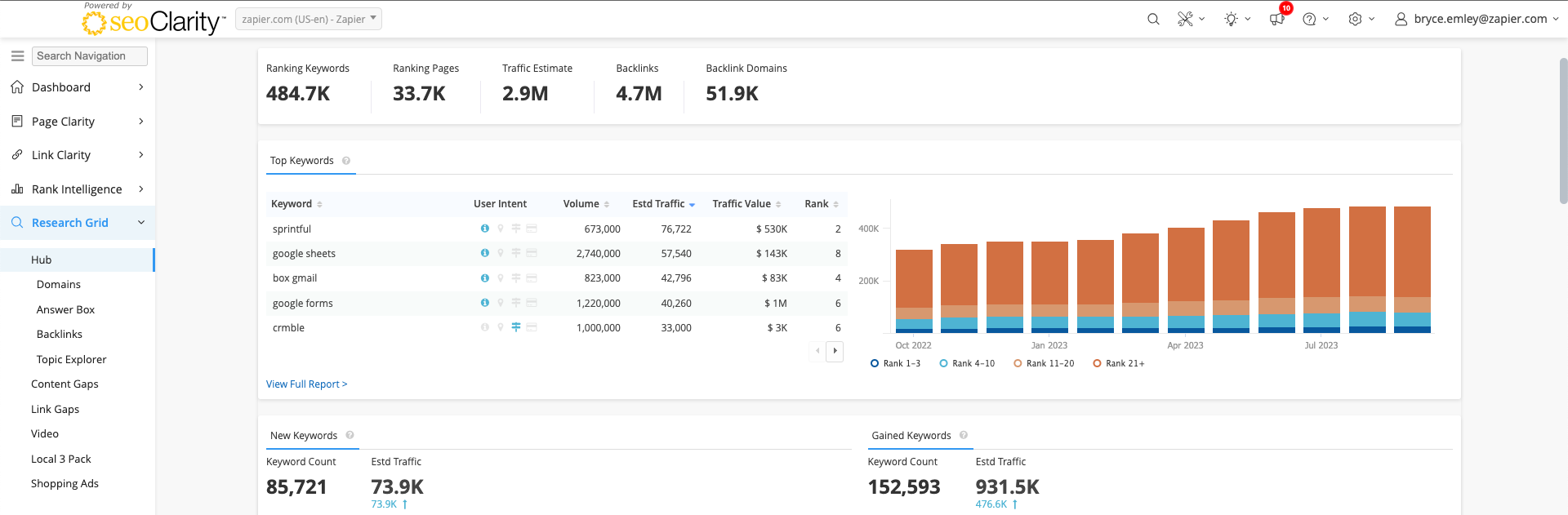
Most enterprise SEO tools are expensive, but with seoClarity, it makes sense: it's trying to replace multiple tools, not just charge more for the same thing. For large organizations running complex SEO operations across many pages, the math might make sense.
The breadth is impressive: seoClarity covers rank monitoring, search trend analysis, competitor analysis, traffic projections, topic exploration, diagnostic insights, page error detection—and then layers a full content creation and optimization suite on top of all of it. The Content Fusion feature lets you load a URL or start from a keyword, generate a brief, and move directly into the content management module without leaving the platform. That's a workflow that would otherwise require Ahrefs for research, Clearscope or Surfer for optimization, and something else entirely for publishing.
What really sets seoClarity apart is Sia—the platform's built-in AI assistant. Sia can auto-generate optimized post titles and meta descriptions based on existing search data, produce outlines, expand sections into full text, and handle bulk tasks like translating and grouping keywords, generating page titles en masse, and creating descriptions at scale. For an SEO team managing thousands of pages, that kind of bulk operation capability is the difference between a roadmap and a realistic execution plan.
The tradeoff is that seoClarity isn't a tool you pick up casually. The interface is functional but dated compared to the more polished options on this list, and pricing is opaque enough that most teams will need to go through a sales conversation before they understand what they're actually buying. But if your organization needs an all-in-one platform that can handle the full SEO lifecycle at scale—without routing every task through multiple tools—seoClarity makes a serious case.
seoClarity pricing: Custom
Best free Ahrefs alternative
Google Keyword Planner

Google Keyword Planner pros:
Completely free, with no time limits or credit caps
Forecasting tools for PPC budget planning
Can pull keyword suggestions directly from your website URL
Google Keyword Planner cons:
Designed primarily for paid search; organic research is secondary
Search volume shown in ranges, not exact figures, without an active ad spend
Google Keyword Planner is free, which is really the only reason it makes this list.
Keyword Planner has two core features. The first is for discovery: enter a seed term, and it generates related keyword ideas with search volume, year-over-year change, competition level, ad impression share, and bid ranges. The second is for depth: search volume and forecasting tools that let you model potential reach and budget for paid campaigns. If you're running or planning Google Ads alongside your organic strategy, the forecasting feature is useful for understanding where organic ranking might save you PPC spend.
The limitation is the same one it's always had: Keyword Planner is built for advertisers, not content strategists. Search volume is displayed in wide ranges ($1K–$10K rather than exact figures) unless you have an active ad campaign, and the organic keyword optimization guidance is minimal compared to a dedicated SEO tool. It also won't tell you how specific pages rank, give you backlink data, or help you close a content gap against a competitor.
But for someone who needs to validate keyword ideas without paying for a subscription, or who wants to inform organic strategy using Google's own data, Keyword Planner is the most reliable free starting point available. It's also the most underrated tool in SEO—largely because it lives inside Google Ads and people assume it's only for paid search.
Google Keyword Planner pricing: Free
Best Ahrefs alternative for rank tracking with integrations
Moz Pro
Moz Pro pros:
Largest ready-made integration gallery of any rank tracker tested
Page Optimization Score gives keyword-level on-page guidance
Strong community resources and documentation
Moz Pro cons:
Fewer tracked keywords per dollar than most competitors
Dashboard visualizations feel dated compared to newer tools
Moz is one of the oldest names in SEO, which means something in a space where new tools appear every few weeks with big promises and small track records. It also means the platform has had two decades to build out integrations with the rest of the marketing stack, and that investment shows.
Moz Pro integrates with apps like HubSpot, WordPress, Google Docs, and other big hitters. For teams running complex digital marketing operations across multiple platforms, that connectivity is often what determines whether an SEO tool actually gets used or becomes one more tab nobody opens. Moz's community and learning library are also really robust—if you're new to the platform or just trying to figure out how to use a specific feature, the documentation and forum resources are better than most competitors offer.
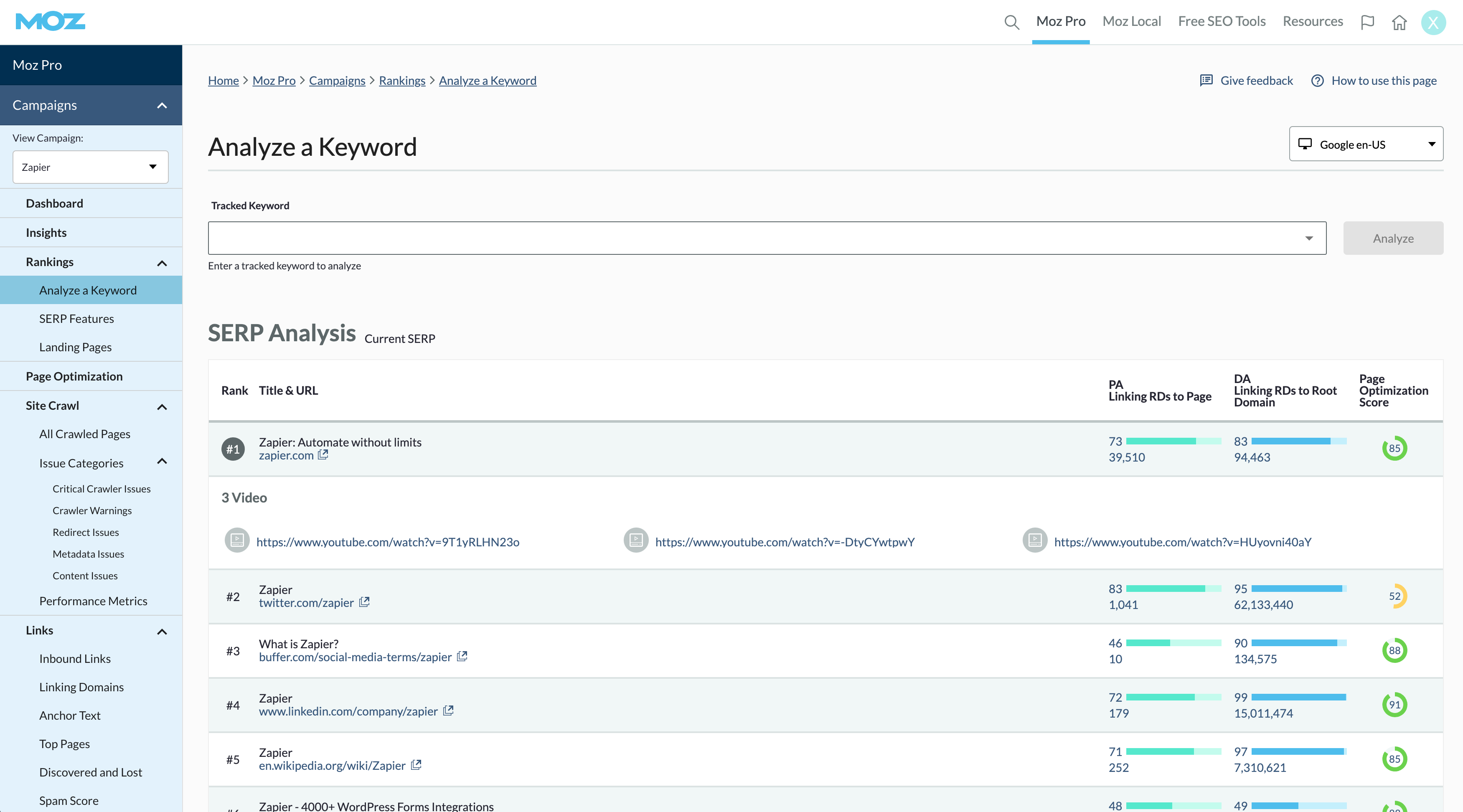
On the SEO side, Moz Pro does what you'd expect from a household name: position tracking, keyword suggestions, site health diagnosis, and competitor analysis. The Page Optimization Score is a standout feature: it pulls up a dedicated interface that grades your target webpage on SEO best practices, breaks down keyword usage across on-page elements, and specifically flags what's helping and what's hurting your score for a given keyword. That level of per-keyword, per-page guidance is more actionable than most dashboard-level metrics.
Moz Pro tracks fewer keywords per dollar than Semrush or Ahrefs, and the interface doesn't have the same polish as newer tools. But if you need a reliable, integrations-friendly rank tracker with a long track record and solid on-page optimization depth, Moz Pro earns its place on the list.
Moz Pro pricing: From $49/month for the Starter plan, which includes 1 user, 50 tracked keywords, and basic site auditing; higher tiers add tracked keywords, campaigns, and additional users.
Which Ahrefs alternative should you choose?
Most of these alternatives aren't trying to beat Ahrefs at its own game; they're solving adjacent problems or doing specific things better for specific teams.
If you're looking for the most direct Ahrefs replacement and have the budget for it, Semrush is the obvious answer. It's the closest thing to a full-spectrum competitor, with more features across more SEO use cases and a track record of its own. But the other options on this list are competent in a specific area: Similarweb for competitive market research, Clearscope and Surfer for content optimization, Mangools for beginners, seoClarity for enterprises, Moz Pro for rank tracking, and even Google Keyword Planner for free keyword research.
Take stock of what you're actually using Ahrefs for (or what you wish it did better), and the right tool on this list should become pretty clear.
Related reading:


