
Yoast SEO remains the undisputed #1 WordPress SEO plugin out there with over 10 million active installations. It's one of the originals, and a firm favorite with WordPress site owners. But a newer option closely competing with it on the charts is Rank Math, with over four million active installations.
I've used both Yoast and Rank Math on my WordPress websites, and found they both have their strengths and weaknesses. For this article, I spent time with both of these WordPress search engine optimization plugins to see how they work, compare their features, and help you choose one for your website.
Table of contents:
Rank Math gives you more global SEO options with website builders
Both plugins make it easy to see how your pages and posts are optimized
Rank Math has more AI features, but they cost more than Yoast
Rank Math vs. Yoast at a glance
Yoast SEO | Rank Math | |
|---|---|---|
Ease of use | ⭐⭐⭐⭐⭐ Clear instructions; good visuals | ⭐⭐⭐⭐⭐ Easy to navigate and use; clear instructions |
Setup | ⭐⭐⭐⭐ Good onboarding experience; easy to set up for everyone | ⭐⭐⭐⭐⭐ Excellent setup with two presets available (Basic and Advanced Modes) |
Keyword optimization | ⭐⭐⭐ 1 keyword per page/post; additional site keywords require paid subscription | ⭐⭐⭐ 1 keyword per page/post; additional site keywords require paid subscription |
Popularity | ⭐⭐⭐⭐ #2 in the rankings for SEO WordPress plugins | ⭐⭐⭐⭐⭐ The top-ranked WordPress SEO plugin |
Pricing* | ⭐⭐⭐ Free for one site; $118.80/year per site for Pro, with package deals available for multiple site owners | ⭐⭐⭐⭐⭐ Free for one site; $107.88/year for unlimited personal sites; additional options for businesses and agencies starting at $335.88/year for 200 websites |
*The free version of each plugin can be used on one site with a single account. Of course, there would be ways around this by using different accounts for each site, but honestly, that's a lot more work than it's worth. If you're a web designer or agency owner who manages multiple sites, it's easier to go with a paid option and leave the complexity behind.
Rank Math offers more features for free
Out of the box, Rank Math offers a lot of features for free and only charges a subscription for the advanced or upgraded version of the service. With Rank Math free, you'll get to use features like:
SEO titles and meta descriptions
Social media descriptions
Basic local SEO schema and optimization
Image SEO
Internal link suggestions
404 monitor
301 and 302 redirects
Basic WooCommerce SEO
These features are modular, so you can easily turn on/off any that you aren't planning to use.

Yoast SEO offers many of these same features, but some are only included in the premium add-ons, such as 301 and 302 redirects, multiple focus keywords per page or post, and local SEO. And if you want to use the WooCommerce add-on, you'll need to subscribe to a separate plugin for $60/year.
Yoast does offer bundles to offset the cost of these additional plugins. But considering you can get the same functionality from Rank Math for free, it might not be much of a choice for you if your budget is $0.
Yoast has better readability analysis features
One area where Yoast SEO excels is with its readability analysis: it breaks out the readability score from the overall SEO score, making it easier to see how your content is doing. This is an important metric because search engines use readability as part of your ranking score.
Yoast SEO uses the Flesch-Kincaid Reading Ease test to analyze your content, checking the length of your sentences, the number of syllables in the words, the use of transition words, and how much passive voice you've used. Plus, it even gives you in-depth tips on improving the score, so you'll know exactly what to change and how.
And if you've got the inclusive language feature turned on, your content is analyzed for seven factors, including age, appearance, gender, disability and neurodiversity, and socioeconomic status.

All of these readability factors help increase your search engine ranking for a couple of reasons: readability demonstrates that your content is easy to understand, and it encourages readers to stay on your site longer. Google sees this and concludes that your site is a good one to recommend to others, boosting it in the SERP.
On the flip side, Rank Math includes the readability score as part of its overall SEO score, so you can't tell how your content is doing. And it only gives you basic notes on how to improve it.
Here's how Yoast SEO and Rank Math rank the same page I drafted on a test website:

As you can see, Yoast gives me a better sense of how my content reads and also gives me concrete tips to improve it directly on my site. Rank Math, instead, displays a 2 Errors message and some vague info on what's wrong. To get help to improve it, I need to click the question mark icon to read a generic help article on their website.
Rank Math gives you more global SEO options with website builders
Setting global SEO options for all content on your website is a time-saver for any website owner or marketer. You can set the baseline SEO settings for everything at once and then change individual pages or posts as needed. And if you're using a website builder (like Divi, Elementor, or Beaver Builder) on your WordPress site, you know how configurable settings can get. Editing every page or post on your site individually because you used a builder would become a full-time job.
That's why both Yoast SEO and Rank Math allow you to set global default SEO settings for posts and pages right out of the box. You can configure it for your home pages, other pages, and posts in both plugins. But where Rank Math shines is that it lets you configure global SEO settings for even more content types and site builders for free than Yoast does—even more than the paid Yoast plugin.
Rank Math integrates with several website builders in its free version. If you use any of these, you'll get additional global SEO settings to modify more than just your home page, posts, and pages. If you have those themes or plugins installed on your site, Rank Math automatically displays the relevant settings on the main Settings page. Adjust these like any other content type, and enjoy additional SEO boosts.
For example, if you use Elementor, you can also configure SEO globally for landing pages in Rank Math. Combine Elementor with the Elementor Header & Footer Builder plugin in Rank Math free, and you can configure SEO for templates, widgets, and more.

Yoast only lets you set the global SEO options for four content types in the free version (home page, posts, projects, and pages) and one more (landing pages) if you use a builder like Elementor; there's no option to add global SEO settings for widgets or templates in Yoast if you use a site builder. Yoast SEO does integrate with Elementor, but you can only set SEO options for individual pages, not global ones like with Rank Math.
Both plugins make it easy to see how well your pages and posts are optimized overall
Both Yoast and Rank Math make it easy to see how well your content is optimized visually. It's displayed on the main Pages or Posts page in your WordPress admin panel and when you navigate to the individual page or post.
On the main pages, both plugins show a color-coded visual telling you how things are going (green = good, yellow = needs improvement, red = bad).

Yoast uses a color-coded dot to show the SEO and readability scores (the red and green dots in the screenshot above) in two separate columns. Having the two scores displayed separately is a nice thing to see and is one thing Yoast does slightly better.
Rank Math displays your SEO score (out of 100) and color-codes it like Yoast. While it doesn't break out the SEO and readability scores, what Rank Math does differently is include the keyword, schema, and hyperlink data. At a glance, you see how well that content is optimized for internal and external linking, which is another factor Google uses to measure content.

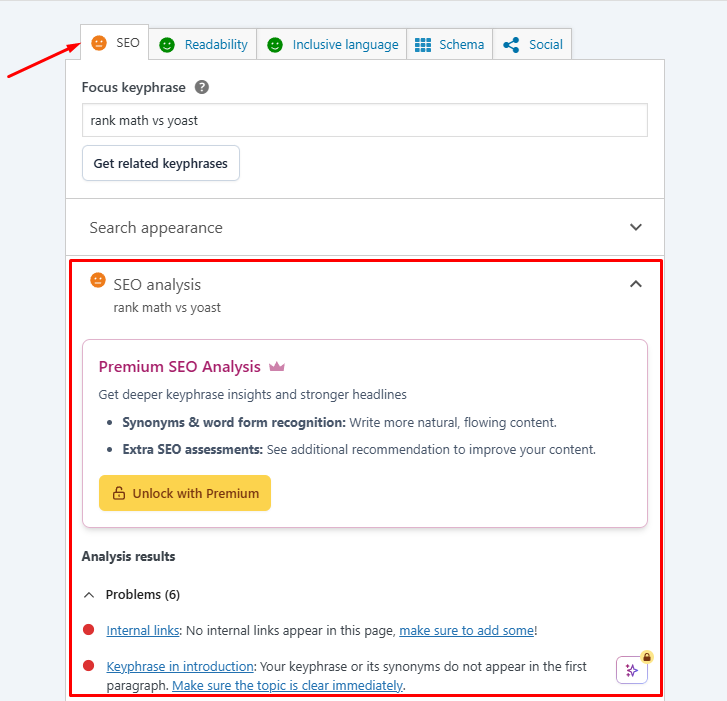
Both plugins show you the SEO optimization level on the individual pages in various spots.
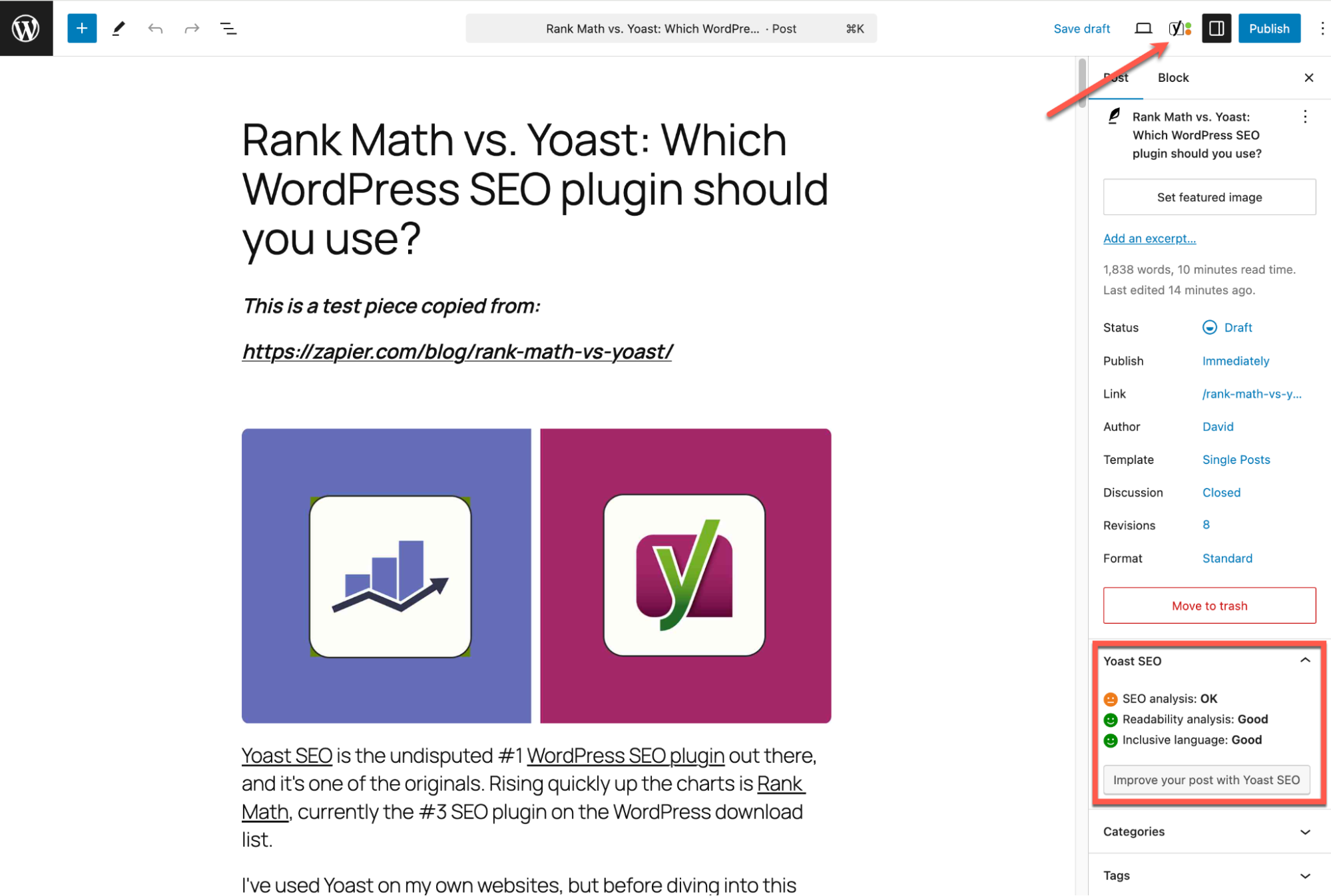
Yoast SEO shows it in two spots:
The upper-right corner of the screen with the traffic lights next to the Yoast logo.
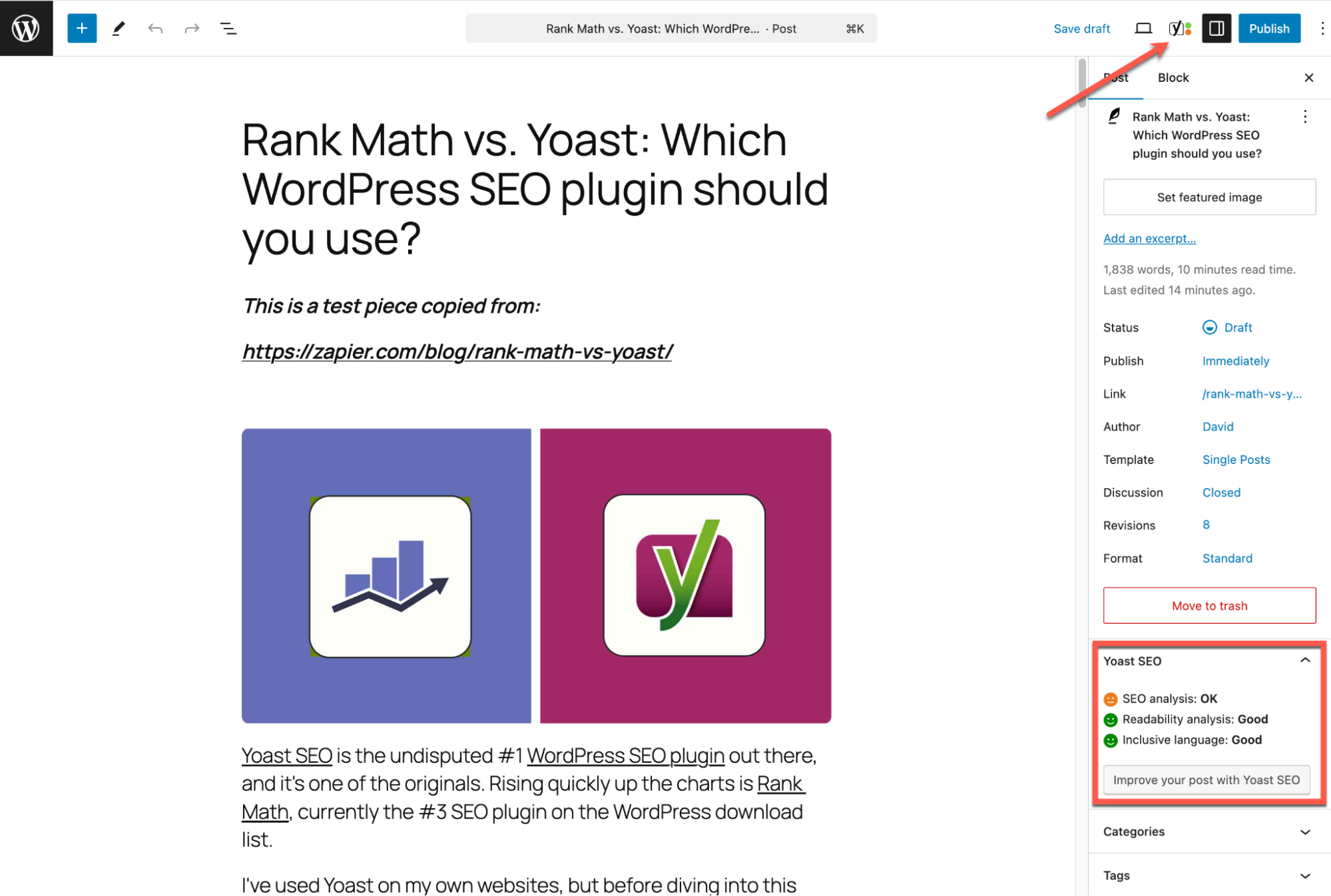
In the Yoast SEO box at the bottom of the page (scroll down from the content to find it).

Rank Math shows it on the right side of the individual page, with the overall score in the upper-right corner.

Rank Math has more AI features, but they cost more than Yoast
With all the talk around AI, it's no surprise that both these apps now include some AI functionality. I haven't actually tested these specific features, but here's how they differ according to the official info.
Rank Math has fully embraced AI by introducing its Content AI module. The collection of 40+ AI tools and 125+ curated AI prompt templates help at every stage of the SEO process, from generating ideas to optimizing content for search engines. For instance, you can use Content AI to:
Receive customized content suggestions tailored to your target audience.
Gain valuable insights on meta tags, OpenGraph, and other crucial elements.
Improve your content using options like Write More, Improve, Summarize, and Fix Grammar.
Content AI is an add-on subscription to the free or premium versions of Rank Math, starting from $83.88/year. It also runs on credits, meaning you'll pay even more if you plan on working with a large amount of text.
Yoast has taken a more cautious approach to AI with three offerings. Yoast AI Generate helps create optimized titles and meta descriptions for your content so it appeals to audiences and search engines. Meanwhile, Yoast AI Optimize suggests edits for your posts and pages, like including more words from your keyphrase in the introduction, which you can dismiss or apply. And Yoast AI Summarize creates a bullet list of key takeaways from your content for better SEO and AEO performance. That's it—for now—but there's nothing extra to pay as it's included in the premium version with zero credits to worry about.
Yoast offers SEO courses as part of your subscription
Both free and premium Yoast users can learn SEO through courses in Yoast SEO Academy. The free courses cover beginner topics such as the basics of structured data and how to use Yoast. Premium courses involve more advanced subjects like technical SEO and SEO for eCommerce.

These courses aren't just videos you can watch on YouTube, either—they provide the full course experience, including videos, worksheets, and quizzes.

This feature won't be super valuable if you already understand SEO, but it could be helpful if you're just starting out. Knowing some of your money will go to SEO courses could make a difference if you were also planning on paying for a different SEO course.
Rank Math, meanwhile, supports its help center articles with YouTube videos on a variety of SEO topics. Since these lessons are on YouTube, you have access to them even if you don’t have Rank Math at all. But they don't have the learning platform features like worksheets and quizzes that could help the SEO knowledge stick.
Rank Math has a much more robust demo than Yoast
Here's another feature difference that won't affect your SEO performance, but it can help if you like to try before you buy. Rank Math has a free demo that lets you test-run all of its free and premium features. Log in to the demo WordPress account to toggle various modules and see how each feature works on pages and posts. The experience feels just like using the plugin in WordPress, except you can't add pages, save pages, or test the AI features.

The closest equivalent for Yoast is the WPDemo demo, but you can only test the free version. So the only way to try any premium Yoast features is to pay for them.
Yoast vs. Rank Math: Which should you use?
Having used Yoast SEO and Rank Math previously and testing out all the latest features, I can confidently say that either is a solid choice for WordPress site owners. They pair well with great content, helping your site move up the search engine rankings and getting more eyes on your content. Here's how I'd break it down.
Choose Yoast SEO if:
You want help with both SEO and your content's readability.
Your site is in a different language (it currently supports 18 languages other than English).
You want to learn more about SEO.
Choose Rank Math if:
You have multiple websites.
You want to try out a wider range of SEO features for free (and scale more affordably).
You want more global SEO options for your website.
While Yoast SEO is the veteran player in the WordPress SEO space, Rank Math has established itself as Yoast's main competitor. Within six years, it gained over four million downloads and a five-star rating. Whichever plugin you pick, your site will be in good hands.
Related reading:
This article was originally published in April 2023 by Julia Borgini. The most recent update, with contributions from Melissa King, was in April 2026.


