We independently review every app we recommend in our best apps lists. When you click some of the links on this page, we may earn a commission. Learn more.
Your brand's reputation now lives inside a new algorithm: one that's based on AI searches made in tools like ChatGPT, Claude, and Gemini. One hallucinated fact, one competitor-favoring answer, and the trust, traffic, and sales can vanish overnight. And with ChatGPT usage soaring and Google's AI answers appearing in nearly half of all searches even on a traditional search engine, the risk (and opportunity) has never been bigger.
Generative engine optimization (GEO) is the next generation of SEO, and using LLM visibility tools is essential for understanding how your brand shows up. These tools track where and how your brand appears in AI responses, flag negative sentiment, and spot when competitors start stealing your spotlight.
I've researched nearly 50 LLM monitoring tools—and tested as many as I could get my hands on—to deliver the definitive shortlist of proven performers. Beyond surface-level features, I'll dig into each tool's ideal applications so you can pick the one that will help amplify your brand's presence in the AI ecosystem.
The best AI visibility tools
OtterlyAI for affordability
Peec AI for smart suggestions
ZipTie for deep analysis and reporting
Similarweb for side-by-side SEO and GEO tracking
Petra Labs for all-in-one enterprise needs
Semrush AI Visibility Toolkit for existing Semrush users
Ahrefs Brand Radar for existing Ahrefs users
Clearscope for content creators
Yext Scout for local tracking
What makes the best AI visibility platform?
How we evaluate and test apps
Our best apps roundups are written by humans who've spent much of their careers using, testing, and writing about software. Unless explicitly stated, we spend dozens of hours researching and testing apps, using each app as it's intended to be used and evaluating it against the criteria we set for the category. We're never paid for placement in our articles from any app or for links to any site—we value the trust readers put in us to offer authentic evaluations of the categories and apps we review. For more details on our process, read the full rundown of how we select apps to feature on the Zapier blog.
When I evaluated these LLM monitoring tools, I didn't just skim product pages. I interacted with them as a user and SEO/GEO expert with skin in the game, creating accounts, watching demo videos, booking product walkthroughs, and reading the product documentation.
Then, when I was able to get hands-on access, I put each AI search optimization tool through scenarios such as those you'd expect to face as a user: monitoring specific brand mentions, discovering which prompts are driving traffic, and brainstorming what new keywords or prompts a brand might want to be associated with. I tested how they handle different AI search engines, dug into reporting capabilities, and also tested the account setup process.
After all that digging, here are the factors I found to be the most important for choosing the best LLM monitoring tool. Just remember: this is such a new software category that no app checks every single box quite yet.
Tracking visibility across all AI engines: LLM outputs vary by platform, so you need visibility into how your brand appears across multiple popular generative engines. This ensures you're not blindsided by gaps in one platform, especially those where your customers hang out most.
Providing insights and action items: Great LLM visibility tools do more than passively monitor—they interpret what's happening and suggest clear, actionable steps to improve brand positioning. Pay extra attention to platforms that proactively share useful research and best practices.
Uncovering trends and patterns: Tracking changes over time helps you spot patterns, whether your brand's visibility is rising, slipping, or reacting to competitor moves—enabling you to respond proactively. Prioritize tools that offer at-a-glance trend oversight.
Exploring conversation data (not just the outputs): Understanding the full context of how users interact with AI engines—including follow-up questions, conversation flow, and the nuanced ways your brand appears throughout multi-turn exchanges—provides deeper insights than simply tracking final outputs. This helps you identify opportunities to appear in related queries and understand the customer journey within AI conversations.
Citation source detection: When LLMs cite sources, you want to know which ones. This helps identify high-performing internal pages, potential misinformation sources, and partnership opportunities.
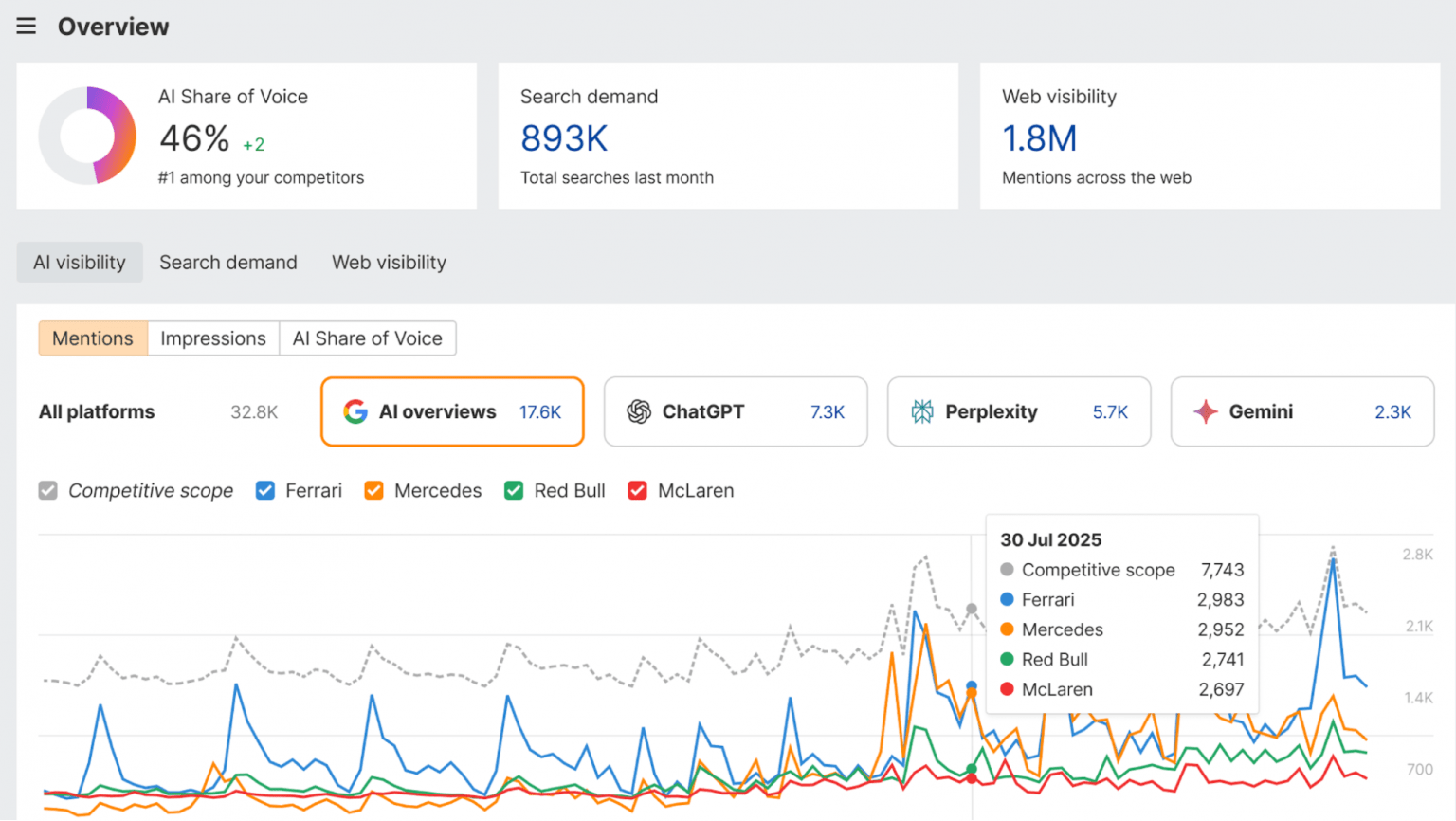
Brand visibility scoring (also known as share of voice): Quantifying how your brand shows up in AI outputs compared to competitors and changes over time helps to measure progress and set concrete goals.
Brand sentiment analysis: It's not just about whether you're mentioned, but how. Sentiment analysis helps you track the emotional tone of AI mentions so you can take steps to safeguard brand perception.
Competitor benchmarking: Benchmarking against competitors shows whether you're leading, lagging, or keeping pace.
AI crawler visibility/technical analysis: This helps you determine if your pages are structured and accessible for AI-driven indexing (and gives you something tangible to focus on if they aren't). Keep in mind that best practices are still being established and constantly changing, but it's good to start somewhere.
Integration features: I handed out bonus points for the LLM visibility tools that play nicely with workflow tools like Zapier for seamless automation.
It's also worth noting that some tools (like ZipTie) track LLM responses using methods that mimic real user behavior rather than relying solely on APIs. This approach can produce more accurate results since it better reflects what actual users see.
There's just a little caveat: LLMs are non-deterministic by nature, meaning the same prompt on the same answer engine at the same time can still produce variations in responses. It's more art than science at this point, so you should expect some fluctuation in the results.
Lastly, when choosing a platform, you should factor in your available budget and the value of the offering. In addition to the features mentioned previously, you'll also want to determine the cost per prompt, how it grows in terms of how often you run it, how many AI search engines you're tracking, and the specific geographical regions you're targeting.
The best LLM monitoring tools at a glance
Best for | Pricing | |
|---|---|---|
Affordability | Free trial available; from $29/month | |
Smart suggestions | Free trial available; from $95/month | |
Deep analysis and reporting
| From $35.63/month | |
Side-by-side SEO and GEO tracking | By request | |
All-in-one enterprise needs | Custom pricing from $15,000/month | |
Existing Semrush users | From $99/month | |
Benchmarking brand performance | Add-on from $199/month | |
Content creators | From $129/month | |
Local tracking | By request |
Note: The LLM monitoring space is evolving rapidly, with new features being added regularly. I recommend checking each tool's current capabilities directly, as features may have been added since this article was last updated.
Best AI monitoring tool for affordability
OtterlyAI

OtterlyAI pros:
Lite plan has an affordable price for small teams and freelancers
GEO and content audits to help you optimize your content
Suggests LLM prompts based on your SEO keywords
OtterlyAI cons:
Limited recommendations and AI engine support unless you pay for a Standard plan or add-ons
Not as robust as more expensive options
OtterlyAI comes highly recommended in SEO circles and stands out as one of the most affordable tools for getting started on the market currently, making it accessible to freelancers and smaller teams that don't operate with enterprise budgets.
The account setup process is straightforward. And a major benefit for those already tracking SEO results is that it turns your target keywords into related LLM prompts. It also has a neat GEO audit feature, which helps you understand how to optimize existing content for better LLM visibility.
OtterlyAI's answer engine tracking covers a lot of the main players, but you'll want to check to make sure it includes those where your target audience hangs out, and whether accessing the most relevant data comes at an extra cost that ultimately makes it less affordable. And if you don't want to opt for the $189/month Standard plan or above, you'll also need to decide whether you can do without crawler traffic analysis or unlimited optimization recommendations.
Ultimately, the value of using a tool like OtterlyAI is that it's affordable and straightforward enough to just get started, while still offering multiple ways to monitor and improve brand visibility.
OtterlyAI pricing: From $29/month for the Lite plan, which includes the daily tracking of 15 prompts and tracks Google AI Overviews, ChatGPT, Perplexity, and Microsoft Copilot. Claude, Google AI Mode, and Gemini are available as extra add-ons.
Best LLM monitoring tool for smart suggestions
Peec AI

Peec AI pros:
Pitch Projects feature lets you share AI visibility reports
Easy to navigate
Data included with each prompt is generous
Peec AI cons:
Lacking trend data
Only tracks three answer engines in baseline plans
Peec AI is another top contender for enterprise marketing teams and agencies alike. I was initially pulled in by their Pitch Projects, designed to help you win new business by sharing AI visibility reports, including brand data relative to competitors.
It has a straightforward and friendly user interface, and there's a Google Data Studio connector to incorporate live visibility and source data into dashboards—a nice touch.
Peec operates with a baseline layer of smart AI suggestions, offering ideas for the most relevant prompts and competitors to track. And compared to some other options on this list, the data included with each prompt is generous: daily tracking, unlimited countries, and all models included with your plan. In my daily GEO work, Peec shows me the AI outputs and citations people use to compare different products, so I know how to position my clients' products as the top choice.
But beyond that, Peec AI is notably lacking trend data and AI crawler visibility insights. And while it works with six AI models in its Starter, Pro, and Advanced plans, you can only pick three of those available choices unless you pay for additional models. You'll also have to shell out for the Enterprise plan if you want access to models like Claude and DeepSeek.
Peec AI pricing: Free trial available; from $95/month for the Starter plan, which includes tracking for 50 prompts across three supported engines of your choice.
Best AI visibility tool for deep analysis and reporting
ZipTie

ZipTie pros:
Descriptive, detailed insights
Granular filtering options
AI Success Score to see how things look at a glance
ZipTie cons:
No conversation data
Charges for each tracked AI engine
For teams hoping to drill into GEO data at a very granular level, ZipTie is a great fit. For starters, the in-app insights offer descriptive details about the most important inputs and your brand's LLM visibility performance. It also offers deeper analysis and robust filtering at the URL level (not just the domain level), by query, and by AI platform. And it identifies the most influential URLs targeting relevant queries you've set up, which is very useful for examining content.
To understand your brand's LLM visibility performance at a glance, ZipTie's proprietary AI Success Score offers an estimate based on tracked mentions, overall sentiment analyzed, and inclusion in citations. ZipTie also offers a technical GEO audit in the form of Indexation Audits, which analyze URLs to understand whether there are any issues preventing indexation by LLM bots.
Plus, ZipTie has an in-platform content optimization tool that identifies questions for which your existing content could provide better answers, plus suggestions for where in the content to incorporate the answers.
While ZipTie certainly excels when it comes to useful data, there's a notable exclusion compared to some other offerings on this list: conversation data. ZipTie also charges for each engine you track, which can be another major limitation for folks hoping to choose more than a handful at an affordable price.
ZipTie pricing: Customizable pricing plans beginning with the Starter preset at $35.63/month
Best LLM SEO tool for side-by-side SEO and GEO tracking
Similarweb

Similarweb pros:
Access to SEO and GEO data for better understanding of your visibility
GA4-type reports for crawler traffic and topic performance
Includes AI ads tracking
Similarweb cons:
User reports of data inaccuracies for smaller businesses
No public pricing
Similarweb has built a reputation as a reliable source of web traffic data. Its public data is useful for competitor and industry benchmarking across a variety of use cases, including SEO and prospect research.
This data-backed approach now covers the world of AI visibility tracking, combining SEO and GEO data in a way I found particularly useful. Using the AI Brand Visibility tool, you can identify the top prompts that are driving traffic, the top sources for a given topic, and traffic distribution to see which AI channels are bringing you the most traffic.
One unique feature is that Similarweb tracks referral traffic from AI chatbots as GA4-type reports and identifies the overall topic themes bringing the most traffic. That's actionable information for improving your content and site for GEO.
Keep in mind, though, that some users report inaccuracies in Similarweb's traffic data, especially for smaller businesses. Similarweb's AI visibility tracking may work more effectively for midmarket or enterprise companies.
Similarweb AI visibility tools pricing: By request; free demo available
Best AI visibility tool for all-in-one enterprise needs
Petra Labs

Petra Labs pros:
Singles out final citations in AI responses
Tracks your individual brand channels' appearance in AI
Differentiation between brands and sub-brands
Petra Labs cons:
High monthly price that makes it inaccessible to small and midmarket businesses
Not ideal for teams that want to handle their own GEO
Massive datasets and fierce competition make AI visibility extra tricky for enterprise businesses. Petra Labs combines proprietary technology with GEO consulting to give enterprises a leg up on their competition.
Full disclosure: Zapier uses both Petra Labs' software and GEO services to improve its AI visibility. But that means the Zapier team has firsthand experience with the product and the team that I was able to verify. Janine Anderson, Senior Web Marketing Manager, told me: "The white-glove service provided by Petra is unmatched. I can go to them with any question, at any time, and they'll help me get the data and analyze it in a way that anyone on my team can understand."
Petra Labs' granularity helps you make sense of all the AI data points that enterprises look at. The app singles out the sites that actually appear in AI's final citations, so you know which ones are the biggest competitors to target—or where to get your brand mentioned. And I like how it separates mentions of your brands and sub-brands—super handy when you have a lot of products to track.
If it sounds like this is dense software to work with, that's because it is. But unlike with a lot of other platforms, you're not staring blankly at the data or asking an AI bot to help you make sense of it. Petra Labs' GEO team can build a strategy based on all that info for you and execute on it with content marketing and digital PR. "AI visibility is such a moving target," Janine told me. "Petra is able to help us stay agile, so we know we're not missing anything important."
These bespoke solutions come with a hefty price tag, though. Monthly costs start at $15,000, with the typical annual total coming to $250,000 to $600,000. Enterprises with complex LLM visibility needs may find it worth it, especially as the AI visibility landscape shifts under our feet by the second, but the cost isn't feasible for many businesses.
Petra Labs pricing: Custom pricing from $15,000/month
Best LLM visibility tool for existing Semrush users
Semrush AI Visibility Toolkit

Semrush pros:
Combines AI visibility tracking with a trusted SEO tool
Tracks brand mentions, prompts, citations, sentiment, and competitor visibility across major AI platforms
Semrush cons:
Charges for more users
May be more platform than you need if you want only lightweight AI visibility tracking
Semrush's AI Toolkit is a solid option if you're already in the Semrush ecosystem and want one place to manage SEO data and AI search tracking.
This tool operates an extensive prompt database: 317+ million prompts in total. And while not exhaustive compared to other options on this list, it tracks many of the most popular answer engines, including ChatGPT, Google AI, Gemini, and Perplexity.
Where Semrush stands out is actionability. If competitors appear more often in AI search engines, Semrush makes it easy to move directly into things like content optimization, backlink analysis, site audits, and competitive research to understand what needs fixing.
Semrush's AI Toolkit is available as an add-on for existing Semrush users. But keep in mind that while a lot of AI visibility platforms don't charge based on how many users need access, Semrush does. Also, after its recent acquisition of Semrush, Adobe announced that it will use Semrush's AI visibility data in its Brand Visibility platform, so it's unclear if the AI Toolkit will stick around.
Semrush also integrates with Zapier, so you can connect Semrush with 9,000+ apps and orchestrate workflows across your tech stack. For example, you can do things like send notifications for completed audits, get an AI-generated summary of the audit in Slack, and create tasks based on results. Learn more about how to automate Semrush.
Semrush AI Toolkit pricing: Available as an add-on for existing Semrush users, starting at $99/month/domain/sub-user for tracking across ChatGPT, Google AI, Gemini, and Perplexity
Best AI search visibility tool for existing Ahrefs users
Ahrefs Brand Radar

Ahrefs Brand Radar pros:
Built into a trusted platform
Straightforward yet info-packed interface
Great for benchmarking against competitors
Ahrefs Brand Radar cons:
Pricier than other options
There are better choices out there if you don't already use Ahrefs
Ahrefs' Brand Radar lives up to its name by offering a streamlined, focused approach to monitoring your brand's performance across major AI platforms. It's a solid option for benchmarking brand performance against competitors, and its straightforward interface makes it easy to assess where you stand in terms of AI visibility. And just like with Semrush, if you already use Ahrefs for SEO, it's easy to add Brand Radar to your toolkit.
To some extent, it makes sense to stick with tools that you're already familiar with, especially if they can connect the dots between SEO and GEO. Plus, if you already use the Ahrefs MCP to work with SEO data in your AI tools, you can also pull from Brand Radar data. Just know that Ahrefs Brand Radar's current offering involves more limited data and more of a limited focus than its broader SEO suite, though it's still comprehensive.
Regardless, Ahrefs is super easy to use, and that extends to the Brand Radar tool. Its high monthly price takes it out of the running for businesses with tight budgets, but you do get what you pay for.
Ahrefs Brand Radar pricing: Add-on available in addition to your existing Ahrefs plan (free or paid), at $199/month, tracking Google AI Overviews, Google AI Mode, ChatGPT, Perplexity, Gemini, and Copilot
Best LLM monitoring tool for content creators
Clearscope

Clearscope pros:
A leader in content optimization, now adapted to GEO
Excellent GEO content creation tool
Connects your Clearscope-created pages with your cited pages
Clearscope cons:
Metered custom prompt tracking
LLM tracking limited to ChatGPT, Gemini, and Perplexity
Clearscope's LLM visibility solution is a natural evolution of its existing SEO content optimization tool, making it an especially good fit for those on the content side of SEO who are adapting to the GEO era.
Its GEO features integrate nicely with the existing toolset, while also expanding its usefulness. For example, Clearscope has a Content Inventory feature that tracks the pages you've created with its tool, which now connects with its AI Cited Pages view to close the gap between what you're creating and what's actually driving LLM visibility results.
Paired with Clearscope's content optimization tool, the AI Draft feature is one of the best AI content creation tools I've tried. It's flexible enough to handle different brand voices, content formats, and outline customization—while abstracting some of the AI complexity going on behind the scenes.
Clearscope's approach to GEO is fundamentally grounded in SEO best practices, including how it measures a brand's share of voice. The Topic Exploration feature goes beyond a primary keyword focus to a topic clustering/fan out approach, so you're effectively addressing the breadth of the topics relevant to your offerings.
Because Clearscope is laser-focused on content SEO and GEO, it makes a great addition to your workflow, but you might need to use it in tandem with other tools to get things like competitor benchmarking. Its LLM tracking is also currently limited to ChatGPT, Gemini, and Perplexity.
Clearscope pricing: From $129/month for the Essentials plan
Best AI visibility platform for local tracking
Yext Scout

Yext Scout pros:
AI visibility by individual brand location
Agents that improve your location-based visibility for you
Connects to a broader suite of brand visibility tools
Yext Scout cons:
Works best alongside the rest of the Yext platform
Designed for enterprises, making it too powerful for small and midmarket businesses
A lot of AI visibility trackers tell you how your brand shows up nationally. But that scope becomes an issue when your company has multiple locations, and you want to know how each one appears in AI. Yext's Scout tool breaks down AI brand monitoring by location.
My favorite Yext Scout feature is its map showing how much visibility each of your locations has in high-intent searches based on engine data from the big players, like ChatGPT, Gemini, Claude, and Perplexity. Hexagons in various colors show your visibility in the corresponding location, so you can know how each of your branches is doing at a glance.
Based on this location data, Yext Scout also recommends actions that you can send agents to perform across Yext's marketing tools. These agents do require you to use the rest of the Yext platform, which could be a negative if you're just looking for an AI visibility tool.
But if you're willing to go all in on Yext, Scout offers similarly powerful features to other tools on this list. It measures performance against your 20 closest competitors per scan, based on location and trends, so you know which nearby businesses are showing up in AI. Sentiment analysis brings up recurring themes in AI outputs related to your brand, and citation tracking shows which sources those answers use to pinpoint what content to change.
As with the rest of the Yext platform, Yext Scout has a very specific user in mind—enterprises with hundreds to thousands of locations. So if you run a handful of sites, your business might be a little too local to get the most out of Yext Scout.
Yext Scout pricing: By request; third-party pricing info suggests at least $199/month
Which LLM monitoring tool should you choose?
Unfortunately, to get everything you want out of an AI visibility tool right now, you may need to use (and pay for) more than one. But even if you're willing to pay top dollar, measuring LLM visibility is still a bit of a black box. In a sense, we're trying to find a way to work around and measure data that the LLMs are currently locking up.
Plus, there are new AI visibility tools popping up left and right as GEO grows as a specialty. A few tools I tested that hit on a lot of the important features and almost made the list include: Goodie, Amplitude, AthenaHQ, Am I on AI?, Rankshift, XFunnel, Knowatoa, Waikay, Evertune, Superlines, RankScale, Scrunch, and SISTRIX.
Yes, it's a little messy and definitely imperfect, but waiting for perfect data means missing the opportunity to shape how AI platforms talk about your brand right now—and that's a risk no forward-thinking marketer can afford to take.
Related reading:
This article was originally published in November 2025. The most recent update, with contributions from Melissa King, was in September 2026.