How one Miro employee took peer feedback from 50% to 93% participation in eight weeks
Nick Krekis built two AI-powered people operations systems in under a year, both designed around the people on the other end
Nick Krekis was part of a four-person tiger team bringing AI agents into Miro.
Challenge
Miro's engineering org ran a peer feedback cycle every performance period. Participation sat at 50%. Around 400 reviews submitted from a team of engineers who gave each other feedback constantly in every other context.
The problem wasn't culture. Engineers were giving feedback all day in Slack, on Miro boards, in calls. The formal system just made it painful:
• The requester: Got a generic message in a large Slack channel, pointing them to HR software they'd only opened to book a holiday.
• The reviewer: Couldn't see how many reviews they still owed.
• The manager: Had to open each review individually, copy it into a Google Doc, go back, open the next one, repeat.
Nick Krekis and Sean Dixon, former head of people technology at Miro, had eight weeks before the next performance cycle.
"For most managers, people management is their second or third job at best. Yet we keep designing HR processes that assume they will stop everything, context switch into an unfamiliar system, and do something that feels like admin."
Solution
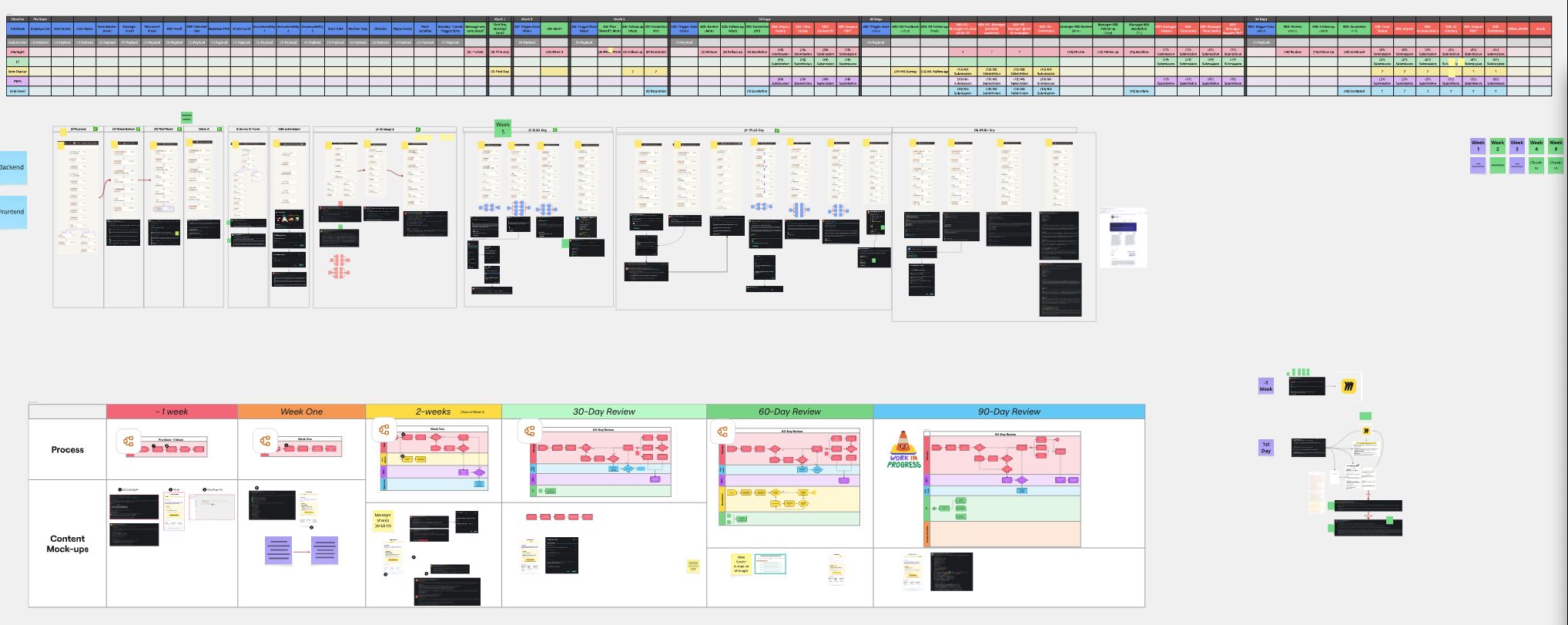
Nick mapped five personas on a Miro board before opening Zapier. His instinct: start with the finished product, then work backward. The first thing he showed the engineering team was the end state: a Slack notification, a formatted HTML email, three peer reviews organized and ready to read.
Then he broke the full process into three workflows (nominations, collecting reviews, sharing results) and mapped every decision tree.
Nominations
A Zap reads from a Zapier Table, finds each engineer by their Miro email in Slack, and sends a personal DM. Not a broadcast. The message opens a Slack workflow: confirm your manager, select nominees from a dropdown, submit. That's the engineer's entire experience.
Collection
Scheduled push messages for people with outstanding reviews, plus a pull mechanism: a pinned workflow in the engineering Slack channel where anyone can check their own status and submit. Google Sheets runs the conditional logic. Zapier Paths handles branching: someone with two reviews gets a different email build than someone with three.
Delivery
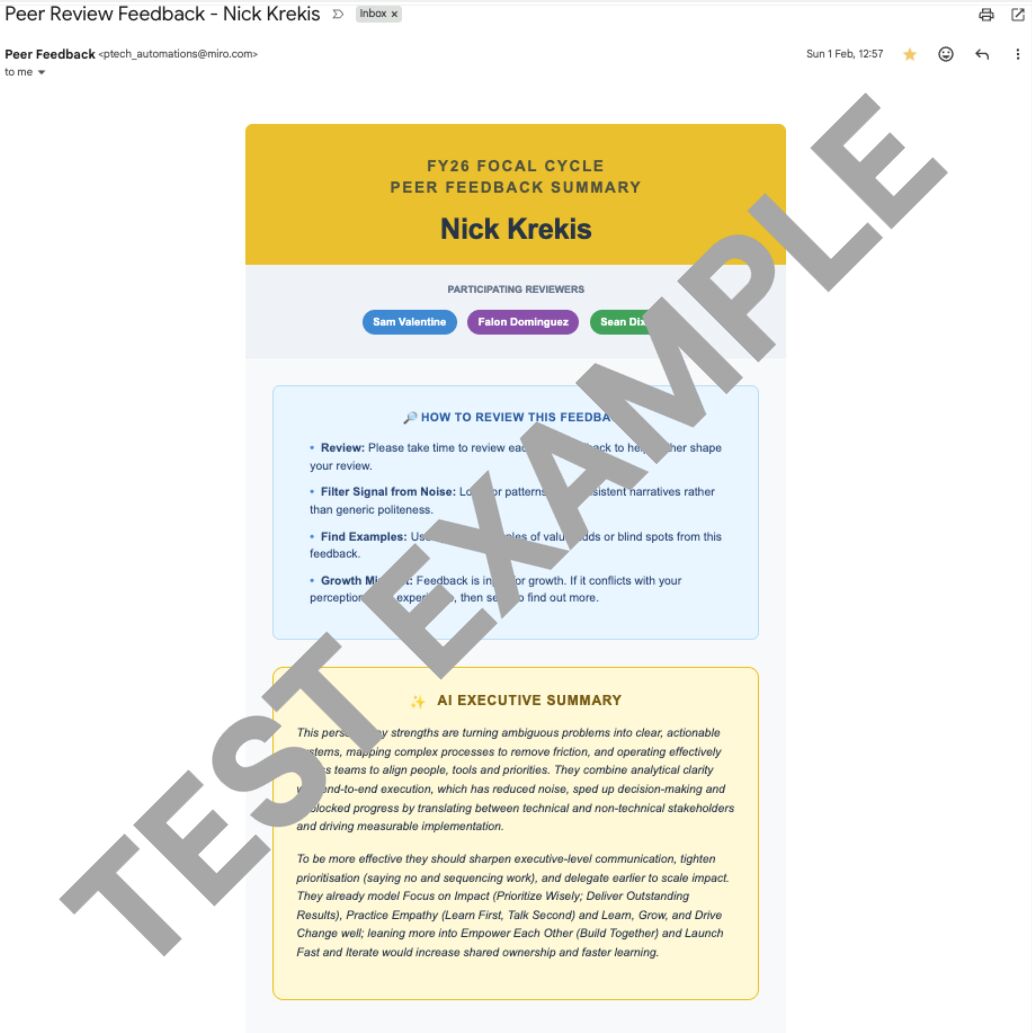
AI generates a summary from the verbatim responses. Everything goes back as a formatted HTML email: summary up top, full feedback below. Then a batch upload pushes the data back to Workday. The core HR system never changed.
"I want our core HR system to be stable, secure, and boring. I make no apology for that whatsoever. Rather than trying to fight that, we worked around it."
Results
Participation went from 50% to 93%. Reviews went from roughly 400 to over 1,600. Nick built a live adoption dashboard alongside the system, showing day-by-day completion rates. If a message wasn't converting, he adjusted in real time.
Every day they sent a nudge, participation jumped roughly 10%. The team didn't pull the previous year's benchmark until near the end of the cycle. When they compared, they'd nearly doubled expectations.
"The results definitely exceeded where we were at, moving from 43% to 93% was a great accomplishment."
Then he built a second system
With the feedback system live, Nick had room to breathe. Three months this time, not eight weeks. And he wasn't fixing something broken. He was building something Miro had never had: a structured 90-day onboarding path between new hires and their managers.
The full architecture: 25-step automation, each step linked to specific data fields on a Miro board. Three layers: architecture, backend, engagement.
At week three, a Gemini Gem walks the manager through four expectation-setting questions. At every 30-, 60-, and 90-day milestone, the system resurfaces those original expectations so the manager evaluates progress against what they wrote. No searching for the doc. No context switching.
If a new hire is off track, the manager triggers what Nick calls the "doorbell": the system creates a thread with their People Business Partner, pre-loaded with all 90-day context. The PBP walks in already knowing the full picture.
The playbook
Nick's framework for anyone building AI transformation inside a company:
• Find the early adopters: Don't tell 300 people to figure it out on their own.
• Build them into champions: Get leadership to amplify their examples.
• Architecture over tools: Individual productivity gains are 10% improvements. Redesigning the workflow is where the 10x lives.
• Discovery first: "There are so many places that you can start. The difficulty is leadership saying everyone needs to be using AI right now. But that's not how you get to the force multiplier effect."
"The architecture layer is so much more important than just 'hey, go play with this tool.'"
Read more customer stories
How Superhuman scales operations across marketing and support with Zapier