Zapier vs. Composio
Published: 9/16/2026 | by Ryan Kane
Composio gives developers a secure way to hand AI agents access to outside apps without exposing raw credentials, and it's good at that one job. But it stops there: there's no visual builder, no workflow engine, and no path for anyone on your team who isn't comfortable writing Python or TypeScript. Zapier does the same credential brokering, then adds everything Composio leaves out: a no-code visual builder, deterministic AI, data capture, structured data storage, and process mapping, all governed from one place.
Here's what you'll get with Zapier:
Build without writing a line of code: Zapier's AI copilot, visual builder, and MCP server let anyone on your team ship a working automation, while Composio requires Python or TypeScript and a working knowledge of agent frameworks.
Connect 9x more apps: 9,000+ integrations, governed by Zapier, versus Composio's roughly 1,000 developer-focused toolkits.
Pay one predictable rate: Zapier bills by completed task. Composio meters tool calls, trigger events, premium tools, LLM tokens, and connected accounts separately, so your bill depends on four different usage dimensions instead of one.

Comparison
Compare Zapier and Composio pricing, integrations, and more
Reviews
See why customers choose Zapier
Features
Review Zapier and Composio features in depth
FAQ
Get answers to your questions
Composio vs. Zapier comparison
| Zapier | Composio | |
|---|---|---|
| Overview | Zapier is a no-code AI orchestration platform that gives agents secure, governed access to 9,000+ apps across an organization | Composio is a developer-first integration and authentication layer that gives AI agents secure tool-calling access to apps |
| Implementation | Minutes to a working automation via Zapier Copilot, the visual builder, Zapier MCP, or the Zapier CLI | A few lines of Python or TypeScript to your first tool call, assuming you already have a dev environment and an LLM API key configured (and know what that means) |
| Integrations | 9,000+ apps, governed by Zapier, plus Zapier MCP and the Zapier SDK for any AI client or codebase | ~1,000 toolkits focused on developer and enterprise apps; custom toolkits require ongoing upkeep |
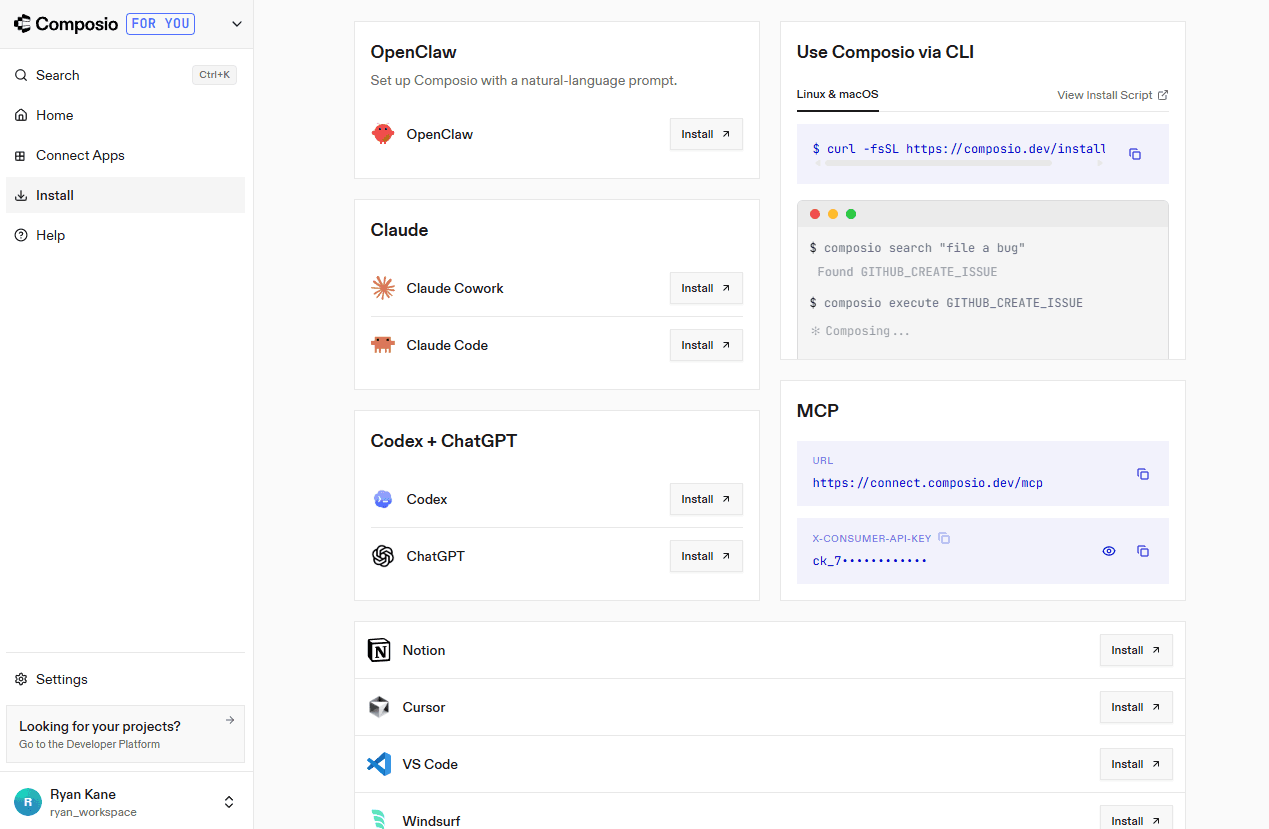
| Ease of use | No-code editor and AI copilot let anyone on the team build and modify automations | Developer platform requires Python or TypeScript; Composio For You offers a no-code layer for connecting AI chat tools, but it isn't a workflow platform |
| AI capabilities | Agentic AI steps—tool calling, multi-step reasoning, human-in-the-loop checkpoints—mixed with deterministic logic, plus native MCP/SDK/CLI support | Sandboxed code execution and just-in-time tool loading, with native SDKs for the OpenAI Agents SDK, Vercel AI SDK, and Claude Agent SDK (LangChain and CrewAI connect via MCP) |
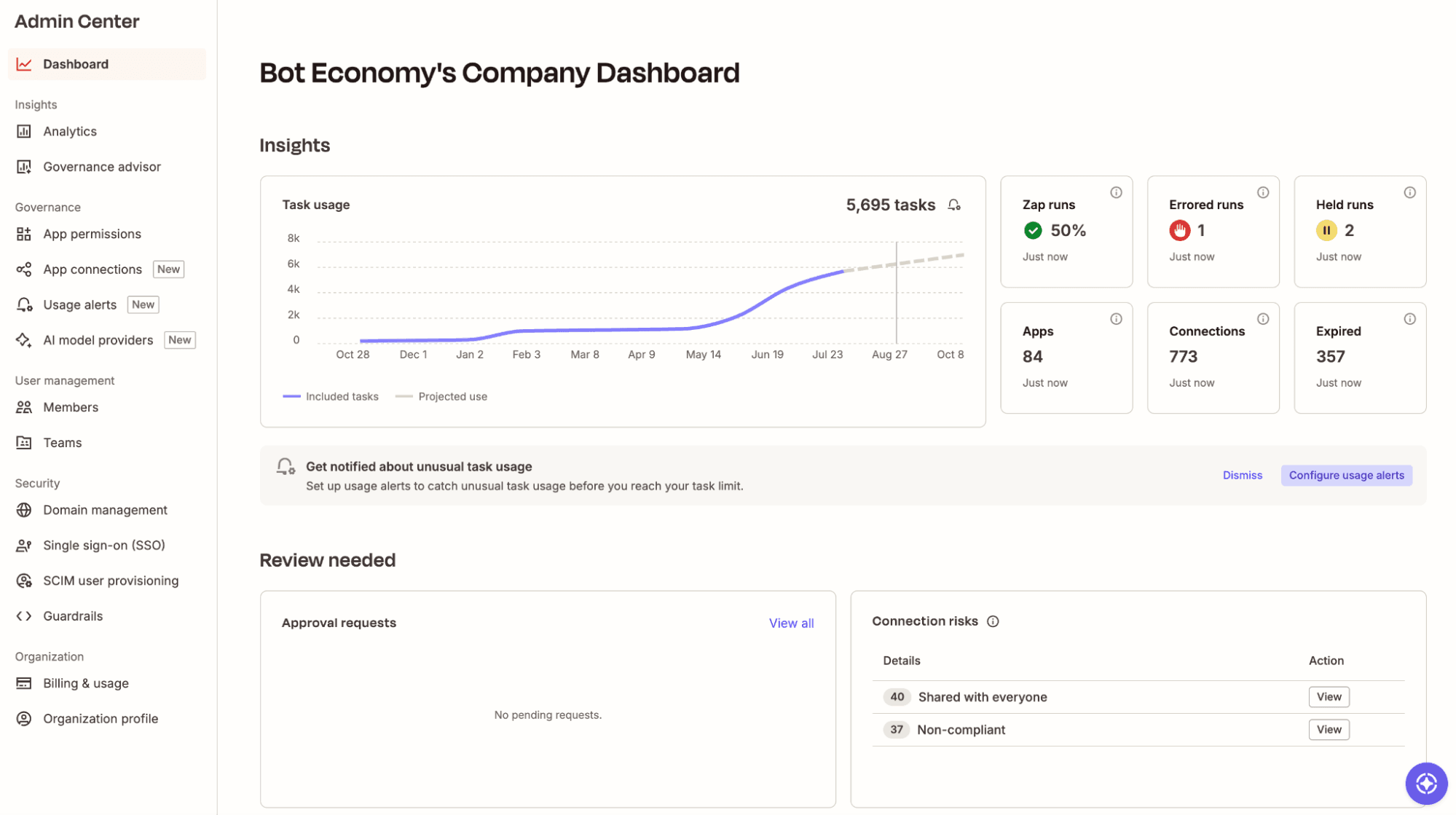
| Security & governance | SOC 2 Type II, SOC 3, GDPR, and CCPA certified, plus SAML SSO, audit logs, and role-based access control starting on the Team plan, with SCIM provisioning and app- and action-level restrictions added at Enterprise | SOC 2 Type II and ISO 27001:2022 certified platform-wide; SAML/OIDC SSO, SCIM provisioning, a KMS proxy, and a dedicated SLA are all Enterprise-only |
| Pricing | Free plan available for 100 tasks; paid plans start at $19.99/month for individuals; Team plan starts at $69/month for up to 25 users; custom enterprise pricing | Free for 100K tool calls/month; Pro plan is $29/month plus metered overage across four usage dimensions; custom enterprise pricing |
| Reliability & performance | Public status page, autoreplay, custom error handling, task histories, and version rollback included on all paid plans | Public status page with visible incident history; automatic retries on reads, but writes aren't retried by default to avoid duplicating side effects |
What customers say about Zapier
"The way we're using Zapier at Pretto is really deeply rooted in our DNA. Everyone has a Zapier account and is encouraged to automate their jobs. In a snap, the whole company becomes more efficient and happier at the same time."
—Etienne Batise, Engineering Manager, Pretto
Customer testimonial
"Zapier gave us a way to move fast, solving local operational problems while we wait for a global IT project."
—Rubén del Fresno Escribano, Sales Project Manager, Just Eat Spain
Customer testimonial
"[Zapier] connects apps and helps automate work that doesn't require technical expertise."
—Lars Christensen, Social Ads Specialist, Veo
Customer testimonial
"As Head of Growth, I rely on [Zapier] to keep our acquisition data flowing cleanly between ad platforms, CRMs, and analytics tools without engineering dependency."
—Tony U., Head of Growth, information technology and services company
Capterra review
Trusted by 3.4 million companies



















AI automation starts and scales with Zapier
Build reliable, consistent workflows across tools, people, and processes. Access 9,000+ apps securely from any surface, and add AI to the mix only when you need it.
Compare features: Zapier vs. Composio
Composio is an integration layer for developers building agents from scratch, while Zapier is a no-code AI orchestration platform that gives agents safe access to 9,000+ apps. I tested both Composio and Zapier to understand what each does best. Based on that experience, here's a full comparison to help you decide which one makes sense for you.
Implementation
Composio gets a developer to a working tool call in a few lines of code, while Zapier gets anyone, developer or not, to a working automation in minutes.
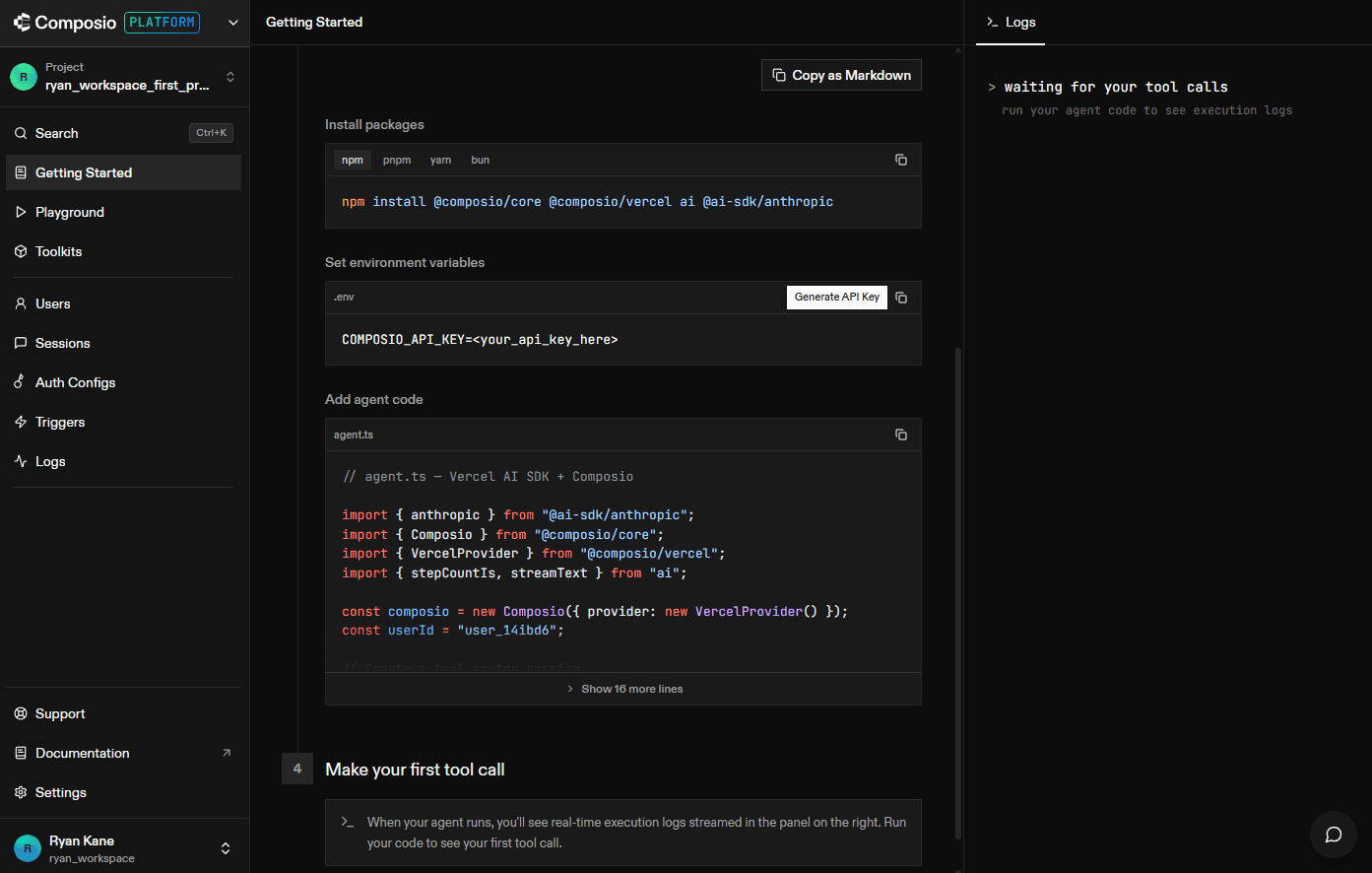
After signing up for a Composio account, you'll grab an API key from your dashboard and install the Python or TypeScript SDK. From there, it's a handful of lines of code to initialize the client, create a session for a user, and call a tool.
If you already have a dev environment and an LLM API key configured, that first tool call can happen in minutes. But that's the best case—you're also responsible for wiring up whichever agent framework you're using (like LangChain, CrewAI, or the OpenAI Agents SDK), and the moment you need something Composio hasn't pre-built, you're reading API docs and writing your own toolkit.
Zapier gets you to a working automation in minutes, regardless of entry point. If you're a developer coding in a tool like Cursor or VS Code, the Zapier SDK plugs directly into your project with built-in authentication, token refresh, retries, and error handling. But non-developers have just as many options. If you're connecting an existing AI client like Claude or ChatGPT, add the Zapier MCP server, and your AI has governed access to 9,000+ apps immediately.
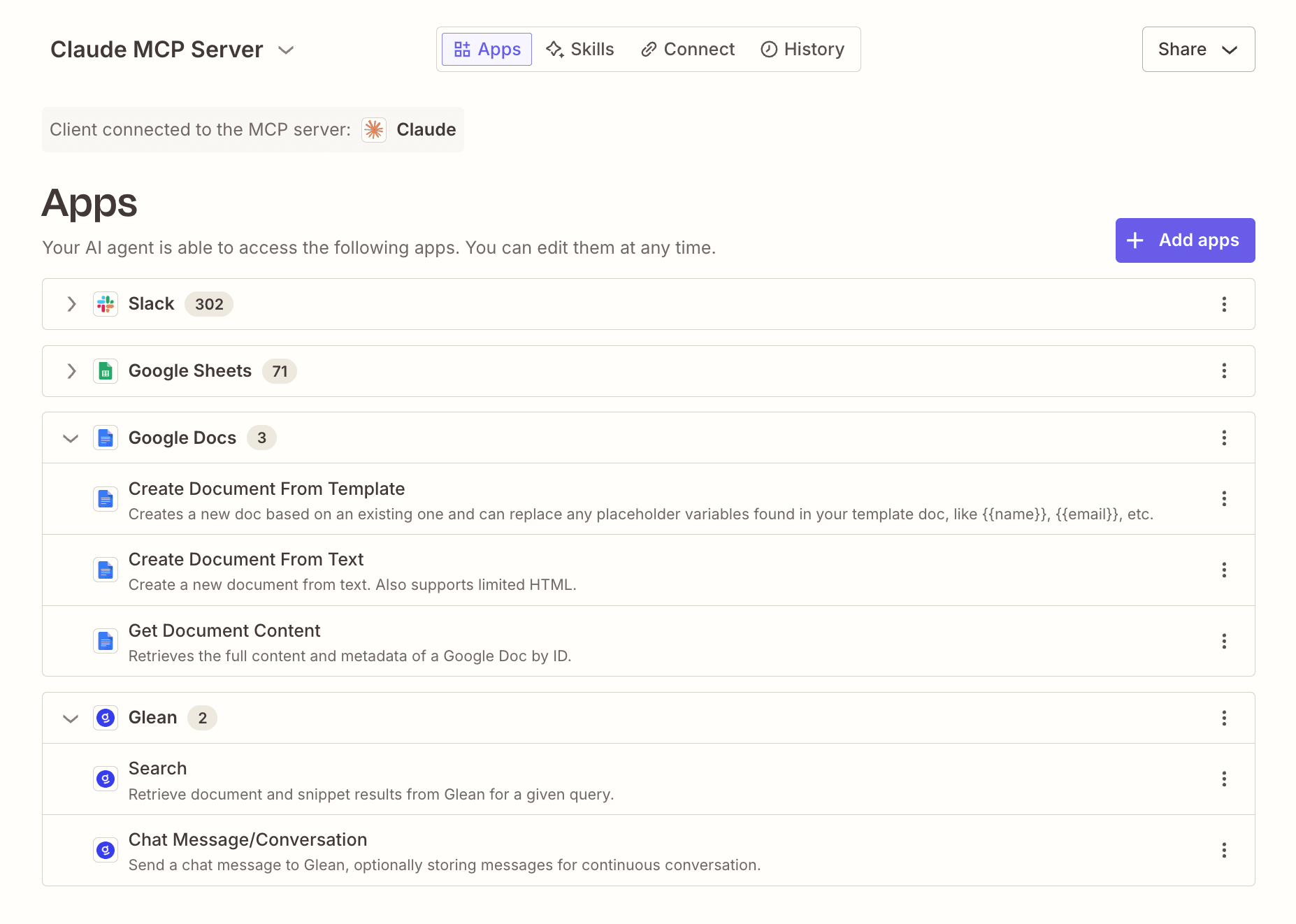
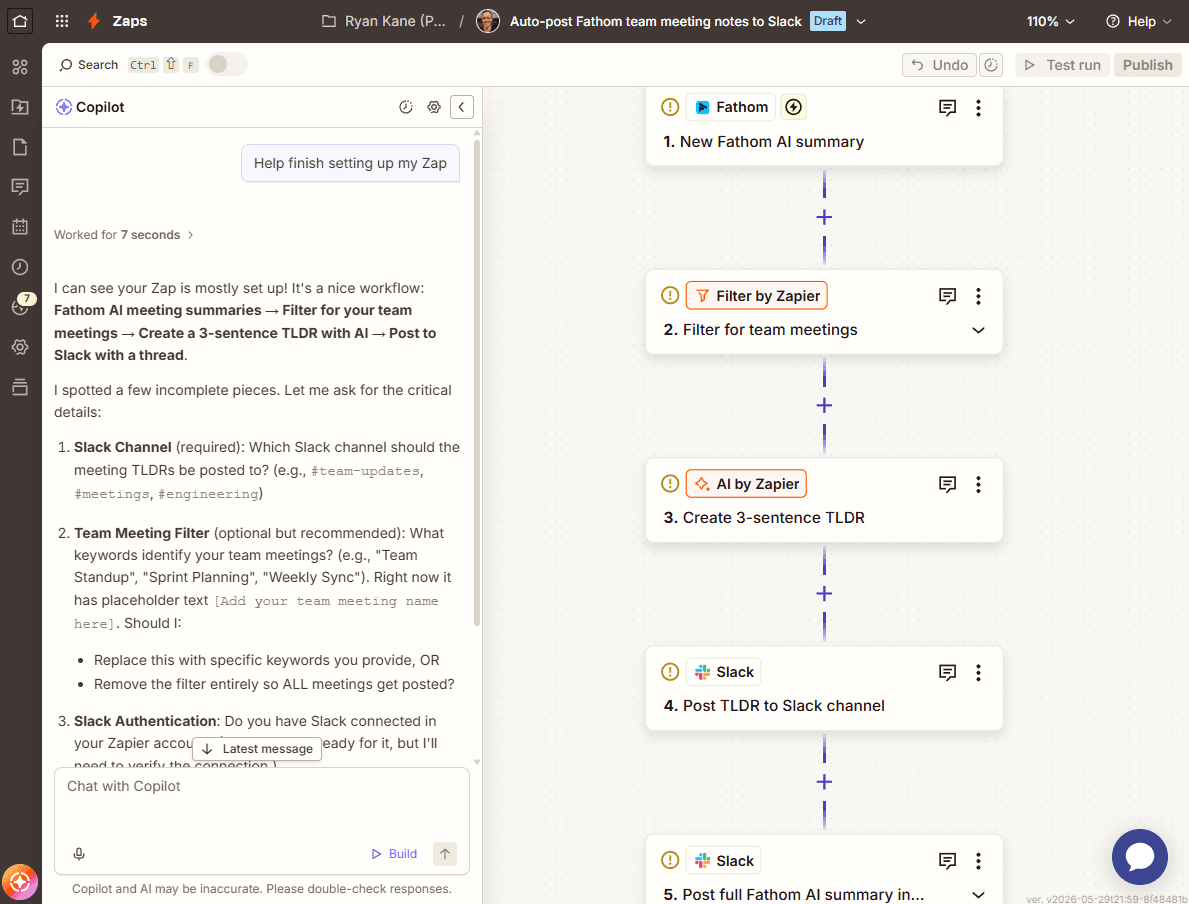
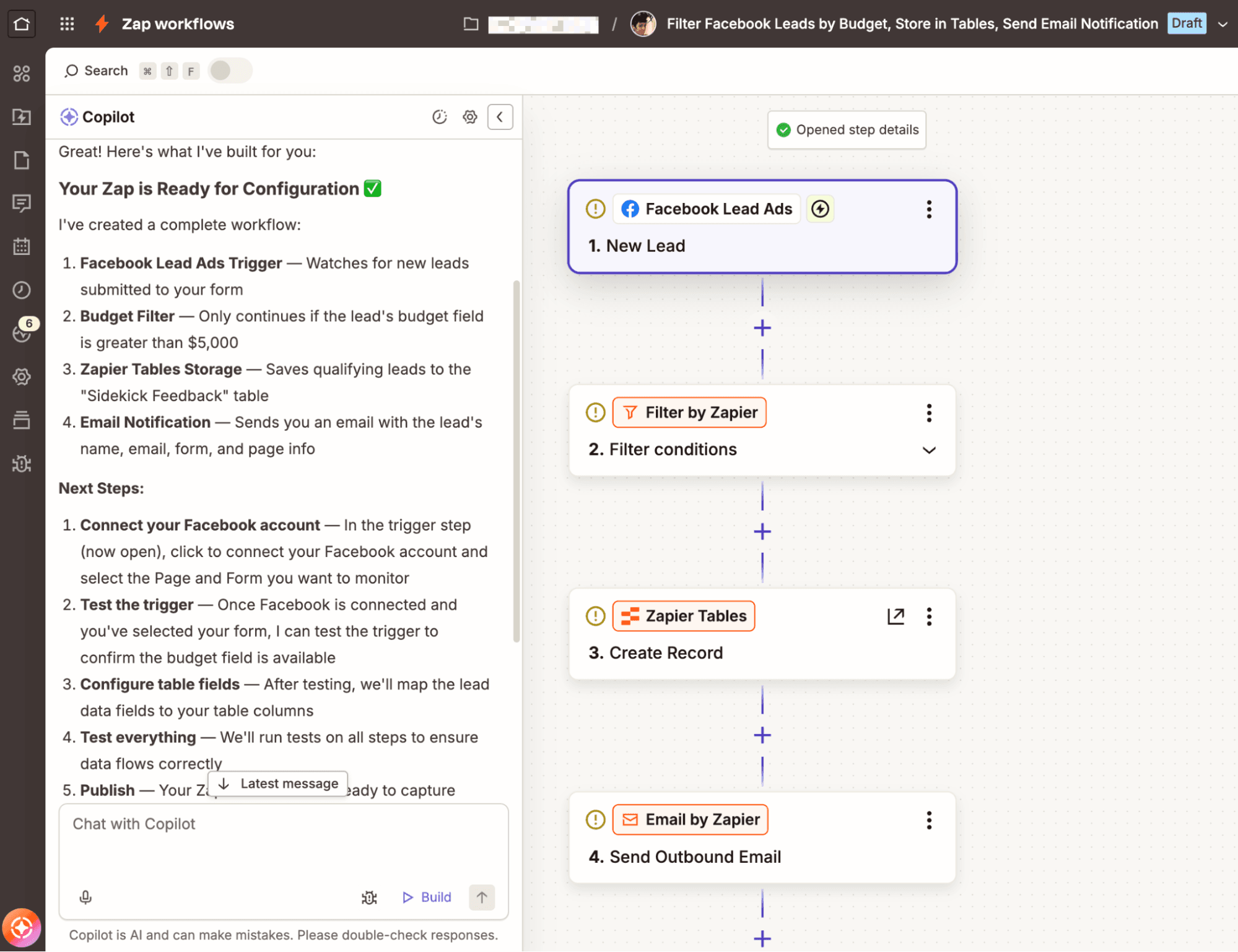
Alternatively, Zapier Copilot builds the automation for you from a plain-language description, and you can make tweaks yourself—or continue to chat with Copilot—in the visual builder.
FAQ: Zapier vs. Composio
What's the difference between Zapier and Composio?
Composio is a developer-focused integration and authentication layer. It gives AI agents secure, tool-calling access to outside apps, and that's largely where its scope ends. Zapier does the same credential brokering, then adds a no-code builder, agentic AI, structured data storage, and process mapping on top, all governed from one place. If you're only trying to solve authenticated app access for an agent you're coding yourself, both are worth a look. If you need automation that anyone on your team can build and IT can govern, Zapier is the broader platform.
Is Composio cheaper than Zapier?
It depends heavily on your usage pattern. Composio's free tier is generous (100,000 tool calls/month), but the pricing model comes with four separate metered dimensions—tool calls, trigger events, premium tools, and LLM tokens—so costs get harder to predict as you scale past the free tier. Zapier charges per completed task, and that covers the whole platform, not just the authentication layer. Composio users also pay separately for their LLM, agent framework, and hosting, none of which is included in its sticker price.
Can Zapier replace Composio?
For most teams, yes. Zapier handles the same credential brokering Composio does, then adds agentic workflows, data storage, and a no-code builder that Composio doesn't offer at all. The exception is a team already deep into a specific agent framework like LangChain or CrewAI that wants Composio's native SDK integration and sandboxed execution model specifically—for that narrower use case, Composio may still be the better fit.
Do Zapier and Composio work together?
They can, though most teams end up choosing one as their primary layer rather than running both. Composio is scoped narrowly to authentication and tool-calling for agents you're building yourself, while Zapier is a full orchestration platform that already includes that same credential brokering. A team using Composio to build a custom agent product could still use Zapier MCP or the Zapier SDK to reach the other side of their stack—internal business apps, CRM data, ticketing systems—without building a second integration layer from scratch.
When is Composio the better choice?
If you're a developer building an AI agent product for external users, each of whom needs their own authenticated app connections, Composio's session model and native framework SDKs are a strong fit. It's also worth a look if your agent already runs on LangChain, CrewAI, or another framework with first-class Composio support, or if you want the largest possible free tier while prototyping. Composio isn't trying to be a no-code platform or an org-wide automation tool, and it doesn't claim to be—Zapier is the better choice the moment more than one non-developer needs to build or maintain something.
AI automation starts and scales with Zapier
Build reliable, consistent workflows across tools, people, and processes. Access 9,000+ apps securely from any surface, and add AI to the mix only when you need it.
About the author: Ryan Kane is a writer and marketer based in Mérida, Mexico. He writes about SaaS, AI, and marketing while building fun Internet side projects. Learn more: ryankane.co.