Form submissions are flowing your way. Now what? For starters, you can connect your form to Zapier to automate the whole follow-up process. Then take it a step further by bringing ChatGPT into the mix to draft responses or analyze submissions the moment they land in your forms app.
In this post, I'll show you how to build a Zap—what we call an automated workflow—that does just that. It'll pull in form submissions, generate a personalized response with ChatGPT, and save it to Gmail as a draft for you to review. Then I'll show you how to tweak that Zap by sending the data to apps other than Gmail, including a spreadsheet workflow you can pair with Zapier MCP to act on your submissions directly from your AI.
Build automations from wherever you work. Describe the outcome you want, and Zapier connects your tools, runs the steps, and stays on the job after you close the chat. Combine AI with reliable, deterministic automation across 9,000+ apps. Get started for free.
Table of contents
How to build a Google form response generator
In this section, I’ll show you how to build a Zap that:
Triggers when you receive a new form submission
Then automatically generates a personalized reply with ChatGPT
And saves that response as an email draft for you to review
Before we get started, you’ll need to create a Zapier account if you don’t already have one.
Then either go to the Zap editor to build from scratch or start with a Zap template. Just click the template below to use it.
Create Gmail drafts with ChatGPT-generated replies for new Google Forms submissions


Note: This template uses Google Forms, ChatGPT, and Gmail. But Zapier connects to hundreds of form, email, and AI tools, so you can swap in whichever ones you or your team prefer. To see a complete list of apps, visit the directory.
Step 1: Set up your Google Forms trigger
First, create a form with fields for a name, email address, and any other data you want to collect. Here's an example:

Now set up your trigger, the event that starts your Zap. If you're using the Zap template, this will already be selected for you. Otherwise, select Google Forms for the trigger app and New Form Response for the trigger event. Then connect your account.

Now click Continue and select the form you want to connect.

Click Continue and Test trigger. (If you don't already have form responses, submit at least one, so Zapier can pull a test record. Having a test record will come in handy when setting up the remainder of this Zap.)
Choose one of the form responses, then Continue with selected record.

Step 2: Set up your ChatGPT action
Now let's set up the action, the event your Zap will perform once it's triggered. In your first action step, choose ChatGPT as your app and Conversation as your action event.
Tip: You'll see an option to connect to AI by Zapier instead. The advantage of using AI by Zapier is that you don't need an OpenAI account to use it, and you can switch to another AI tool at any time without rebuilding your Zap, if, say, one model leapfrogs another. Learn more about the benefits of AI model flexibility.
Connect your account. If it's your first time connecting ChatGPT to Zapier, this window will open.

Follow the inline instructions to create your API key. (Zapier encrypts and stores your key securely.) When you're done, click Continue.
Select your model, then type in a prompt. (We've got some tips to help you write effective prompts here.) For example, if you wanted to draft a friendly reply to a customer feedback submission, you could write something like this: Write a warm, single-paragraph email response to the customer, thanking them for their feedback and addressing any specific concerns they raised.
To personalize the response, you'll want to map data from the form submission. To do this, just click the plus sign (+) in the User Message field and click on the data you want to include in your ChatGPT prompt.
Here's a prompt for my silly ice cream form, with the name and flavor mapped from the form response.

Pro tip: Want help deciding which ChatGPT model to pick? We keep tabs on what the latest ChatGPT models excel at.
Make any other adjustments you'd like—you can, for example, set max tokens or adjust the temperature to control AI's creativity—then click Continue.
Now test the step to see a sample response. You can always go back and tweak your prompt until the output is to your liking. Here's what ChatGPT came up with for me.

Step 3: Set up your Gmail action
Now it's time to set up the final action step in your Zap.
To add another step, click the plus sign (+) under the ChatGPT action.

Search for and select Gmail for your action app and Create Draft as your action event. Then click Continue. If you're using the Zap template, this will already be done for you. Connect your Gmail account to Zapier, then click Continue.
Tip: Optionally, you can choose Send Draft as your action event if you don't need to review the output and just want to automatically send the email.

To customize your action, add who you want to send the email to. You'll map data from your previous Google Form. Also be sure to add a subject and body, mapping the ChatGPT output in the Body field. Fill out any other fields you'd like.
Once you're finished customizing your action step, click Continue..Next, test your Zap. Once the test runs, an email will be sent to your drafts folder. Double check the email to make sure it looks right. Here's what mine looked like:

Now you can edit the message to your liking and hit send when you're ready.
Send ChatGPT responses to other apps
You can also send these AI-generated responses to other apps. Whether you want to notify your team of submissions, store submissions in a spreadsheet, or send a text to the submitter, the Zap templates below can get you started fast.
To your chat app
Before you reply to a form submission, you may want to send it to your team first. As an example, someone who doesn't check their email often might need to QA ChatGPT's suggested reply before it goes out. In that case, you can send a notification to a specific channel in a place like Slack, Teams, or Discord.
You don't have to use ChatGPT to draft a reply, either. You can just as easily prompt it to summarize the submission, extract the key details, or analyze it against criteria you care about, then post that to your channel instead.
Send new Google Forms submissions to ChatGPT then post to Slack

Send new Google Forms submissions to ChatGPT then post them to Microsoft Teams

Send new Google Forms submissions to ChatGPT then post to Discord

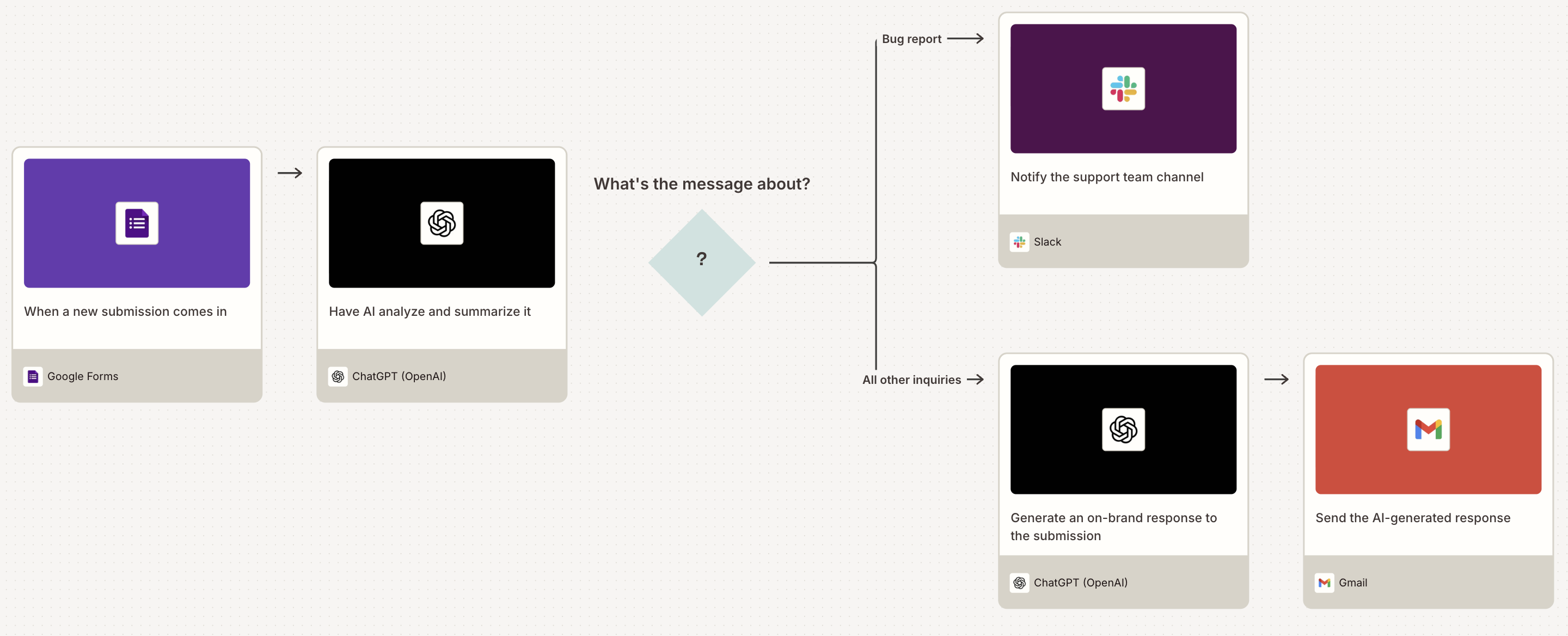
What if you want to take different actions depending on the type of form submission you receive? In that case, you'll need a path step, which lets your Zap branch based on conditions you set. So a regular submission can go to Gmail as a draft (like we set up earlier), while anything flagged as urgent—maybe a customer complaint or a bug report—can be sent with an AI summary to a Slack channel instead.

To learn more about setting up path steps, check out our feature guide.
To your SMS app
When you need to respond to a form submission quickly for something that's urgent or time-sensitive, a text usually beats an email. People also just expect texts for certain things now, like appointment confirmations or follow-up messages from service businesses (think plumbers, salons, and clinics). If your form is collecting a phone number with explicit consent to text, SMS is probably the channel respondents are expecting to hear back on anyway.
Send Twilio text messages with ChatGPT-generated content from new Google Forms submissions

Send Telnyx text messages with ChatGPT-generated content from new Google Forms submissions

To your spreadsheet tool
Sometimes you just need to log an AI-generated response somewhere you can find it later. That's where a spreadsheet or database comes in handy.
This setup shines when you want a row-by-row record of every submission, every AI-drafted reply, or both. Having that is useful for audits, where you're checking on the AI output (is ChatGPT actually responding the way you'd want it to?), or building a dataset you can refer back to when you're fine-tuning prompts later. It's also a smart choice when you'd rather batch-review drafts at the end of the day instead of approving them one by one.
Log new Google Forms submissions and ChatGPT replies as rows in Zapier Tables

If you want to make this Zap even more powerful, build it, then connect ChatGPT to Zapier MCP. It's a tool you install into your AI that lets you connect to more than 9,000+ apps in our directory with governed access. From there, you just prompt ChatGPT in plain English to take action in your other apps, and it does the work for you.
This is great if you've always got ChatGPT open anyway. Whenever you're ready to actually review the submissions piling up in your spreadsheet, just ask ChatGPT to pull certain rows and edit them directly.
To learn more about installing Zapier MCP into ChatGPT, check out our MCP feature guide.
Use ChatGPT and Zapier together to power your business
Every form submission kicks off downstream work. With Zapier and ChatGPT handling the intake, that work doesn't have to start from scratch, and your team is free to focus on other tasks.
Email, chat apps, spreadsheets, and SMS tools are just the beginning. Zapier connects to thousands of apps, so wherever your form responses need to go next, there's a way to get them there automatically.
Want to find more ways to use AI to help you scale? See what else you can build with ChatGPT today.
Related reading:
This article was originally published in September 2023 by Elena Alston. It was most recently updated in May 2026.